
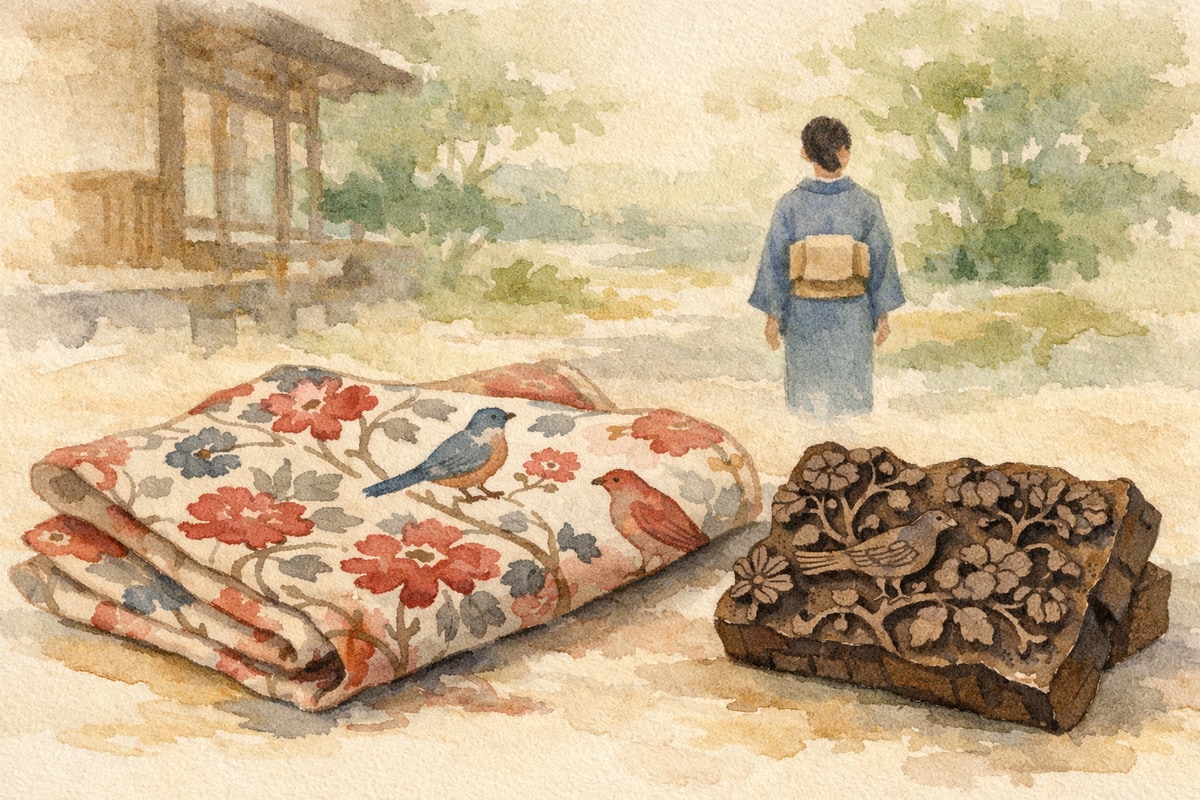
A single piece of cloth catches your eye at the edge of an antiques market. Neither cherry blossoms nor chrysanthemums, but unfamiliar flowers and birds crowded densely across the fabric, carrying a faint scent of some far-off land — for many people, this is their first encounter with sarasa. Why does such an exotic pattern live on within the kimono? Unravel it, and a small story that crossed the sea comes into view.
What Is Sarasa? The Origins of the Name and Pattern
Sarasa refers to cotton cloth decorated, through stencil dyeing or hand-painting, with stylized patterns of flowers and plants, birds and animals, or human figures. Behind the birth of these motifs lies a history where an exotic, foreign sensibility overlapped with Japan’s own climate and aesthetic sense. The reason sarasa patterns feel different from the kimono you might be used to seeing is that they originally came from outside Japan — once you realize that, the unusual arrangement of flowers and birds starts to make sense.
From India to Japan — Foreign Patterns That Arrived Through Nanban Trade and the Sakoku Era
Sarasa is said to have reached Japan sometime between the Muromachi and Momoyama periods, during the flourishing of Nanban (“southern barbarian”) art. It can be confirmed in written records from the 17th century onward, and the leading theory holds that it was brought by trading ships from Spain, Portugal, the Netherlands, and England — known collectively as Nanban ships and “red-haired” (kōmō) ships. Ships connected to the Dutch and British East India Companies are thought to have carried a particularly large share.
The costly Indian sarasa that arrived in Nagasaki came to be called “kowatari sarasa” (old-imported sarasa), and was used by daimyo families such as the Ii and Date clans for pouches and wrapping cloths (fukusa) that held their tea utensils. Because Japan did not yet have the technique for madder (akane) dyeing at the time, the colors of wa-sarasa (Japanese-made sarasa) were said to be somewhat more subdued than those of the original Indian sarasa. Even so, distinctly Japanese motifs such as fans were gradually worked in, and wa-sarasa slowly developed a character of its own.
The Spread of Wa-Sarasa — Nabeshima Sarasa, Kyo Sarasa, Nagasaki Sarasa
As Japanese artisans imitated the costly kowatari sarasa, wa-sarasa began to be produced in various regions. Among the earliest known was Nabeshima sarasa. Its origins are said to trace back to the Keicho era, when Kuyama Dosei, a man from Goryeo brought back by the domain’s founding lord Nabeshima Naoshige from his Korean campaign, transmitted the technique, which was then passed down for generations by oral instruction alone. Also known as “Dosei sarasa” or “Hanbei sarasa,” it is, intriguingly, the only wa-sarasa for which a genuine secret technical manual survives to this day. Its dyeing method, which combines woodblock printing with stencil printing, is said to have no parallel outside of modern suri-yuzen (block-printed yuzen) dyeing.
However, when the Meiji-era abolition of the domains (haihan-chiken) broke the line of succession, Nabeshima sarasa disappeared entirely in the early Taisho period. The late Suzuta Teruji later deciphered the technique from the surviving secret manual and samples, reviving it as “mokuhan-zuri sarasa” (woodblock-printed sarasa). Today, that technique is carried on by Suzuta Shigeto, a holder of Living National Treasure status. A technique lost and then called back by someone’s hand — such stories are, in fact, not uncommon in the history of kimono.
Kyoto was home to the development of Kyo sarasa. It flourished as a hand-painted sarasa, with everything from the initial design to the final coloring done entirely by hand, and developed especially along the Horikawa river, where the water quality was good and many dyeing artisans lived — hence it is also called “Horikawa sarasa.” Its patterns are marked by flowing curves and sharp outlines drawn heavily with ink lines. Nagasaki sarasa, meanwhile, developed from sarasa brought in by an English trading ship that visited Hirado in 1613, and is known for its vivid coloring achieved with dyes such as sappanwood (suou). Other regional wa-sarasa, including Amakusa sarasa, Sakai sarasa, and Edo sarasa, also emerged through the late Edo period.
Styling Sarasa Patterns — Enjoying Them with Obi and Accessories
Because sarasa kimono have their roots in cotton cloth, they are generally considered everyday wear rather than suited to formal occasions. That said, pairing one with a fukuro obi or a Nagoya obi with metallic thread is said to be one way to raise the formality slightly. Since the pattern itself is already dense and richly drawn, layering another patterned obi on top can create visual clash. Letting the distinctive sarasa pattern take center stage while keeping the obi as a supporting player — this kind of restraint is what leads to a styling that truly suits sarasa.
If you’re unsure about color coordination, sticking to tones within the same color family creates an elegant look, while choosing a contrasting color makes for a more distinctive, individual outfit. Since the sarasa fabric itself is already patterned all over, it works well to think in terms of using the obi and small accessories to balance the whole look, much as one would with komon (a casual kimono with a small repeating pattern). If you’re unsure how to choose a han-eri (decorative collar) or obijime (a cord tied over the obi), the article How to Choose and Attach a Han-eri may also be a useful companion read. Note that machine-dyed “sarasa-style” kimono that skip the stencil-dyeing process also exist, so if texture and feel matter to you, it’s worth checking the fabric and dyeing technique beforehand.
Sarasa is one thread in a much larger pattern vocabulary. This introduction lays the main kimono motifs out side by side with photographs, so you can see where sarasa sits among yuzen, tsumugi and the seasonal patterns mentioned above.
Sarasa’s Place Alongside Yuzen and Tsumugi
Sarasa patterns have historically been produced not only by hand-painting or woodblock printing but also through stencil dyeing using Ise-katagami stencils. Lineages like Kyo sarasa, where each design is drawn by hand one piece at a time, share something in common with the world of hand-painted yuzen. If you’re curious about the difference between hand-painted and stencil-dyed yuzen, the article What Is Yuzen? A Gentle Guide to the Difference Between Hand-Painting and Stencil Dyeing traces the outlines of these techniques and may help clarify sarasa’s place in relation to them.
In terms of formality, sarasa is classified as everyday wear, but this is a separate matter from price. Just as a tsumugi (a textured, hand-woven silk) kimono costing several hundred thousand yen is still, formally speaking, everyday wear, the measure of price and the measure of formality quietly run on separate tracks in the world of kimono. If you’re curious about the depth of tsumugi as a material in its own right, the article An Introduction to Tsumugi: How Do Yuki Tsumugi, Oshima Tsumugi, and Ushikubi Tsumugi Differ? is also worth a look.
Even in a season when the breeze of unlined summer kimono still feels far off, and a lingering chill remains in the air, sarasa’s flower-and-bird motifs carry with them a faintly warm, foreign air. A pattern that crossed the sea and has continued to this day, subtly shifting color through the hands of artisans in Saga and Kyoto — adding a small story like this to today’s outfit is, in its own way, a wonderfully stylish way to enjoy kimono.