
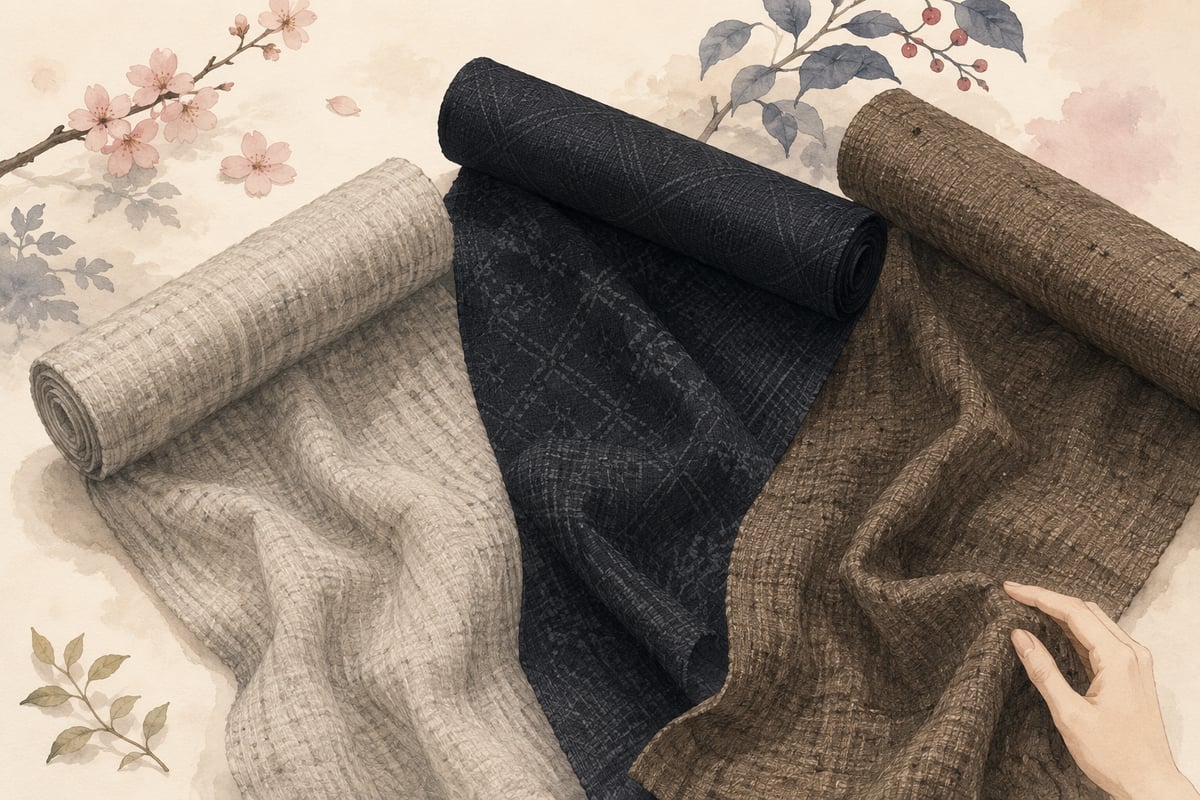
There’s something endearing about tsumugi (a textured, hand-woven silk) — a fabric that grows more comfortable the more you wear it. Among its many varieties, “Yuki tsumugi,” “Oshima tsumugi,” and “Ushikubi tsumugi” stand out as the three names known as Japan’s three great tsumugi. Today, let’s unravel what makes each one distinct.
🌸 The quick version (for those in a hurry)
Yuki tsumugi (a prized hand-woven silk) comes from the Kinugawa river basin in Ibaraki and Tochigi, spun by hand from silk floss. Oshima tsumugi comes from Amami Oshima in Kagoshima and is known for its mud-dyeing technique. Ushikubi tsumugi comes from Hakusan City, Ishikawa Prefecture, and is woven from thread made from double cocoons spun by two silkworms together. Origin, material, and character — each of the three is entirely its own.
Yuki Tsumugi: The Lightness of Wearing Air
Yuki tsumugi is a woven textile born along the Kinugawa river basin, spanning Ibaraki and Tochigi Prefectures. Its threads are spun by hand, one at a time, from silk floss. As the cocoons are gently stretched into thread, tiny pockets of air become trapped within it — and this is the secret behind that uniquely warm, soft touch against the skin. Its origins are said to trace all the way back to the Nara period, and it’s said to have come to be called “Yuki tsumugi” sometime around the Kamakura period.
Oshima Tsumugi: A Deep Black Born of Mud
Oshima tsumugi comes from Amami Oshima in Kagoshima Prefecture, and its raw material is 100% pure silk (shoken). Perhaps the most evocative part of its story is the dyeing process. The threads are repeatedly soaked in a liquid made by boiling down a plant called teechigi, then dipped into iron-rich mud paddies — this back-and-forth process allows the tannin and iron to react, producing that deep, quiet black. It’s a color that, quite simply, can only be achieved on the soil of Amami. The finished cloth is light, resists wrinkling, and takes on richer character the more it’s worn.
Ushikubi Tsumugi: Sturdy Enough to Pull Out a Nail
Ushikubi tsumugi has been passed down in what is now Hakusan City, Ishikawa Prefecture, in an area once known as Ushikubi Village. It was recognized as a traditional craft in 1988. Its defining feature is that its thread is drawn from “tamamayu,” double cocoons spun jointly by two silkworms. Thread taken from tamamayu is thick, textured with small knots, and full of trapped air. This sturdiness has earned it the nickname “nail-pulling tsumugi” — the idea being that if the fabric catches on a nail, the nail will come out of the wall before the cloth tears. As for its origins, one legend tells of a Genji princess who, after her clan’s defeat in the Heiji Rebellion, fled to this region and taught the local villagers how to weave.
Comparing the Three Tsumugi at a Glance
| Tsumugi | Origin | Material | In a word |
|---|---|---|---|
| Yuki Tsumugi | Ibaraki / Tochigi (Kinugawa river basin) | Hand-spun silk floss thread | The lightness of wearing air |
| Oshima Tsumugi | Amami Oshima, Kagoshima | Pure silk (mud-dyed) | A deep black born of mud |
| Ushikubi Tsumugi | Hakusan City, Ishikawa | Silk thread from double cocoons | Sturdy enough to pull out a nail |
*Details regarding history and origins are passed down as traditional lore.
In Terms of Formality: Everyday Wear to Casual Outings
All three are rare, labor-intensive textiles, but in terms of formality, they rank as everyday to casual outing wear. As also noted in our quick-reference guide to kimono types and formality, price and formality are two entirely different measures — and tsumugi is a prime example of that.
Frequently Asked Questions
Q. Why is Oshima tsumugi so often black?
A. Because mud-dyeing is a special technique that can only be done in the mud paddies of Amami Oshima. The teechigi dye reacts with the iron in the mud to produce that distinctive black.
Q. Is it really true that Ushikubi tsumugi can “pull out a nail”?
A. This is a piece of traditional lore that speaks to the sheer sturdiness of thread made from tamamayu. It’s best enjoyed as a colorful way of describing just how tough the thread really is.
Q. Can all three be worn to a wedding?
A. Since tsumugi ranks as everyday to casual outing wear in terms of formality, it isn’t suited to formal occasions like weddings. It’s best enjoyed for outings and everyday wear, where its character can really shine.
Summary
- Yuki tsumugi comes from Ibaraki and Tochigi, prized for the light, airy feel of its hand-spun silk floss thread
- Oshima tsumugi comes from Amami Oshima in Kagoshima, defined by the deep black that mud-dyeing produces
- Ushikubi tsumugi comes from Hakusan City, Ishikawa Prefecture, known for its rare sturdiness thanks to thread from double cocoons
- All three rank as everyday to casual outing wear in formality — remember that price and formality are separate things
The more you learn, the more you notice how a single piece of tsumugi carries the character of its native land woven right into it. Why not let today’s outfit carry a little story of its own? Tsumugi belongs to the world of “weaving” — for a look at the world of “dyeing,” see our article on yuzen as well. And if you’re considering tsumugi as an everyday kimono, our piece on whether to rent or buy a kimono may also be worth a look.
Articles on tsumugi, yuzen, monyou, and other topics in dyeing and weaving are collected in our guide to dyeing, weaving, and traditional motifs.