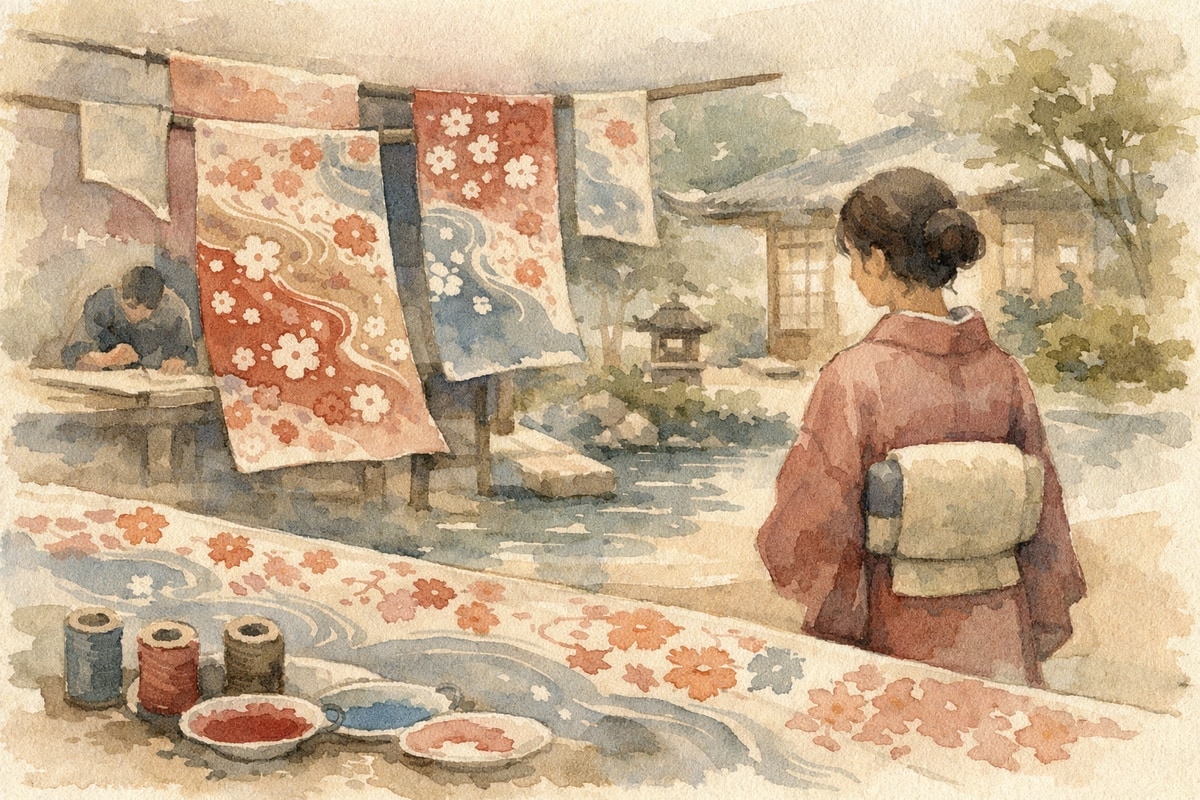
Mention yuzen, and many people picture those vividly colored, picture-like kimono patterns. But yuzen is actually created along two quite different paths: “hand-painted” and “stencil-dyed.” Today, let’s gently unravel the difference between them.
🌸 The short version (for those in a hurry)
Hand-painted yuzen is a technique in which an artisan draws each line by hand with rice-paste resist, then colors the design by hand. Stencil-dyed yuzen (kata yuzen) is dyed using paper stencils and paste dyes. If you see a thin, thread-like white line along the edge of a pattern, that’s a sign of hand-painted work.
Hand-Painted Yuzen: The Warmth of Hand in Every Line
Hand-painted yuzen is made by squeezing a paste made from glutinous rice out of a thin tube to draw the design. This paste line is called “itome,” and it acts as a resist along the outline of the pattern, keeping neighboring colors from bleeding into one another. After the resist paste is applied, the fabric is colored, then coated again with a protective resist paste before dyeing. If you look closely, you can see a faint white line along the outline of the pattern — that’s how you can identify hand-painted yuzen.
Stencil-Dyed Yuzen: A Different Kind of Beauty, Born from the Stencil
Stencil-dyed yuzen (kata yuzen), on the other hand, is dyed using stencils made of persimmon-tannin paper along with paste dyes. Because a stencil can be reused, the same pattern can be dyed onto many bolts of cloth (tanmono). For especially intricate designs, more than a hundred stencils may be used. This is also a relatively new technique, one that developed in the early Meiji era after synthetic dyes were introduced from overseas.
Kyo Yuzen and Kaga Yuzen: Two Distinct Personalities
Among the various forms of yuzen, Kyo yuzen and Kaga yuzen are especially renowned. Both grew out of the same “Yuzensai” technique, yet each developed a completely different character.
| Aspect | Kyo Yuzen | Kaga Yuzen |
|---|---|---|
| Decoration | Lavish use of gold leaf, gold and silver powder, and embroidery; showy and gorgeous | Little to no gold or silver leaf or embroidery; finished through dyeing alone |
| Pattern tendencies | Elegant harmony of bright colors | Realistic flowers and plants rendered in a “five-color” palette of indigo, ochre, green, ancient purple, and crimson |
| Technical features | Fully divided labor (separate artisans for design, paste application, dyeing, and embroidery) | “Soto-bokashi” shading (darker at the edges, paler toward the center) and a worm-eaten-leaf motif |
| Production region | Kyoto | Around Kanazawa City, Ishikawa Prefecture |
*Some aspects of the historical origins are passed down as tradition.
The yuzen technique is said to have been established in the mid-Edo period by Miyazaki Yuzensai, a fan painter in Kyoto. This skill was later carried to Kanazawa, where it developed its own distinct character as Kaga yuzen — so from a single root, two personalities branched off. Kaga yuzen was designated a national Traditional Craft in 1975.
Frequently Asked Questions
Q. Is one considered superior to the other, hand-painted or stencil-dyed?
A. There’s no ranking between the techniques themselves. Both demand a high level of skill, and each has its own beauty.
Q. For beginners, which is easier to start learning about, Kyo yuzen or Kaga yuzen?
A. Start by noticing whether there’s decoration or not. If you see gold leaf or embroidery, it’s likely Kyo yuzen; if realistic flowers and plants are expressed through dyeing alone, it’s likely Kaga yuzen. That’s an easy way to begin telling them apart.
Q. I’ve also heard of Tokyo yuzen.
A. It’s sometimes counted as one of the “three great yuzen” styles. This article has focused mainly on Kyo yuzen and Kaga yuzen.
In Summary
- Hand-painted yuzen is a technique in which color is applied by hand while itome resist paste protects the outlines. A white line along the pattern’s edge is the telltale sign.
- Stencil-dyed yuzen (kata yuzen) uses stencils and paste dyes, and developed further with the introduction of synthetic dyes in the Meiji era.
- Kyo yuzen is known for its gorgeous use of gold leaf and embroidery, while Kaga yuzen is defined by realistic flowers and plants expressed through dyeing alone.
The more you know, the more the artisan’s handiwork comes into view within a single pattern. Why not add a small story to what you wear today? Alongside this look at the “dyeing” side of yuzen, you might also enjoy our introduction to tsumugi, which unravels the world of “weaving.” And if you’re thinking of getting a yuzen piece of your own, see also Kimono: Is It Better to Rent or Buy?
Articles on kimono materials and techniques — dyeing, weaving, and motifs — are gathered together in our Dyeing, Weaving, and Motifs Guide.