
“Can’t we just have her wear the same kimono she wore at 3 again at 7?” — this is actually a question we hear quite often from parents starting to prepare for Shichi-Go-San (a celebration for children aged 7, 5, and 3). To answer it up front: in most cases, the answer is no, because the kimono itself is tailored differently for age 3 and age 7. But once you understand why, it actually becomes much easier to decide whether renting or buying suits your family better. Let’s work through this step by step.
Shichi-Go-San kimono: age 3 and age 7 aren’t really the “same garment”
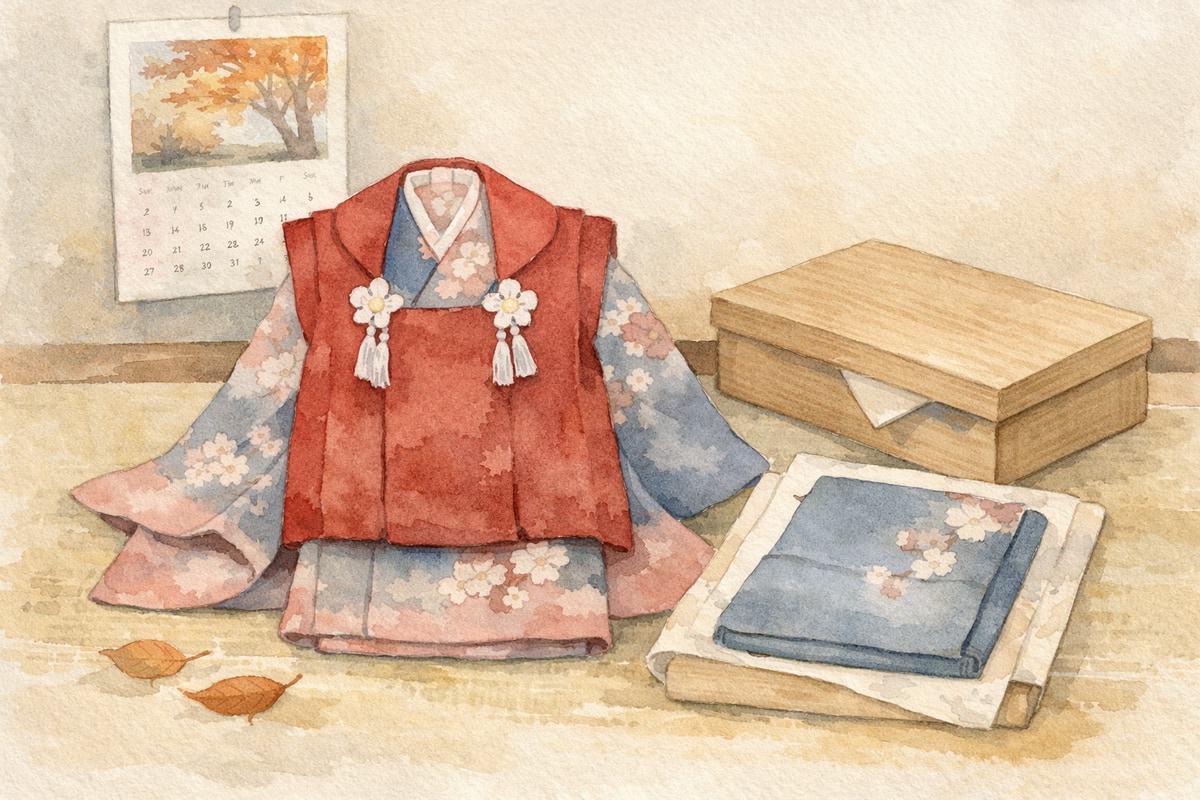
The Shichi-Go-San celebration at age 3 traces back to a ritual called *Kamioki no Gi* (the ceremony of letting hair grow). Children this young usually still find it hard to have an obi (the wide sash tied around a kimono) tied snugly, so many families instead pair the kimono with a hifu — a sleeveless overcoat-like layer worn without an obi, held in place with a koshihimo cord or a hanhaba obi (a narrow half-width sash) instead. In some regions, though, it’s customary for even 3-year-olds to be dressed with a proper obi just like adults, so it’s worth checking what’s customary in your area or family.
Age 7, on the other hand, marks *Obitoki no Gi*, the milestone at which a girl ties the same kind of obi as an adult for the first time. The kimono worn at this age is made the same way as an adult’s — what’s called a hondachi cut. Traditionally, 5-year-old boys wear hakama. In other words, the 3-year-old’s hifu set and the 7-year-old’s hondachi kimono are structurally different garments from the start. For a full rundown of what to prepare at each age, see Shichi-Go-San: Kimono and Preparation Checklists for Ages 3, 5, and 7.
How much difference is there between renting and buying?
Honestly, price is usually the biggest sticking point. For rentals, a full set typically runs about 10,000 to 30,000 yen. High-end pieces from specialist kimono shops (gofukuten) or branded items can run over 100,000 yen, but that’s outside the standard range. Broken down by age, some data puts 3- and 5-year-old sets at 10,000–20,000 yen, and 7-year-old girls’ sets at 20,000–50,000 yen — the 7-year-old sets tend to run a bit higher because there are more obi-related accessories involved.
For purchases, the gap between polyester and pure silk (shoken) is significant. In polyester, a full 3-year-old set runs around 10,000 yen, a 5-year-old’s hakama set starts around 15,000 yen, and a 7-year-old’s set starts from around 20,000 yen. In shoken, prices start around 20,000 yen for age 3, around 50,000 yen for a 5-year-old’s full hakama set, and around 40,000 yen or more for age 7. Overall, most purchases fall somewhere in the 10,000–100,000+ yen range, though high-end shoken pieces can exceed 300,000 yen. Rather than assuming “buying is always more expensive,” it helps to weigh the material against how many times the kimono will actually be worn — that makes the choice much clearer.
Can a kimono be re-tailored and reused between age 3 and age 7?
This naturally raises the question of reuse between siblings. The precise answer is: it’s sometimes possible, but only if the children are the same gender and the garment goes through the proper re-tailoring process. A 3-year-old’s kimono requires kata-age (shoulder tucks), koshiage (waist tucks), and himo (cord) attachments, and sometimes sode-age (sleeve tucks) as well; a 7-year-old’s kimono requires kata-age, and sometimes koshiage — the required work differs by age. There are even cases where an adult-style tsukesage kimono is tailored for a 3-year-old with extra length built in, so that by age 7 it can be adjusted to fit using the age (the tucked, sewn-in portion that controls length).
That said, because a 7-year-old wears a hondachi kimono while a 3-year-old wears a hifu set, while a 3-year-old’s hifu set can often be passed down as-is to a younger sister, reusing that same garment for a 7-year-old’s celebration is difficult in many cases. If you have sisters close in age and want to pass the same hondachi kimono between them at age 7, it’s best to consult the gofukuten handling the tailoring.
Re-tailoring an Omiyamairi robe for Shichi-Go-San
Many parents wonder, “It seems wasteful not to reuse the celebratory robe from the Omiyamairi shrine visit — can we?” The short answer: it can’t be worn as-is, but it can be re-tailored into a Shichi-Go-San kimono. This requires a set of adjustments known collectively as “miage,” including attaching a han-eri (half-collar), replacing the cords, re-sewing the sleeve openings, kata-age (adjusting the yuki, the sleeve length from center-back to wrist), and koshiage (adjusting the mitake, the kimono’s overall length). This work is essential because the Omiyamairi robe and the Shichi-Go-San kimono differ not only in mitake, yuki, sleeve length, and body width, but also in sleeve shape (square versus rounded), the presence of seams, and even how the garment is worn.
However, since 7-year-olds wear a hondachi kimono, re-tailoring from an Omiyamairi robe generally isn’t well suited to that age — it’s more realistic to consider it for ages 3 or 5. Because re-tailoring is done by hand and takes time, it’s best left to a specialist shop, and you should allow at least one month, with extra time during the busy Shichi-Go-San season. On the other hand, requesting the work more than six months in advance risks the child growing and the kimono no longer fitting by the time it’s needed — so timing the request is a bit of a balancing act.
Buying means more storage and upkeep — what exactly changes?
Choosing to buy definitely adds work before and after the big day. If re-tailoring is part of the plan, you’ll need to coordinate with whoever does the work, and afterward there’s the task of airing out the kimono before storing it. With a rental, all you have to do is return it to the shop after wearing it — so in many ways, this comes down to a practical question of who takes on that extra effort. Whether you’re planning to reuse the kimono for a younger sibling or another child is really the deciding factor between buying and renting.
Which families suit renting, and which suit buying?
With all this in mind, a clearer picture emerges. Renting suits families who only need the kimono for one occasion and want to keep things simple on the day itself. Since prices start in the 10,000-yen range, it’s also an easy fit if you want to keep costs down.
On the other hand, if you have a younger sibling of the same gender whose age gap works well for reuse, or if you have a sentimental Omiyamairi robe you’d like to put to use, buying or re-tailoring is worth considering. The key is to think of price and “how many times it will be worn afterward” as two separate questions. If you’d like a broader framework for deciding between renting and buying, see Kimono: Rent or Buy? Five Questions to Help You Decide What’s Right for You.
When should you start booking?
Finally, a detail that’s easy to overlook: timing. Demand for Shichi-Go-San rentals peaks from July through October, with September and October tending to be especially busy for bookings. Some families start preparing as early as April or May, in spring. For the newest and most popular designs, it’s recommended to book in March or April, right when rental availability opens up. As a general guideline, it’s a good idea to start moving about three months before the Shichi-Go-San date. Checking in on availability before summer ends — rather than scrambling once the busy autumn season arrives — tends to keep things at a comfortable pace.
In summary
Coming back to the question we started with: because the tailoring itself differs between age 3 and age 7, a kimono generally can’t be reused as-is across both ages. That said, re-tailoring does open up some possibilities, whether between same-gender siblings or by converting an Omiyamairi robe. Renting offers simplicity and easier budget control, while buying suits families who value future reuse or sentimental pieces. Talking as a family about how many times, and by whom, the kimono will be worn is often all it takes to make the choice between renting and buying feel much less daunting.