
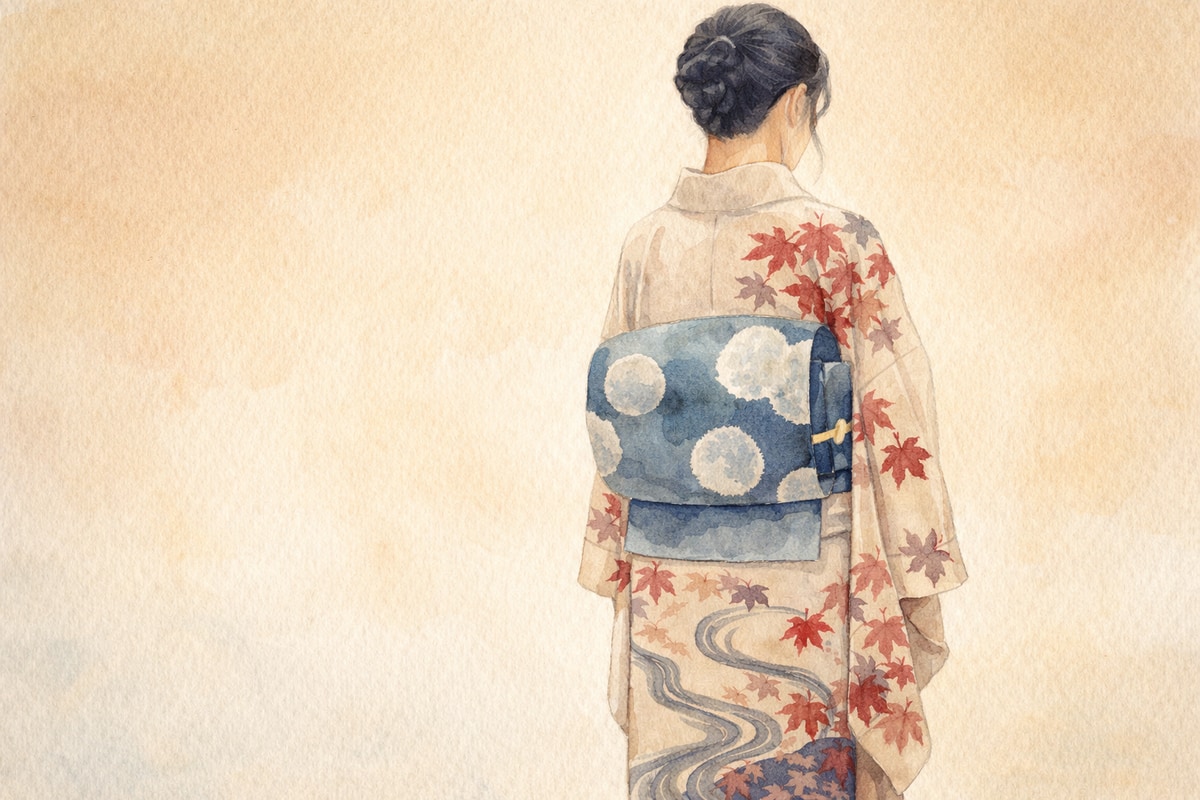
You spread out a kimono patterned with tatsutagawa (autumn maple leaves scattered on flowing water), and gently lay a yukiwa (snow-ring) obi (the wide sash tied around a kimono) beside it. The moment these two motifs sit together—one autumn, one winter—your hand pauses. Is this a seasonal mismatch? If that question has crossed your mind, let’s sit with it for a moment.
To get straight to the point: a yukiwa-patterned obi and a tatsutagawa-patterned kimono can be paired without any seasonal awkwardness. The reason lies in the nature of the yukiwa motif itself. Dig a little deeper, and you’ll find that although yukiwa began as a winter design, it has since grown into a far more versatile, all-season pattern.
Yukiwa Was Once a Year-Round Motif
Yukiwa depicts a snow crystal as a round, six-petaled flower, and is said to be a stylized version of patchy, lingering snow. When it first came into use as a pattern around the Muromachi period, it was indeed associated with winter. But by the Edo period, snow came to be seen as a bringer of rich meltwater and a sign of good harvests—an auspicious symbol in its own right. It was also adopted as a cooling motif on yukata (a light cotton summer kimono), evoking a sense of refreshment. Before long, yukiwa had become a motif to be enjoyed throughout the year.
In winter, it captures the season in full bloom; in spring, it evokes the wistful lingering of melting snow; in summer, it serves as a symbol of coolness. Paired with bamboo grass or nandina, yukiwa reads as wintry; paired with spring flowers, it reads as springlike—it is a pattern that harmonizes with whatever season accompanies it. The yukiwa motif itself carries no “winter only” restriction, and that is our starting point.
If you’d like to learn more about yukiwa, see also When Is the Season for Yukiwa? A Gentle Guide to Why a Winter Motif Can Be Worn in Summer Too.
The Autumn Story Carried by Tatsutagawa
The tatsutagawa motif, on the other hand, depicts maple leaves scattered across flowing water, and takes its name from an actual river running through Ikoma District in Nara Prefecture. It carries a literary fragrance, linked to a waka poem by Ariwara no Narihira as well as to poems in the Kokin Wakashu. Its standard wearing season is understood to be autumn, roughly September through November, when the maple leaves turn—so strongly tied to the season that it is even introduced by official government sources as a classic autumn kimono motif.
What’s interesting, though, is that tatsutagawa too can be brought closer to year-round wear with a little ingenuity. Paired with blue-toned maple leaves or flowing-water patterns, it becomes a cool, refreshing yukata motif that gets ahead of the season; combined with year-round motifs like spring flowers, it can be styled into a piece that isn’t confined to autumn alone. Some references even describe the suitable season for tatsutagawa as “autumn, or year-round”—and the more you learn about it, the more you sense just how generous and versatile this motif truly is.
For more on the tatsutagawa motif itself, see What Is the Tatsutagawa Motif? Unraveling the Kimono’s Autumn Story Through Maple Leaves and Flowing Water.
Pairing a Yukiwa Obi With a Tatsutagawa Kimono
With all this in mind, pairing a tatsutagawa-patterned kimono (an autumn motif) with a yukiwa-patterned obi (a year-round motif) isn’t really a seasonal mismatch at all—it’s better understood as “adding a year-round motif obi to an autumn kimono,” which is actually a quite natural combination. Because yukiwa is the less season-bound of the two, it doesn’t compete with the autumn mood of tatsutagawa, but quietly complements it instead.
Conversely, avoiding yukiwa out of the assumption that it’s strictly a “winter motif” might be a bit of a missed opportunity. As an auspicious motif, yukiwa is considered appropriate to wear regardless of season, and layering a snow motif over an autumn outfit creates a stylish, subtle way of softly bridging the boundary between seasons. That, in fact, is where the charm of pairing yukiwa with tatsutagawa lies.
Deciding Which Piece Carries the Season: Obi or Kimono
That said, there’s one thing worth keeping in mind: in this pairing, the “seasonal lead” is the tatsutagawa kimono. A kimono covers far more surface area than an obi and has a much stronger influence on the overall impression. If you think of it as tatsutagawa speaking for autumn, with the yukiwa obi playing a supporting role alongside it, the whole coordination stays balanced and clear.
On the other hand, if you want yukiwa to take center stage during the heart of winter, it’s worth adding winter touches to your accessories as well as the obi. If you’re unsure about wearing a yukiwa-patterned obi outside its most literal season, you may also find Does a Tatsutagawa-Patterned Obi Feel Out of Place Worn Off-Season? How to Think About Timing helpful. Simply deciding in advance whether the obi or the kimono should carry the season’s voice brings the whole outfit into focus.
A Small Story for Today’s Outfit
Picture a single snow crystal settling onto a river’s surface scattered with autumn leaves—look at a tatsutagawa kimono and a yukiwa obi this way, and rather than a seasonal mismatch, you’ll start to see two motifs quietly joining hands. As the first cold winds brush your cheeks, choosing an outfit like this might just be a wonderfully stylish way to spend the autumn.