
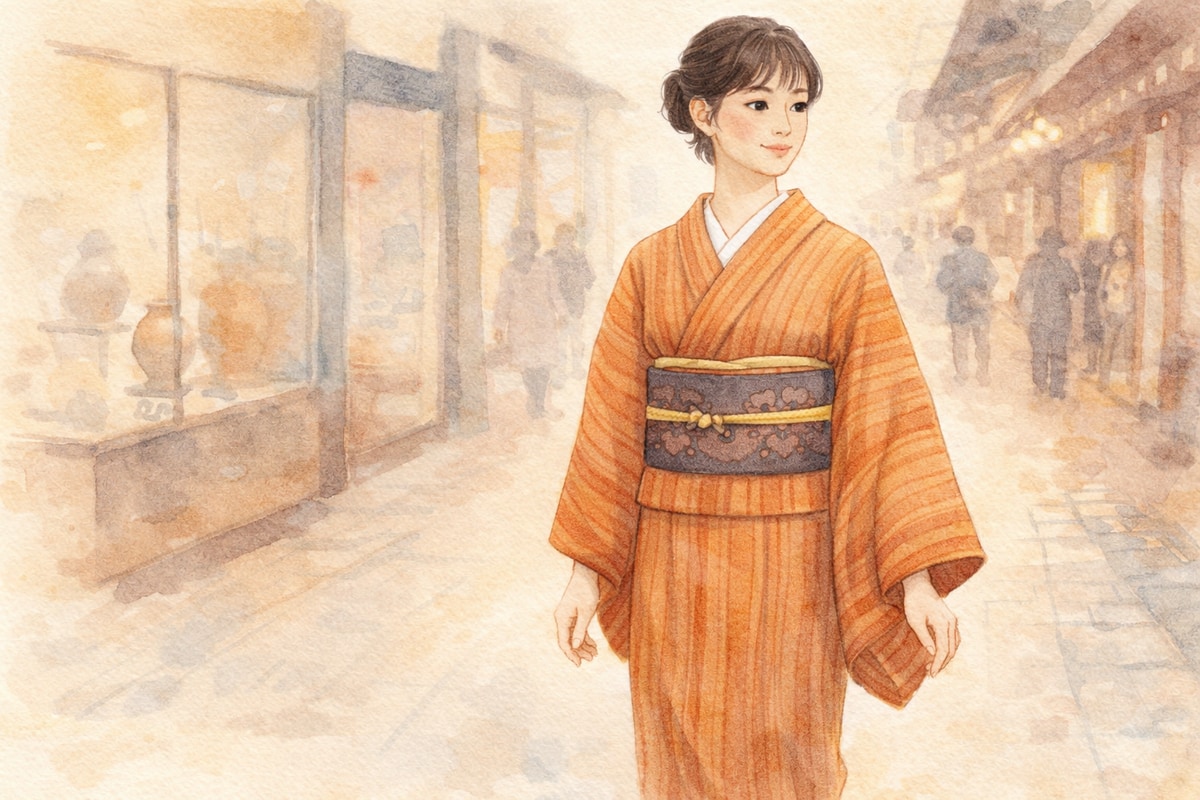
When the first cold winds of the season stir, many people pull a tsumugi (a textured, hand-woven silk) kimono out of the closet. But just as you’re about to slip it on, your hand pauses — “This would be fine for a dinner with friends, but surely not for a wedding?” This article is for anyone unsure how far they can take tsumugi into casual territory. Let’s work through the boundaries, one by one.
Tsumugi Is a “Everyday” Kimono — Starting With the Basics of Formality
Historically, tsumugi was woven from thread spun out of waste cocoons, originally as humble work clothing. No matter how expensive a piece of tsumugi may be, on the scale of kimono formality, it still counts as everyday wear. A tsumugi worth hundreds of thousands of yen ranks, formality-wise, alongside komon (a casual kimono with a small repeating pattern) as “town wear” — one of the more curious and quietly fascinating aspects of the kimono world. Price and formality are two separate yardsticks, sitting side by side. The general understanding is that tsumugi and komon belong to the “town wear” category, while iromuji (solid-color kimono) and tsukesage and above are considered formal wear. For more on the different types and weaves of tsumugi, see An Introduction to Tsumugi: How Do Yuki, Oshima, and Ushikubi Tsumugi Differ?.
Occasions Where Tsumugi Is Welcome — From Casual Outings to Lessons
Tsumugi comes alive most in relaxed settings. Dinners with friends, the theater, museum visits, cafes, shopping trips. As an easygoing, stylish “outing kimono,” tsumugi can even take center stage. Many people wear it to lessons or hobby gatherings too, enjoying the texture of the weave while spending unhurried time. That, in essence, is where tsumugi truly shines.
Occasions to Avoid — Weddings, Tea Gatherings, Ceremonies
On the other hand, there are clear occasions where tsumugi doesn’t belong. Attending a wedding as a relative, a formal tea gathering, a decoration ceremony or official function, any formal public occasion. No matter how costly the tsumugi, the shared understanding in the kimono world is that it cannot be worn to occasions demanding formality, such as weddings or tea ceremonies.
What causes particular confusion is “tsumugi houmongi (a semi-formal kimono)” — tsumugi fabric decorated with a flowing eba pattern. With its showy design, it can look formal at a glance, but it isn’t necessarily treated the same as a standard formal houmongi. This is an easy point to get wrong, so it’s worth remembering. That said, tsumugi can sometimes be an option for tea ceremony lessons or casual gatherings, though acceptability varies by occasion, so it’s safest to follow the host’s guidance.
Regional Differences in Custom — Oshima Tsumugi and the Coming-of-Age Ceremony
That said, the formality of tsumugi also varies by region. In the Amami Islands of Kagoshima, the home of Oshima tsumugi, the custom of wearing tsumugi to weddings and the seijin-shiki (the Coming-of-Age ceremony) is still very much alive. Amami City has held a “Tsumugi Day” every year since 1978, and records show that at one Coming-of-Age gathering for twenty-year-olds, 204 out of 931 attendees across the 13 districts of the islands wore tsumugi. Some areas even offer subsidies for purchasing it, showing just how deeply tsumugi is rooted as formal attire for special occasions there. While tsumugi is treated as everyday wear nationally, a completely different story is woven into it at its place of origin — the more you learn, the clearer it becomes that kimono formality isn’t a single, fixed rule. Those wanting to enjoy Oshima tsumugi as stylish everyday wear may also find When Should You Wear Oshima Tsumugi? Occasions for Casual Wear and What to Check Before Renting useful.
Men’s Tsumugi and the Exception of Solid-Color Tsumugi
Men’s tsumugi follows a different yardstick altogether. There’s a custom whereby adding a crest to a solid or near-solid tsumugi allows it to pass as semi-formal wear for men. Hand-woven tsumugi fabric, costly due to the labor involved, is often more luxurious than the machine-produced white silk used for formal wear, and the dividing line in formality tends to come down to whether the pattern is clearly visible, as in everyday wear.
For women’s wear too, there’s an exception: solid-color tsumugi bearing a single crest is customarily treated as acceptable even for formal occasions, despite being tsumugi. It’s rather endearing, really, how much a single crest can transform the character of tsumugi, that quintessential everyday kimono.
Comparing With Other Casual Kimono — Komon and Solid-Color Kimono
To get a clearer sense of where tsumugi stands, it helps to place it alongside its neighbors. Komon, like tsumugi, is town wear, though depending on the pattern it can sometimes rank slightly higher. Solid-color kimono, once a crest is added, can become semi-formal wear, placing it a notch above tsumugi in formality. If you simply keep in mind the broad divide — “tsumugi and komon are casual,” “solid-color kimono and tsukesage and above are formal” — you’ll find yourself far less puzzled about what to wear for each occasion.
In Summary — The Line Is Drawn by Formality, Not Price
How casual can tsumugi go? The answer lies not in price, but in the formality of the occasion. You can confidently wear it to dinners, lessons, the theater, or a stroll through town, while holding back for weddings, tea gatherings, or formal ceremonies. That’s the basic dividing line. Still, there are exceptions — regional customs, crested kimono for men, solid-color tsumugi with a single crest. The more you learn, the more depth you discover in this kimono. Why not let today’s outfit carry a small story of its own?