
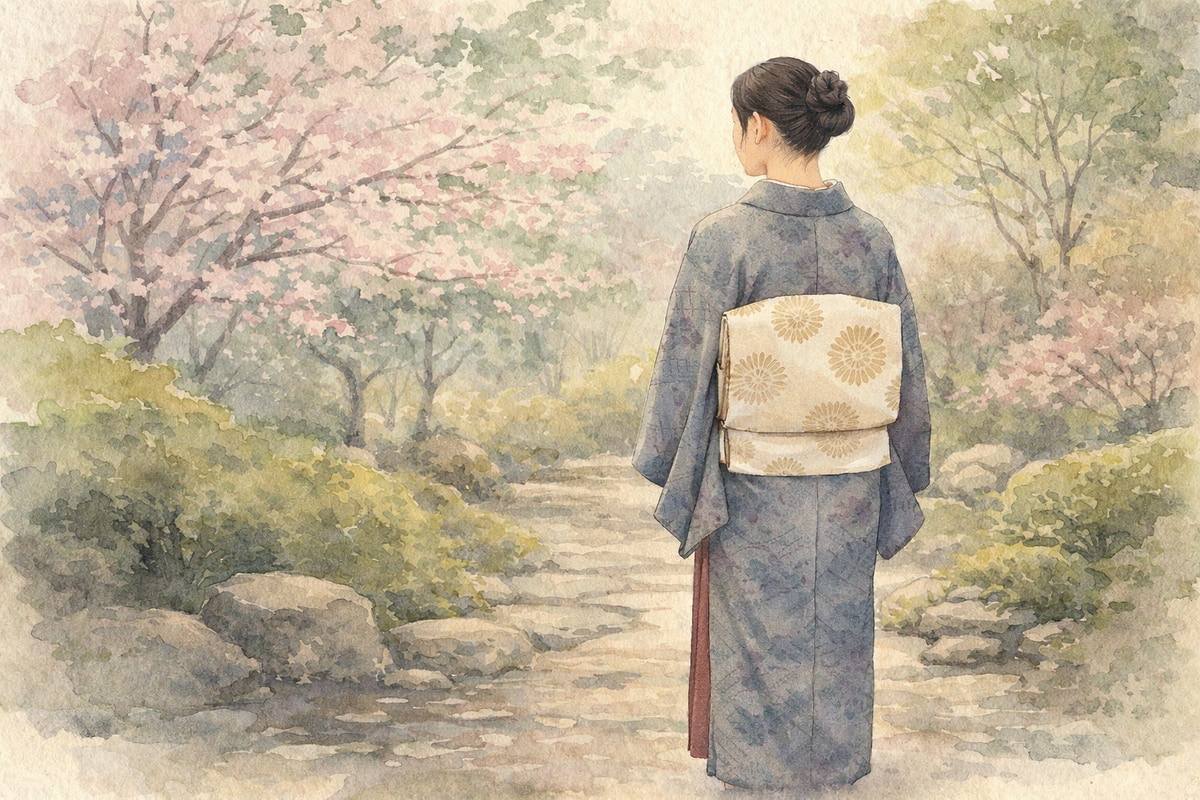
A kimono with the Tatsutagawa motif, or an obi (the wide sash tied around a kimono) bearing it. The moment you hold one, you may find yourself pausing over what color to choose for the obijime (a cord tied over the obi) and obiage (a fabric accent above the obi). Should you match the red of the autumn leaves, or lean into the coolness of the flowing water? It seems like such a small thing—a single cord, a single piece of cloth—yet it has the power to shape the impression of an entire outfit. This article gently walks through how to choose obijime and obiage colors for those who have a Tatsutagawa-pattern kimono or obi in hand.
The Story of Autumn Leaves and Flowing Water in the Tatsutagawa Motif
The Tatsutagawa motif depicts autumn leaves scattered across flowing water. It is said to take its name from the Tatsuta River, which flows through Ikoma District in Nara Prefecture and has long been known as a celebrated spot for autumn foliage. As a kimono or obi pattern, it is traditionally worn during the autumn leaf season, from around September to November. However, versions that pair blue-toned leaves with flowing-water patterns give a cooler impression, so they are sometimes worn ahead of season as summer pieces, such as on a yukata (a light cotton summer kimono). The Tatsutagawa motif wears two faces—the fiery red of autumn leaves, and the cool refreshment of flowing water—and that duality is the starting point for thinking about which accessories to choose.
For more on the motif’s origins and development, see What Is the Tatsutagawa Motif? Unraveling Autumn in Kimono Through Leaves and Flowing Water. The more you learn about it, the more depth you find.
Choosing Accessories That Bring Out the Autumn-Leaf Colors
If you want to enjoy the Tatsutagawa motif as an autumn pattern, the basic approach is to pair the obijime and obiage with warm autumn colors. Shades like yellow, vermilion, and ebicha (a reddish brown) have long been cherished as colors that add a seasonal touch to early-autumn outfits. Mustard, deep crimson, and dusty orange are also classic go-to colors for autumn obiage and obijime.
The red of autumn leaves is not a single color. Some lean toward a blazing vermilion, others toward a deep, muted crimson. Deciding on your obijime and obiage colors after first seeing which red the leaves in your kimono or obi lean toward will help keep the overall look from feeling mismatched. If the leaves lean vermilion, grounding things with a crimson obijime brings a settled calm. If they lean crimson, adding a bright mustard obiage lends a touch of lightness—this kind of contrast is a rather stylish approach.
Coordinating Around the Flowing-Water Blues
At the same time, the appeal of the Tatsutagawa motif isn’t limited to its autumn leaves. The lines of flowing water carry their own cool, refreshing expression. Rather than committing entirely to the red of the leaves, weaving a touch of the water’s blue into part of the obijime or obiage lets a thread of coolness run through the autumn feeling.
One well-known example pairs a Nagoya obi dyed with the Tatsutagawa motif against a deep purple kimono. The way a calm background color quietly holds both the red of the leaves and the lines of the water together is worth remembering as a kind of model. Rather than making the obijime and obiage the center of attention, it helps to think of them as a bridge connecting the two colors—the autumn leaves and the flowing water—which makes them easier to choose.
Keeping the Seasonal Feeling From Becoming Too Strong
Even though you’re leaning into autumn colors, filling every accessory with deep, warm autumn tones all at once can sometimes feel a bit heavy. Letting the autumn color shine in either the obijime or the obiage, while keeping the other muted and pale, is one way to avoid overdoing the seasonal effect.
Fabric is also worth considering. Non-sheer chirimen (crepe) or rinzu (a type of damask silk) obiage are generally suited to October through May, while ro (a sheer, gauzy summer silk) suits June through September. If you’re wearing the Tatsutagawa motif in autumn, a chirimen or rinzu obiage fits naturally; if you’re wearing it early as a summer piece, ro is the better choice. Paying attention to seasonal fabric alongside color keeps the whole look consistent.
Tips for Dividing Roles Between Obijime and Obiage
When both the obijime and obiage try to take center stage, they end up clashing. In formal settings, the basic approach is to pick one color from the kimono or obi’s pattern and use a paler shade of that same color family as the obiage’s base color. With the Tatsutagawa motif, you might pull one shade from the red of the autumn leaves and make the obiage a lighter version of it—following that sequence makes the decision easier.
Another common approach is to coordinate the obijime and obiage in the same color family, with the obiage rendered in a paler shade than the obijime—essentially dyeing the obiage to match the obijime’s color. Even within the same red family, some suggest cherry-blossom pink in spring and persimmon or bordeaux in autumn, to heighten the seasonal feeling. For a Tatsutagawa-motif obijime, choosing a slightly muted persimmon or crimson, rather than a red closer to vermilion, will likely feel more in keeping with the depth of autumn foliage.
If you’d like to revisit the fundamentals of choosing obijime and obiage—including formality levels and color matching—see A Guide to Choosing Obijime and Obiage: The Basics of Formality and Color Matching.
A Small Story for Today’s Outfit
Whether you let the red of the autumn leaves take the lead, or bring out the coolness of the flowing water, the same Tatsutagawa-pattern kimono or obi can take on quite different expressions depending on which direction you lean. When in doubt, pick out just one red from the autumn leaves in your kimono or obi, and let that color show faintly in either the obijime or the obiage—that alone can bring the whole look together. As the trees quietly begin to turn, why not let the small cord and cloth in your hands reflect a touch of Tatsutagawa’s autumn as well?