
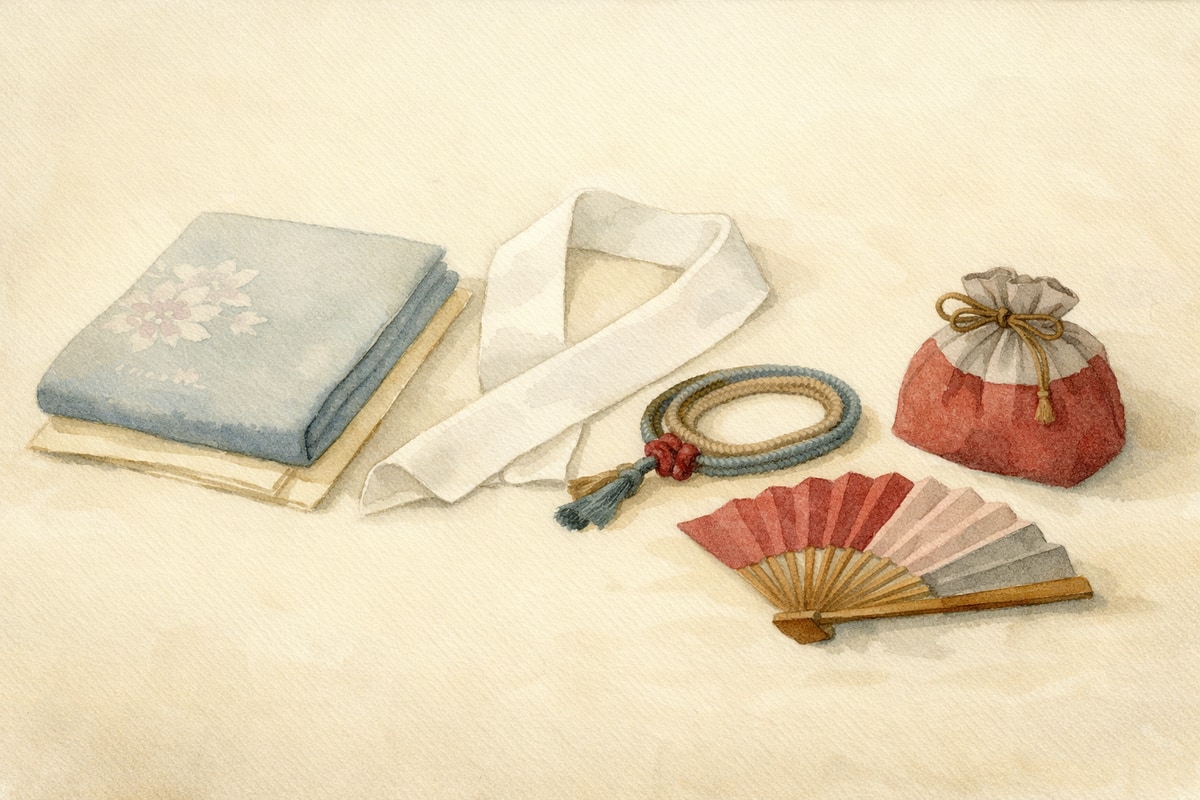
Pulling a kimono out of the drawer and then freezing over which han-eri (collar cover) to use — Iroha has been there too. Should it be white, or is a colored pattern okay? Should the fabric even change with the season? Actually, there are just two things to check: the season and the occasion. Knowing this alone makes choosing your collar so much less confusing.
What is the han-eri actually for?
The han-eri is a piece of fabric sewn onto the collar (eri) of the nagajuban (an under-kimono), layered on top of it. If you’re curious about kimono terminology and parts, take a look at our Illustrated Glossary of Kimono Names and Parts. Because it sits closest to the face, it quietly shapes the overall impression of how you wear your kimono. There’s a real logic behind choosing its material, color, and pattern — and once you know it, pulling together a kimono outfit becomes that much easier.
Choosing han-eri fabric by season
The first thing to keep in mind is how the fabric changes with the season. The standard han-eri for the awase (lined kimono) season is shioze silk, known for its fine horizontal ribbed weave — a versatile choice that works for everything from furisode (a long-sleeved formal kimono) to tomesode and houmongi (a semi-formal kimono). From June through early September, though, it’s more comfortable to switch to sheer ro (a sheer, gauzy summer silk) or ro-chirimen. Ro is woven with small horizontal gaps that give it a cool, breezy look, while ro-chirimen combines the qualities of ro and chirimen, making it just right for the awase-to-summer transition period known as hitoe. If you’d like to learn more about sheer kimono fabrics, our article Ro, Sha, and Asa — The Cool Elegance Hidden in Sheer Kimono is a good reference. Chirimen, by the way, has a fine crepe texture and a calm look suited to winter, while yoryu has a vertical ribbed weave that touches the skin only lightly, making it feel crisp and dry — some people even wear it like an undergarment during the sweatier months.
Color and pattern etiquette by occasion
After the season, the next thing to check is the occasion. For formal wear, a white shioze han-eri is the standard choice; as long as white remains the base tone, glossy fabrics or ones embroidered with gold or silver thread are also acceptable. For dyed kimono such as iromuji or komon (a casual kimono with a small repeating pattern), colored chirimen other than white pairs easily, while woven kimono like kasuri, tsumugi (a textured, hand-woven silk), or wool suit cotton han-eri or ones with playful, casual patterns better. One point worth remembering is not to pair tsumugi with a formal-looking embroidered collar — festive gold-and-silver-thread patterns are meant for semi-formal wear and above, so pairing them with casual attire creates a mismatch, with the collar looking out of place against the rest of the outfit. It’s also commonly said that white is the choice for tea ceremonies, and as a general rule of thumb, the paler the color, the more formal it is, while deeper colors lean toward everyday wear — keeping this in mind makes choosing much easier.
Attaching the han-eri: sewing or pinning — which is better?
This is honestly the part people hesitate over most. If you have time and want a neat finish, sew it on; if you’re short on time, pins or tape work just fine too. Let’s look at each method.
Sewing it on
When using an insert-type eri-shin (collar stiffener), the trick is to sew more finely around the curved parts of the collar and anywhere that shows from the outside. In particular, the area about 8–10cm to either side of the center of the collar is highly visible, so sew carefully there. As long as you’re mindful of just that stretch, the rest can be a bit rougher without making much difference to the final look.
Attaching without sewing (safety pins or tape)
Pinning with safety pins is also a common method. Line up the center of the han-eri with the center of the nagajuban’s collar and pin the back-center point first, then pin each collar tip, and add a few more pins at the midpoints in between — about 5–6 points on each side, or roughly 10–12 points in total, is enough to hold it securely. When pinning, always pass the needle from the outside toward the inside for safety. On the outer side of the collar, catch only the seam allowance with the pin, and be especially careful around the roughly 15cm stretch from the back-center to the shoulders, since that area is visible to others — make sure the pin doesn’t poke through to the front. That said, for raw-silk (nama-ki) han-eri, a safety pin can leave a hole bigger than the needle itself, so it’s best to avoid pins with that fabric. For those who like to change their han-eri often, double-sided tape is also a good option, since it leaves no visible stitching and keeps the look clean. Whichever method you use, the key positions to secure are the midpoint of the shoulder seam, both ends, and the center of the han-eri — keeping these three points in mind makes a real difference in stability.
If you plan to sew or pin your own han-eri, an eri-shin (collar stiffener) is the small tool that keeps the collar line smooth: you slide it inside the han-eri before dressing, and the neckline holds its shape all day. Please check the product page for current details.
Common questions: areas prone to soiling and when to replace it
Because the han-eri sits so close to the face, it’s prone to picking up foundation and sweat. The area slightly off-center from the middle of the collar, where the cheeks and neck make contact, tends to show soiling most, so it’s worth giving it a quick check each time you wear it. If it starts to look soiled, it’s best to replace it sooner rather than later so you can always wear it with a clean feeling. Since summer heat and sweat take more of a toll, it helps to make a habit of switching your han-eri at the same time you change into hitoe or usumono (unlined or sheer summer kimono), so the seasonal transition goes smoothly. If you’d like to know more about the timing for seasonal kimono changes, check out When Does Kimono Season Change? A Gentle Guide to Hitoe and Usumono as well.
Summary
When you’re unsure about choosing a han-eri, it’s fine to simply check two things in order: season, then occasion. Shioze for the awase season, ro or ro-chirimen for summer. For formal wear, stick with white as the base, while pairing everyday wear like tsumugi with cotton or playful patterns. As for attaching it, sew carefully if you have the time, or use pins or tape when you’re pressed for it. Iroha’s own suggestion is to keep at least one white shioze han-eri and one summer ro han-eri on hand — with just these two, you’ll be covered for most occasions, so it’s reassuring to have them ready.