
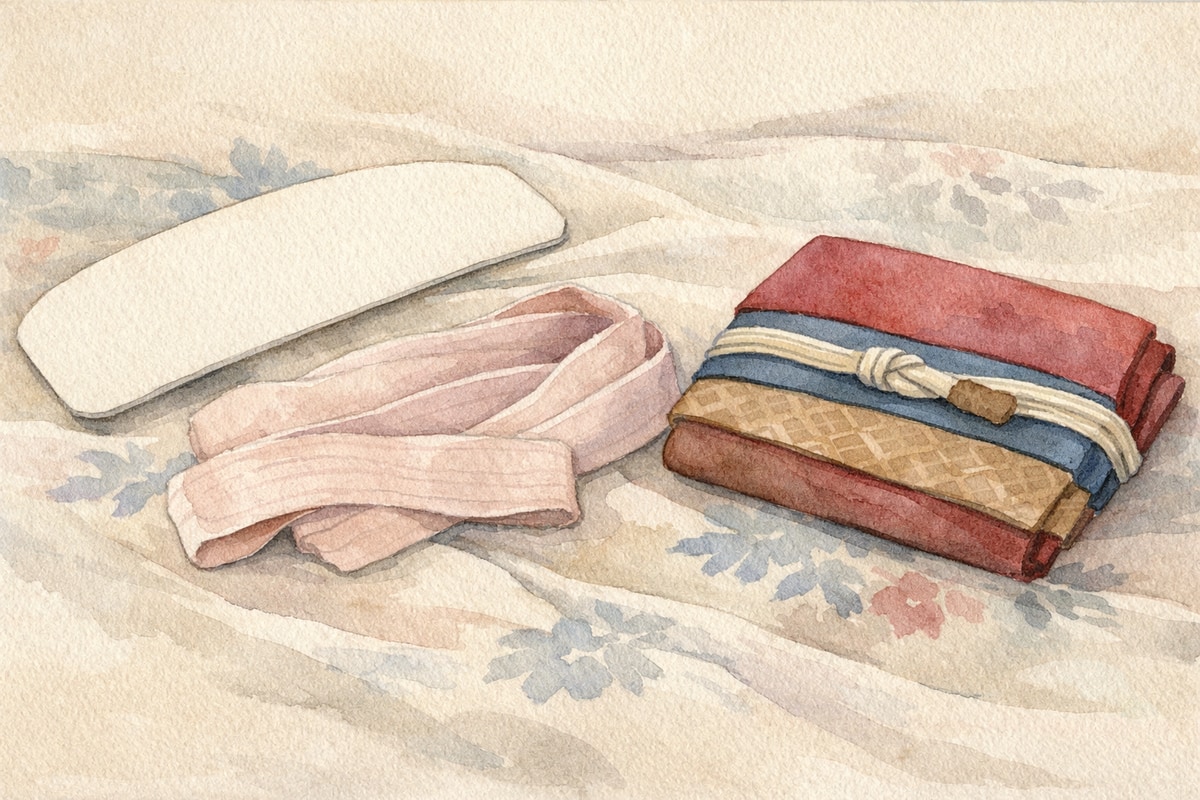
You lay out your accessories to get dressed in a yukata (a light cotton summer kimono), and the obi-ita is nowhere to be found. Only one date-jime turns up instead of two. Have you ever paused, wondering, “Can I actually get dressed without this?” The truth is, the answer depends on the occasion. For a casual neighborhood festival, it might not matter at all — but for other occasions, it definitely does. Let’s start by looking at what these two accessories actually do.
What Do the Obi-ita and Date-jime Actually Do?
An obi-ita is a thin board inserted inside the obi (the wide sash tied around a kimono). It keeps the front of the obi from wrinkling as you wrap it, helping the obi look crisp and neat. You simply slip it between the first and second wrap of the obi, and the front surface instantly looks tidier.
A date-jime is a sash used to stabilize the collar of a kimono or nagajuban (an under-kimono) — worn beneath the kimono to keep the collar area in shape — and to keep the base of the ohashori (the fold tucked at the waist) straight. In standard kitsuke (dressing in kimono), two date-jime are typically used: one for the nagajuban and one for the kimono. Using two is said to reduce the kimono coming loose (kizukure) and help keep the neckline looking crisp.
Some Occasions Where You Can Skip Them
For low-key occasions like a neighborhood summer festival, a fireworks show, or a casual meal at home, you can enjoy wearing kimono perfectly well without an obi-ita. If you choose a soft heko obi or a hanhaba obi (a narrow half-width sash), the obi knot will naturally look relaxed and light even without a board underneath.
And if you don’t have the right tools on hand, don’t worry — a piece of cardboard can stand in for an obi-ita and still noticeably improve the look. The typical items prepared for a yukata kitsuke are the yukata itself, an obi, undergarments, a koshihimo (waist cord), a date-jime, an obi-ita, and a towel for padding — but for casual occasions, skipping one or two of these rarely causes real trouble.
Occasions Where It’s Safer to Have Them
On the other hand, things are different for formal occasions or days when you’ll be wearing kimono for a long stretch of time. On days when you’re tying a Nagoya obi or fukuro obi, taking lots of photos, or if you’re still new to kitsuke, having an obi-ita and date-jime on hand makes a real difference in peace of mind.
It’s especially worth remembering that using two date-jime is more effective at preventing kizukure than using just one. The one for the nagajuban and the one for the kimono each play a slightly different role, so relying on a single one for both tends to loosen the collar area over time. If you’d like to rethink your nagajuban choices as well, take a look at this guide to choosing a nagajuban.
How to Choose an Obi-ita and Date-jime
Obi-ita: Belted or Slide-in?
Obi-ita come in several types — belted, mesh, loofah-fiber, and more — including versions made specifically for front-tied obi styles. The belted type is worn over the date-jime, wrapped around the body and hooked in place before the obi goes on, making it easy for beginners dressing themselves to handle.
The beltless type is a slide-in style, tucked between the first and second wraps of the obi as you tie it. Because it sits closer to the obi’s outer surface, it gives a crisper finish. If you’re wearing a soft or thin obi, choosing a thin, flexible obi-ita will keep it from affecting the obi’s drape.
Date-jime: Hakata Weave or Hook-and-Loop?
A pure silk (shoken) date-jime woven in the Hakata style — a traditional weave from Hakata in Fukuoka Prefecture — is soft along both edges while the section that sits against the chest is firm enough to hold everything snugly in place. Synthetic-fiber versions are more affordable and machine-washable, though they can be a bit more prone to slipping.
Hook-and-loop (“magic belt”) type date-jime fasten with touch tape, saving time, and their stretch makes them easier to handle for those still getting used to kitsuke. Date-jime widths typically run from about 7 to 10 cm, and lengths from 80 to 200 cm depending on the type, so it’s worth checking whether the one you own might be too short.
What Can Be Skipped, and What Can’t
Putting this all together, the roles become clear: the obi-ita is a tool for appearance, while the date-jime is a tool for preventing kizukure. When it comes to appearance alone, a towel or a spare piece of fabric can sometimes substitute in a pinch — but there’s really no good substitute for what the date-jime does in holding the collar and ohashori in place.
If your collar starts to come loose partway through wearing kimono, knowing a quick fix can help you stay calm even while out and about. If that’s a concern, our guide to fixing kizukure is worth reading. And if you’re unsure about obi accessories for yukata, our article on whether obijime and obiage are necessary for yukata may also help.
In Summary: Choose Based on How You’re Wearing Kimono
Neither the obi-ita nor the date-jime comes with a hard rule of “you must have exactly this many.” How necessary they are depends on the occasion and how long you’ll be wearing kimono. For a quick trip around the neighborhood, you can enjoy skipping them — but for formal occasions or a long day out, having both on hand makes a real difference in peace of mind. Think about where you’re headed today, and use that as your guide when deciding what to pack.