
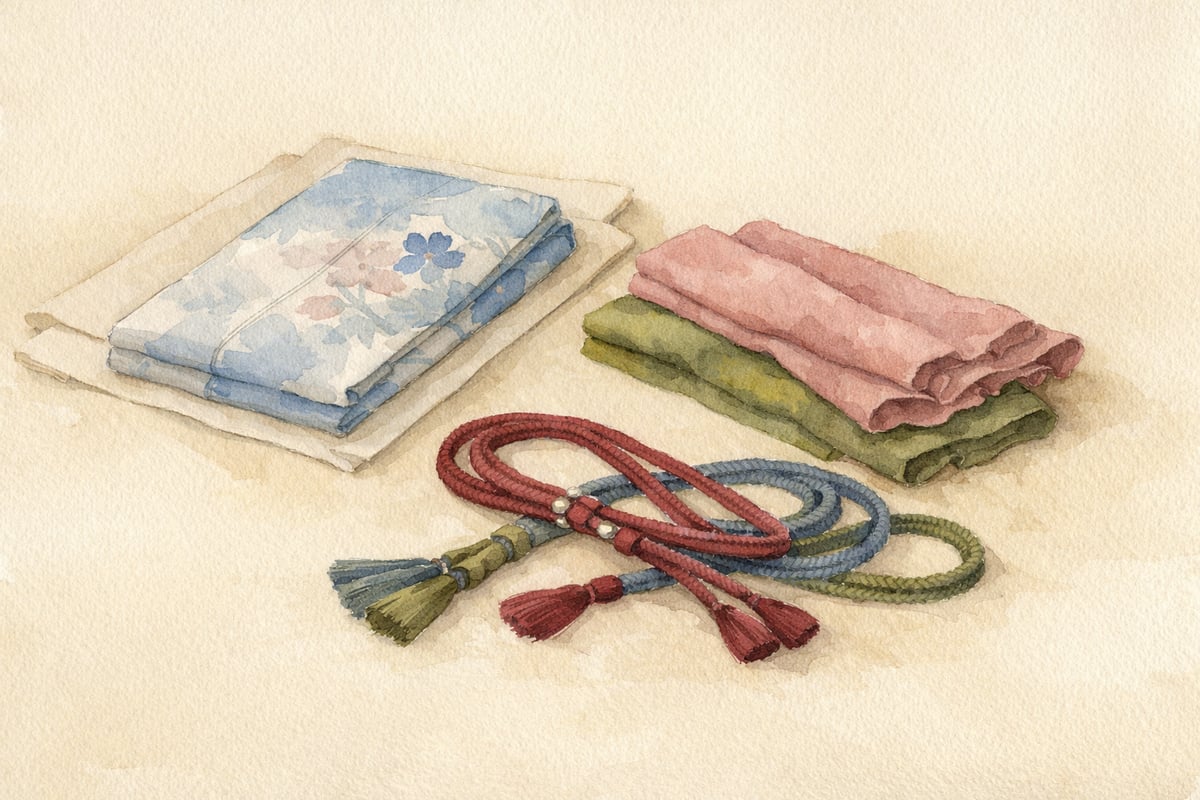
You’ve just tied your obi and are standing in front of the mirror, hand frozen mid-air, not quite sure what to do next. Sound familiar? A hanhaba obi (a narrow half-width sash) alone can feel a little plain, but you’re not sure whether adding an obijime (a cord tied over the obi) or obiage (a fabric accent above the obi) is allowed, or whether it might tip over into looking overdone. Surprisingly many people worry about exactly this. And honestly, there isn’t just one right answer, which is precisely why it’s confusing. Let’s untangle this bit by bit today.
An Obijime and Obiage Aren’t Essential with Yukata
Let’s get straight to it: an obijime isn’t typically used with a yukata (a light cotton summer kimono). The yukata’s original style pairs it with an easy-to-tie obi (the wide sash tied around a kimono), and the look is complete without an obijime at all. If you do choose to add one, it helps to think of it not as a required tool but simply as a decorative accent. That mindset alone can take a lot of the pressure off.
That said, depending on how the obi is tied, an obijime can sometimes help keep its shape stable. So rather than deciding it’s “unnecessary,” it may help to think of it as “something the outfit works with or without.”
The Basic Way to Pair Obi with a Standard Yukata
When it comes to yukata obi, the hanhaba obi is the basic starting point. Light, easy-to-tie styles like the bunko knot or a ribbon-style bow take center stage, and the yukata look is perfectly complete with just that. Once you’ve got this basic form down, it’s worth knowing that pairing a hanhaba obi with a pre-made otaiko-style obi accessory can raise the formality and give a dressier impression. If you’re curious about when to choose a hanhaba obi versus a Nagoya obi, it’s worth also reading The Hanhaba Obi Is the Basic Choice for Yukata — So When Should You Wear a Nagoya Obi Instead?
How to Think About Adding an Obijime or Obiage
This is where adding an obijime or obiage comes in as an option. When you tie a hanhaba obi in an otaiko-style shape, for instance, adding an obijime or obiage opens up a much wider range of color and material combinations to enjoy. When you want to keep that cool, breezy yukata feel while adding a touch more polish, this kind of addition can really work in your favor.
If you’d like to dig a little deeper into color pairing and formality basics for a more grown-up look, it’s worth checking How to Choose an Obijime and Obiage: The Basics of Formality and Color Pairing as well.
The Difference Between Decorative Cords and Sanbu-himo
Here it helps to clarify something called sanbu-himo. A sanbu-himo is originally a cord meant to be threaded through an obidome (an ornamental obi clasp), and it’s characterized by being thinner than a regular obijime, with shorter tassels. Using it on its own is a bit of a departure from its original purpose, but lately it’s become common to see a sanbu-himo worn alone as a decorative touch with a hanhaba obi on yukata.
When used purely as decoration, there’s no need to tie it tightly, and it’s fine to choose based on appearance alone. Once you accept that it’s not a cord meant to secure anything, but purely a decorative touch for color and texture, choosing one becomes much less stressful. That said, if the material is something slippery like synthetic fiber, it can loosen easily, so some people find that a pure silk (shoken) sanbu-himo or a regular obijime holds more securely if you want that extra support.
Where a sanbu-himo really shines is when paired with an obidome. Threading a small obidome onto the thin cord creates a single eye-catching point at the center of the obi, pulling the whole yukata look together neatly. A glass tonbodama (dragonfly-eye bead) obidome looks especially cool and refreshing and pairs beautifully with yukata. Skipping both the obiage and obijime, and decorating with just a sanbu-himo and obidome as a single accent point is one of the easiest ways to look grown-up without overdoing it.
Pairing with a Hekoobi
Another question that comes up often is how a hekoobi (a soft, casual sash) pairs with an obijime. A hekoobi is made of soft fabric with little constriction, and it’s generally considered a casual sash for relaxed wear, not something worn in formal or ceremonial settings. With that casual nature in mind, incorporating an item like a decorative hekoobi, layered over a regular obi to add a touch of flair, is one of the fun ways to enjoy a yukata.
So what about adding an obijime or obiage to a hekoobi? This isn’t something we’d recommend. The whole appeal of a hekoobi is its soft, fluffy texture. Unlike a stiffer obi, if you tie an obijime firmly over it, the soft fabric gets crushed, leading to unnatural wrinkles and a loss of that fluffy, three-dimensional shape. Tucking in an obiage as well just adds bulk around the obi and erases the lightness that makes a hekoobi special. Think of the hekoobi as a sash whose knot itself, soft and full, is the decoration, and it tends to look best left as is. That said, there’s no hard rule against it in today’s styling — some people like to add a single thin sanbu-himo as a color accent. If you do this, just let it rest lightly against the obi rather than tying it snugly.
If you’re torn between a hanhaba obi and a hekoobi, and want to know more about how easy each is to tie and how they differ in appearance, Yukata Obi: Hanhaba Obi or Hekoobi — What’s the Difference in Ease of Tying and Look? lays it out in more detail, so take a look there too.
Colors, Materials, and Numbers for a Grown-Up Look — and How to Avoid Overdoing It
That said, more accents don’t necessarily mean a more grown-up look — that’s what makes dressing interesting. Since the yukata itself is an outfit meant for enjoying a cool, breezy feel, rather than piling on an obijime, obiage, and obidome all at once, it’s often more elegant to subtract, choosing just one accent color and keeping things simple.
For color, picking up a shade already present in the yukata or obi creates a sense of unity. For material, shoken gives a calm sheen, while synthetic fiber or lace gives a cool, light feel. As for how many pieces to use, whether you go with both an obijime and obiage, or decorate with just a sanbu-himo, it’s easiest to start by trying just one approach at a time. Don’t worry, there are only two things to remember: enjoy these pieces as decoration, and don’t add too much. Keeping just these two ideas in mind can make a real difference in how polished your yukata look feels.
In Summary
Once you understand that an obijime and obiage aren’t essential with yukata, but simply decorative extras, it takes a lot of pressure off when choosing how to style your outfit. The basic look is complete with just a hanhaba obi, and from there, adding an otaiko-style knot or a sanbu-himo lets you enjoy both a cool, breezy feel and a touch of style. When wearing a hekoobi, keep in mind that it’s a casual look, and choose your colors and number of accents with a “less is more” mindset. Keep this as a reference point for choosing your next accent piece with confidence.