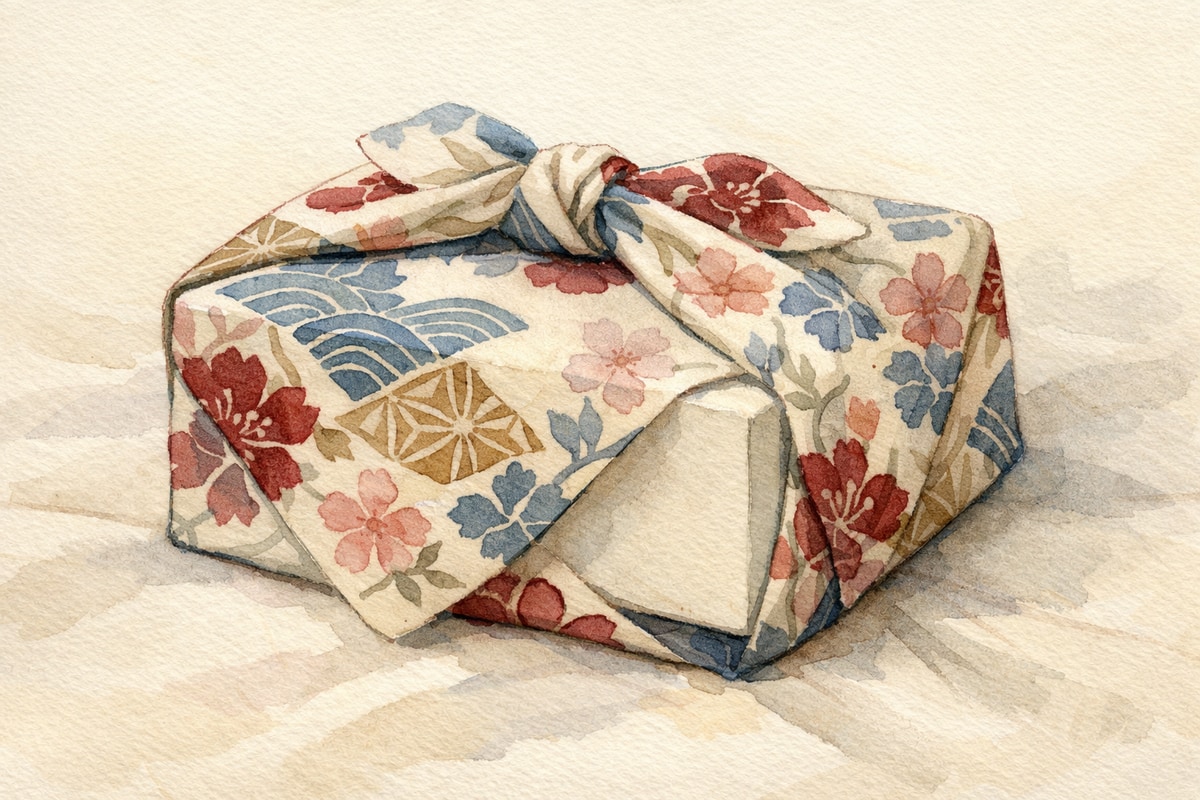
A furoshiki looks almost too simple to bother explaining: it is a square of cloth. No zipper, no handle, no fixed shape of its own. And yet that plainness is exactly the point. The same piece of cloth that carries a bottle of wine to a friend’s house can, an hour later, be folded flat into a pocket, because it never had a shape to begin with — you gave it one, temporarily, with your hands. Understanding that one idea makes the rest of furoshiki use almost self-explanatory.
What the cloth actually is, before you tie anything
Furoshiki simply means “bath-spread cloth,” and the name points to one of its documented early uses: cloth spread on the floor of a communal bathhouse to stand on while undressing, and then used to bundle up one’s clothes and belongings again afterward. Cloth wrapping in Japan predates that specific name by centuries, but the bathhouse habit is the origin most textile historians point to for the word itself, and it helps explain why the cloth was always meant to be practical rather than precious. A furoshiki is defined by function, not fabric — it can be cotton, silk, rayon, or a modern synthetic, printed or plain, and it remains a furoshiki as long as it is being used to wrap or carry.
This is worth separating from kimono-related textiles that look similar but are not interchangeable. A furoshiki is not a fukusa, the smaller silk cloth used to present gifts formally or to handle tea utensils, and it is not scrap cloth left over from making a kimono. It sits in its own category: a general-purpose wrapping textile that happens to share the same weaving and dyeing traditions — chirimen crepe, yuzen dyeing, woven silk — as garment fabric, which is part of why older furoshiki are sometimes collected and displayed the way textile art is.
The one size that solves most problems
Furoshiki are sold in a range of sizes, traditionally measured in shaku (a pre-metric unit still used informally in cloth trades), and it is tempting to think you need several sizes to be prepared. In practice, a square of roughly 68 to 70 centimeters on each side is the size to own first, because it is large enough to wrap a bottle, a stack of two or three books, or a small box with lunch inside, and still small enough to knot without excess cloth flopping everywhere. Smaller squares, closer to 45 centimeters, are suited to single small objects like a folded fan or a jewelry box; larger cloths, over 90 centimeters, are for bulkier things like a blanket or a large box, and behave differently in the hand because the knots sit farther from the object’s edges.
If you are choosing your first cloth with no specific object in mind, the mid-size square is the more forgiving choice. It fails gracefully — a bottle wrapped in a too-large cloth just looks loose, which is recoverable, whereas an object wrapped in a too-small cloth simply will not close.
Three knots that cover almost everything
There are dozens of named furoshiki wrapping methods, and enthusiasts collect them the way some people collect knife cuts or knitting stitches. But three techniques, learned in order, will get a beginner through nearly every ordinary situation.
- Otsukai-zutsumi (the basic carry wrap): the object sits in the center of the cloth, the near and far corners are tied over the top in a simple double knot, and the two side corners are tied over that. This is the default wrap for a box or a stack of flat items, and it is the one worth practicing first because the other methods are variations on the same logic — corner to corner, knot on top.
- Bin-zutsumi (the bottle wrap): the cloth is wrapped diagonally around a bottle or similarly cylindrical object, then the two ends are twisted and tied into a knot that also forms a small loop, which doubles as a carrying handle. This is the wrap most people learn second because it solves a real, recurring problem — carrying a bottle without a bag — and because the twisting motion, once felt in the hands, is easy to repeat.
- Azuma-zutsumi (the bag fold): the cloth is folded and the corners tucked and knotted in a way that produces an open-topped bag shape with two handles, useful for loose items like fruit or bread that would be awkward to knot directly. Of the three, this one takes the most practice to make sit flat, but it is the closest furoshiki gets to behaving like a tote.
These names are the most widely used ones, but it is worth saying plainly that terminology and exact folding steps vary somewhat by teacher, region, and school, in the same way that obi-tying vocabulary varies. Treat the names as useful handles rather than fixed law.
If the three knots in this article made you want to try one, this is a straightforward first cloth: a printed cotton furoshiki in the small everyday size, which suits a lunch box, a book or a gift rather than carrying a kimono. Please check the product page for current details.
Why this plain cloth still matters to kimono culture
It would be easy to file furoshiki under general Japanese craft and leave kimono out of it, but the two are connected in practice, not just in aesthetics. A furoshiki is the traditional way to carry a folded kimono itself — protecting it from dust and light while it travels to a dressing appointment or a formal event — and cloth wrapping shares the same underlying value that shapes kimono care: flat, unstitched cloth stores and travels better than anything with a fixed, bulky shape. A kimono folded flat inside a furoshiki takes up little more space than the garment alone, which is also the logic behind how kimono are folded and stored at home.
There is also a quieter cultural habit worth knowing: the cloth used to wrap a gift is traditionally taken back by the giver once the gift has been handed over and unwrapped, rather than left with the recipient. This custom is not observed identically everywhere — some hosts will insist the guest keep it, some regions treat it more loosely than others — so it is safer to think of it as a common courtesy to be aware of than a fixed rule to follow exactly.
So the plain square that seemed almost too simple at the start turns out to be doing something specific: it is cloth doing the job that boxes, bags, and paper usually do, and doing it in a way that folds away to nothing when the job is finished. Start with one mid-size cloth, learn the basic wrap and the bottle wrap first, and the rest of what furoshiki can do will follow from those two.