
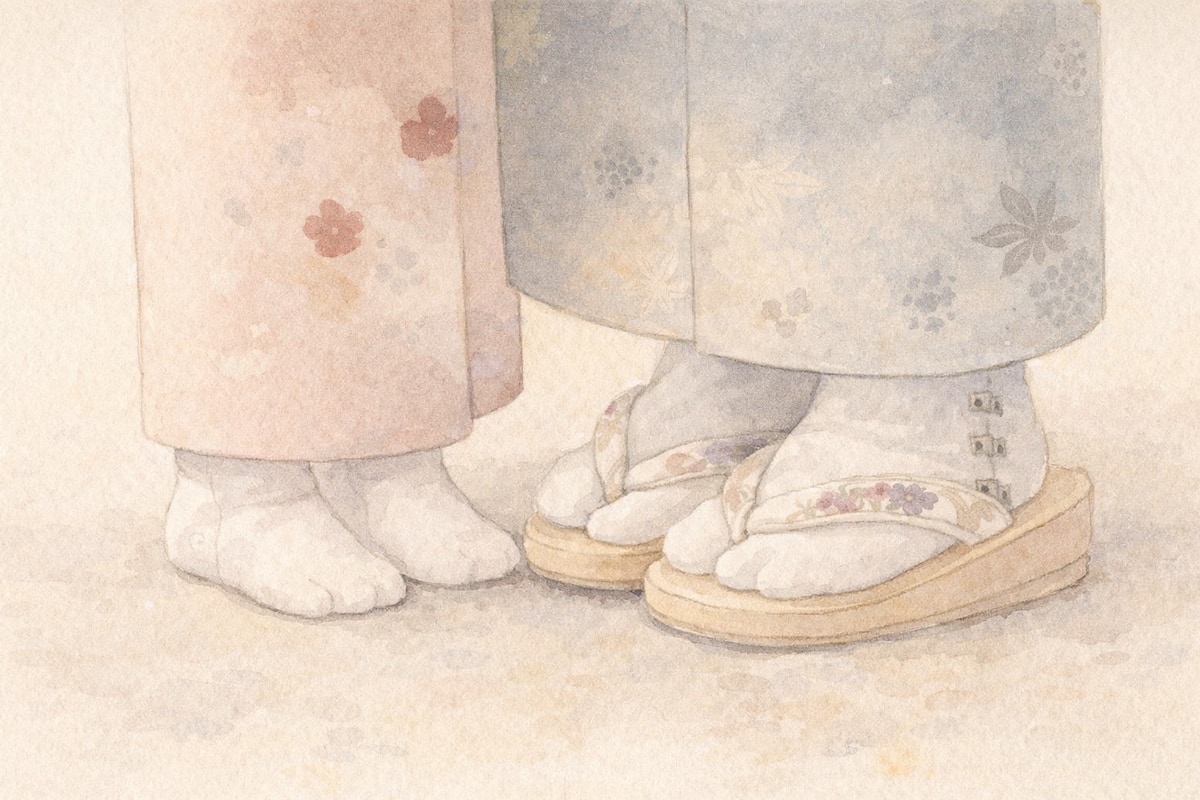
Have you ever tried to put tabi (split-toe socks worn with kimono) on a child on Shichi-Go-San morning, only to be met with tears of “it hurts, I don’t want to”? And then there’s the question of whether you really need to wear the same formal white tabi to a theater outing. Tabi covers and tabi socks sound similar, but they’re actually quite different in how they’re made. This article walks through, occasion by occasion, which one to choose if you’re a child wearing kimono for Shichi-Go-San (a celebration for children aged 7, 5, and 3), a parent accompanying them, or someone who wants to enjoy kimono at the theater.
First, let’s understand how tabi covers and tabi socks are made differently
These two items have similar names, but once you understand how they’re constructed, choosing between them becomes much clearer. Proper tabi traditionally have metal fasteners called kohaze that snap shut, and that’s what makes a pair of tabi “formal.”
Tabi covers are worn over white tabi to protect them from dirt and cold, and come in two types: ones with kohaze, and stretchy ones made of elastic material without kohaze. Since the sizing matches regular tabi, if you’re unsure, just go with your usual tabi size and you’ll be fine. For more on choosing tabi sizes, see our article on tabi sizing and how to choose.
Tabi socks, on the other hand, are socks shaped like tabi with a split at the toe, meant to be worn on their own. They come in a thicker type suitable for going out and a thinner type for after a bath, and generally don’t have kohaze at all. The key point here is that stretchy materials—whether or not they have kohaze—can’t be used for formal dress. Even if they look like white tabi, remember that for formal occasions like weddings and funerals, proper white tabi are the standard.
Shichi-Go-San and theater outings call for different answers
Now that you understand the difference in construction, the next question is “so which one is right for my situation?” Shichi-Go-San and theater outings actually call for completely different things.
For children wearing kimono at Shichi-Go-San
White tabi are commonly paired with Shichi-Go-San outfits, but there’s no strict rule about it—some families use colored or patterned ones, or even five-toed socks. What matters more than anything is reducing the strain on a child’s feet.
For children who find bare feet in zori (flat kimono sandals) uncomfortable, sock-type tabi or stretchy tabi are a great choice. They’re less constricting and easier to put on and take off, making them manageable even for kids who aren’t used to wearing tabi. Tabi socks with an elastic opening and non-slip grips on the heel are made specifically for occasions like Shichi-Go-San, Hinamatsuri (the Doll Festival), and school entrance ceremonies, making them a perfect fit for celebratory events. Being machine-washable is also a relief, since small children tend to get their feet dirty easily. For tips on preparing children for unfamiliar zori, our article on practicing with zori so kids don’t trip is worth checking out too.
For moms and dads accompanying children at Shichi-Go-San
Meanwhile, a mother in a houmongi (a semi-formal kimono) or iromuji (a solid-colored kimono), or a father in haori and hakama, is dressed in semi-formal attire. In this case, white tabi are the standard, and etiquette calls for properly matching tabi and zori as well. In cold weather, there’s no issue with layering a tabi cover over white tabi for warmth. Tabi covers are useful not just for protecting against dirt but also as a way to stay warm, making them ideal for a chilly Shichi-Go-San outing. That said, keep in mind that even a tabi cover with kohaze cannot substitute for proper formal white tabi. It should always be thought of as an extra layer over white tabi for warmth and protection, not a replacement.
For enjoying kimono at the theater
There’s no special dress code for watching kabuki, and most people enjoy it in their everyday casual clothes. Wearing kimono is completely fine and can even add to the atmosphere of the occasion. If you’re heading out in a casual kimono like komon (a casual kimono with a small repeating pattern), feel free to wear tabi socks without kohaze for an easygoing outing. Even if you’re not used to wearing tabi, being able to slip them on like regular socks is a nice bonus for an outing like a theater visit. That said, while colored or patterned tabi socks suit casual cotton or wool kimono, pairing a more formal kimono like houmongi with white tabi will give a more refined impression.
Warmth and ease of care are also deciding factors
Looking at these occasion-specific points together, it becomes clear that whether the occasion calls for formal dress is the first fork in the road, with warmth and ease of care being the deciding factors after that. Because tabi covers are made of stretchy material that fits snugly, they’re reliable for keeping warm in cold weather. We also cover cold-weather tabi solutions in our article on whether flannel linings help keep tabi warm in winter, so take a look if you’re concerned about the cold.
When it comes to care, many tabi socks are machine-washable, which is a relief given how easily children’s feet get dirty. Tabi covers are also made of synthetic stretch fabric, so they’re easy to hand-wash at home—and it’s nice that neither requires the kind of careful handling that pure silk (shoken) white tabi do.
Be cautious on rainy days or in situations with a lot of movement
There’s one thing worth keeping in mind. Since both tabi covers and tabi socks are made of stretchy synthetic material, the soles can become slippery on rainy days. Be mindful of your child’s footing during situations like climbing stone steps on a Shichi-Go-San shrine visit or walking on wet floors at the theater, so they don’t lose their balance.
Summary
Tabi covers and tabi socks may sound alike, but they differ in construction—one is layered over tabi, the other is a standalone sock. For the child at the center of Shichi-Go-San, stretchy tabi socks that prioritize ease of walking are a good choice; for the accompanying parents’ formal attire, white tabi paired with a tabi cover makes sense; and for casual outings like the theater, tabi socks alone are plenty. Keeping this breakdown in mind should take the guesswork out of getting ready on the day. It’s worth saving for reference.