
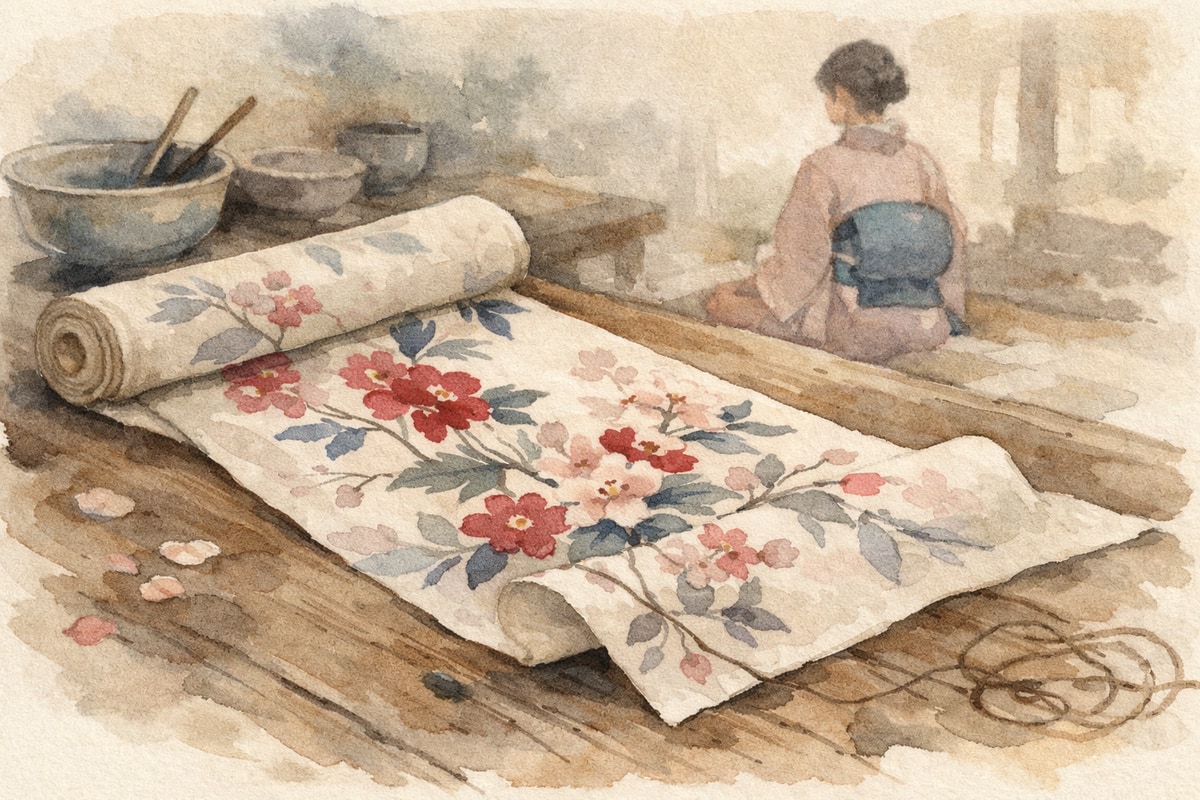
Standing before a shop’s rolls of tanmono (a bolt of kimono cloth), you spot the words “Kyo-Kaga Yuzen” on a price tag. Not Kaga Yuzen, not Kyo Yuzen, but a third name entirely — so where was this kimono actually dyed? Unravel the name, and the answer turns out to be hidden within it.
“Kyo-Kaga” Is Not the Name of a Production Region
Kyo-Kaga Yuzen is not the name of a workshop based in Kanazawa or the Kaga region. It refers to kimono dyed in Kyoto that carry the flavor characteristic of Kaga Yuzen. Some Kyo Yuzen artisans work in Kyoto studios using the motifs and techniques distinctive to Kaga Yuzen, and such kimono are sometimes categorized as “Kyo-Kaga Yuzen.” They’re often described as looking close to Kaga Yuzen at first glance, yet carrying a subtly different atmosphere — and it’s said that many such pieces are made using katazome (stencil dyeing). Rather than naming a production region, this term describes a particular combination of technique and aesthetic feel. That is what Kyo-Kaga Yuzen means.
Understanding the original distinction between Kaga Yuzen and Kyo Yuzen makes the meaning of this name much clearer. For a detailed guide to telling them apart, see What’s the Difference Between Kyo Yuzen, Kaga Yuzen, and Edo Yuzen? An Easy Guide to the Three Great Yuzen Styles.
The Original Differences Between Kyo Yuzen and Kaga Yuzen
Kaga Yuzen is built around the five Kaga colors — crimson, ochre, indigo, grass green, and antique purple — and features realistic renderings of flowers and grasses. It’s known for touches like “insect-eaten” details, where even the marks of leaves nibbled by insects are painted in, and “outer shading,” in which color fades from the outer edge of a motif toward its center. Gold leaf and embroidery are almost never used as embellishment. This technique is said to have developed after a painter named Miyazaki Yuzensai relocated from Kyoto to Kanazawa.
Kyo Yuzen, on the other hand, is prized for its lavish designs incorporating gold leaf, foil, and embroidery. The direction of its shading is reversed as well: color fades from the center of a motif outward toward its outline. Kaga Yuzen’s “outer shading” versus Kyo Yuzen’s “inner shading” — even this single difference in direction reflects each style’s distinct sensibility. For more on how yuzen itself came to be, including hand-painting, katazome, and the paste-resist process, see What Is Yuzen? An Easy Guide to the Difference Between Hand-Painting and Stencil Dyeing.
A Guide to Telling Them Apart
Since the name alone doesn’t settle the question, what should you actually check to identify a Kyo-Kaga Yuzen piece in hand? The seal (rakkan) and the certification label (shoshi) are your best clues. Kaga Yuzen artisans are required to register their seal with the Kaga Dyeing Promotion Association, and the seal is often placed on the inside of the hem. Kaga Yuzen typically carries a “Kaga Yuzen” certification label, while Kyo Yuzen carries a “Kyo Yuzen certification label” — when both the label and the seal are present, you have a clear starting point for appraisal.
That said, identifying a piece by pattern alone isn’t easy even for experts. While there’s a general tendency — Kaga Yuzen without gold leaf or embroidery, Kyo Yuzen with them — appraisers go further, examining the seal and the dyeing technique itself to pin down the region and the artisan. Rather than rushing to a conclusion based on the mood of the pattern alone, checking the seal and certification label is the more reliable path, even if it looks like the long way round. Kaga Yuzen is often the work of a single artisan carried through from start to finish, and pieces bearing a seal or an artisan’s name tend to be valued more highly even on the resale market.
Where This Name Comes Up
At specialist kimono shops (gofukuten) and in the resale market, you may come across labels reading “Kyo-Kaga Yuzen” or “Kaga-style.” Looking at product descriptions on shopping sites, such kimono are typically presented as offering designs similar to Kaga Yuzen at a more modest price, featuring elegant renderings of flowers, grasses, and landscapes without gold-leaf work or embroidery. It makes sense once you think of it this way: a kimono that admires the realistic beauty of Kaga Yuzen, yet was tailored in a Kyoto workshop.
When similarly named kimono are lined up side by side, it’s easy to mix them up. What matters is not the ring of the name, but confirming where and by what technique a piece was actually dyed. Rather than relying too heavily on a single phrase on a price tag, cultivating the habit of looking to clues like the seal and certification label can bring a little more calm and confidence to choosing a kimono.
In Summary: Look at “Where and How It Was Dyed,” Not Just the Name
As the season turns and you start longing for the breeze through an unlined kimono, there’s something wonderfully elegant about pausing at a shop’s rolls of cloth and wondering where a particular piece was born. Kyo-Kaga Yuzen turned out not to be a place name at all, but a term for kimono that capture the flavor of Kaga through Kyoto craftsmanship. Look past the name, and trace the seal, the certification label, and the dyeing technique instead — and the true character of the kimono comes into view. The more you learn, the more you notice that even a kimono’s name carries a small story woven into it.