
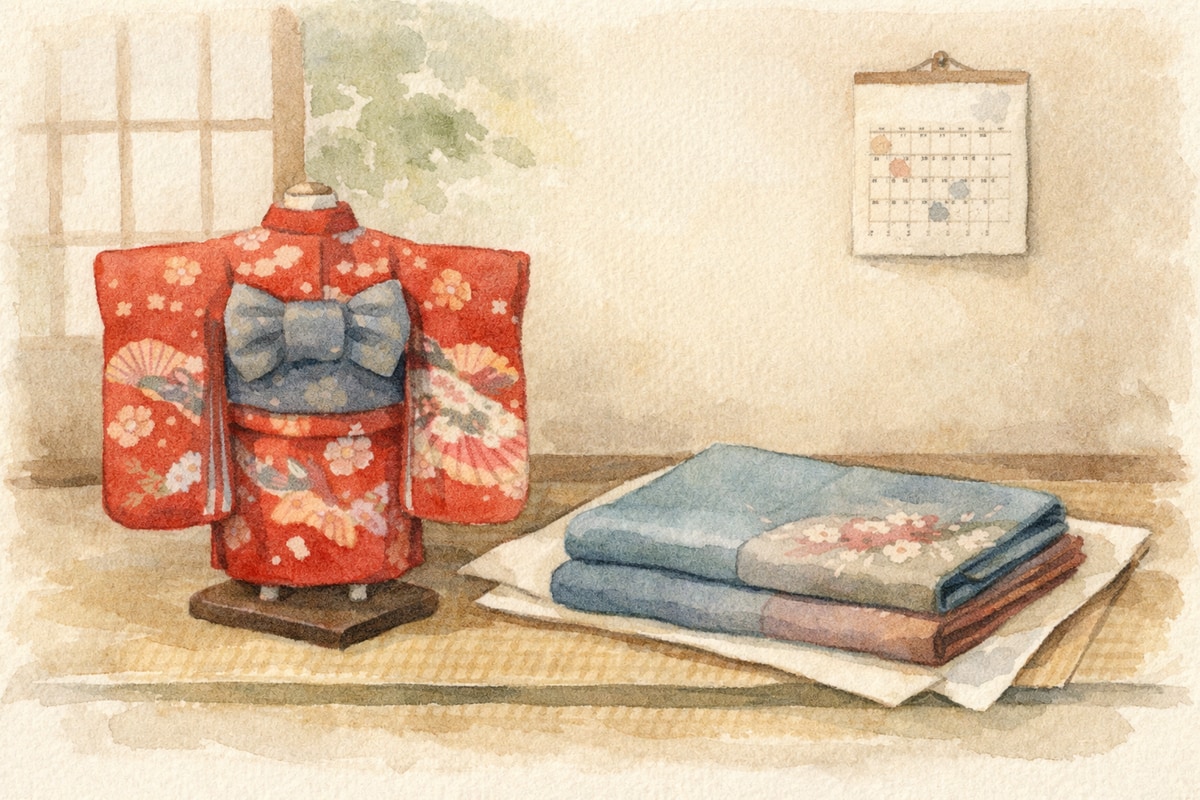
When you start preparing for Shichi-Go-San (a celebration for children aged 7, 5, and 3), the first question you run into is whether to rent or buy the kimono. And once you start thinking not just about the child’s kimono but also about what the mother standing beside them should wear, the worry doubles, even triples. Don’t worry, though. Once you sort out the key points to consider, the time you spend agonizing over it shrinks considerably. Let’s go through it step by step.
Let’s Start With the Conclusion
Let’s start with the conclusion: in most households, the child’s kimono is rented, while the mother’s kimono is either one she already owns, or rented if she doesn’t have a suitable one. This is because children grow quickly, making it hard to reuse the same kimono for years on end. On the other hand, a mother’s houmongi (a semi-formal kimono) or iromuji (solid-color kimono) can potentially be worn on other occasions beyond Shichi-Go-San, so whether to buy or rent really depends on your circumstances — it’s worth confirming with your family in advance.
Why Renting Suits Children’s Kimono (Ages 3, 5, and 7)
Shichi-Go-San is traditionally celebrated when boys turn 3 and 5, and girls turn 3 and 7. Whether to count age the traditional way (kazoedoshi, adding a year at birth) or by actual age has long favored the traditional method, but more families are now celebrating by actual age, and neither approach is more “correct” than the other. At age 3 by the traditional count (2 by actual age), dressing and photography sessions can be physically tiring for a small child, so it’s reassuring to decide based on how your child seems to be doing.
It’s said to be a good idea to factor in height, personality, siblings’ schedules, and events at preschool or school. While the 3-year-old’s hifu (a padded vest worn over kimono) is recommended to be worn at actual age 3, the 5-year-old’s hakama (pleated trousers) and the 7-year-old’s yotsumi (a child’s kimono cut for older children) are said to work whether counted by traditional age or actual age.
Some families have the ubugi (a baby’s first kimono from the shrine visit after birth) altered for reuse. Girls can wear an altered ubugi for the 3-year-old Shichi-Go-San, but it’s difficult to convert it to the yotsumi size needed at 7, so buying new or renting is recommended for age 7. Boys can often wear an altered kimono up through age 5, though larger-built children may outgrow it by the latter half of age 5, in which case some families consider holding the celebration at the traditional age of 4 instead. If you’re planning ahead for age 7, choosing a yotsumi-sized ubugi at the time of purchase makes later alterations easier. The harder it is to predict how a child’s build will change, the more renting tends to be the less stressful choice. For a detailed breakdown of the kimono and items needed at each age, please also see Shichi-Go-San Kimono and Preparation Checklists for Ages 3, 5, and 7.
Do More People Rent or Buy the Mother’s Kimono?
For the mother’s kimono, opinions are more divided, since there’s no growth-related constraint as there is with children. A houmongi or iromuji can potentially be worn again after Shichi-Go-San — for school entrance or graduation ceremonies, weddings, and other formal occasions. So one thing to consider is whether you’re likely to have future occasions to wear it. Many families make use of a kimono they already own if they have one; if not, or if none of their existing pieces suit the occasion, renting tends to be the more practical choice. Since the impression a kimono gives can change depending on the pattern or the presence of family crests, if you’re unsure, it may help to refer to What Should Mothers Wear for Shichi-Go-San? Choosing Between Houmongi, Iromuji, and Komon.
Comparing Typical Costs and Booking Timing
Getting a sense of costs and timing makes it much easier to plan ahead. Let’s sort out what things typically cost before looking at when you should start moving.
Typical Costs
- Renting a child’s kimono: roughly 10,000 to 30,000 yen
- Buying a child’s kimono: roughly 30,000 to 100,000 yen (at a specialist kimono shop (gofukuten), it can run into several hundred thousand yen)
- Having a salon handle dressing and hair styling: roughly 5,000–7,000 yen for a 3-year-old girl, 7,000–10,000 yen for a 7-year-old girl, and around 5,000 yen for boys at both 3 and 5
If you buy, the total cost depends not just on the kimono itself but also on extras like the nagajuban (an under-kimono), obi (the wide sash tied around a kimono), zori (flat kimono sandals), and whether shoulder- and waist-tuck alterations are included as a service. Considering the effort of gathering every accessory yourself, many families find that renting makes the total cost easier to grasp and feel like better value.
Typical Booking Timing
The conventional date for Shichi-Go-San is November 15, but more families are shifting to before or after that date to avoid crowds. One photo studio sets extra charges for particularly busy days from late October through early December, and even into specific dates in early January of the following year. Some shops accept maedori (a pre-ceremony photo shoot) bookings from April all the way through the end of January the following year, giving you plenty of room to plan ahead. Some kimono rental shops require you to visit in person to complete paperwork at least a week before your rental date, so it’s best to check well in advance rather than scrambling at the last minute.
When Siblings or a Second or Third Child Change the Decision
Whether an older child’s kimono can be passed down to a younger sibling is another factor to weigh. Since children’s kimono are tailored with age (shoulder-tuck) and koshiage (waist-tuck) that adjust the fit to the body, differences in build between siblings can usually be absorbed by re-sewing these tucks. The general rule of thumb is that both shoulder and waist tucks are always used at ages 3 and 5, while at age 7 only the shoulder tuck is used, with the waist tuck added only if needed. Even if siblings aren’t exactly the same build, adjusting the tucks often makes the same kimono wearable. That said, the mitsumi (a child’s kimono cut for age 3) and the yotsumi used at age 7 are different size categories, so using the very same kimono for both a 3-year-old and a 7-year-old isn’t really an option. If the children are the same gender and are being dressed for the same age milestone, there’s a good chance the same kimono can be used for a second or even third child. If you’re considering buying, it’s worth checking whether there’s a shop nearby that can handle re-altering the tucks.
In Summary
To sum up: because children grow so quickly, renting tends to be the more popular choice for their kimono, while for the mother’s kimono, the basic approach is to decide between using something you already own or renting, based on how likely you are to wear it again in the future. How far you can reuse an altered ubugi depends on the child’s age and gender, so if you’re unsure, it’s reassuring to check the kimono’s condition and size a few months ahead of time. Booking outside the busiest periods gives you more options, so at the very least, check the timing early. Having walked through all these steps and comparisons, though, what matters most on the day itself is simply seeing your child’s bright, happy face in the photos. Once the preparations are in place, all that’s left is to enjoy this special day to the fullest.