Have you ever paused over a bolt of houmongi (a semi-formal kimono) cloth, noticing a certification stamp that reads “Kyo Yuzen” or “Kaga Yuzen”? The flowers are all hand-painted, so why do the names differ by region? The more you look into it, the more you find a small story hiding beneath the surface.
A Quick Refresher on Yuzen Dyeing: Hand-Painted vs. Stencil-Dyed
When people hear “yuzen,” many picture tegaki yuzen, where each motif is painted by hand with a brush. But there is also kata yuzen, dyed using paper stencils, which allows for larger production runs and a wider range of prices and finishing styles. You can read more about the difference between hand-painted and stencil dyeing in What Is Yuzen? A Gentle Introduction to Hand-Painted and Stencil Dyeing. This article looks at how that hand-painted yuzen tradition developed differently from region to region. In Kyoto, Kanazawa, and Tokyo, yuzen grew three distinct faces.
The History and Elegant Designs of Kyo Yuzen
The father of yuzen dyeing is said to be Miyazaki Yuzensai, a fan painter active in Kyoto during the Jokyo and Genroku eras of the Edo period (roughly 1684–1704). He is credited with bringing together earlier dyeing techniques and establishing a new mode of expression that rendered paintings through dye. Kyo Yuzen and Kyo komon (a casual kimono with a small repeating pattern) were designated as traditional crafts in June 1976. One hallmark of Kyo Yuzen is its lavish use of gold leaf, shibori (tie-dyeing), and embroidery for added brilliance. Elegant, richly decorative designs, shaped by the influence of the imperial court and aristocratic culture, are still carried on today.
The Characteristics of Kaga Yuzen and the “Kaga Gosai” Palette
The history of Kaga Yuzen traces back roughly 500 years to “umezome,” a solid-color dyeing technique unique to the old Kaga domain. Patterns began to appear from around the mid-17th century. In 1712, Miyazaki Yuzensai himself is said to have taken shelter with the Kanazawa kimono merchant “Tarodaya” and passed on the technique for yuzen paste there, a development that is credited with helping Kaga Yuzen flourish. It was designated a traditional craft in 1975.
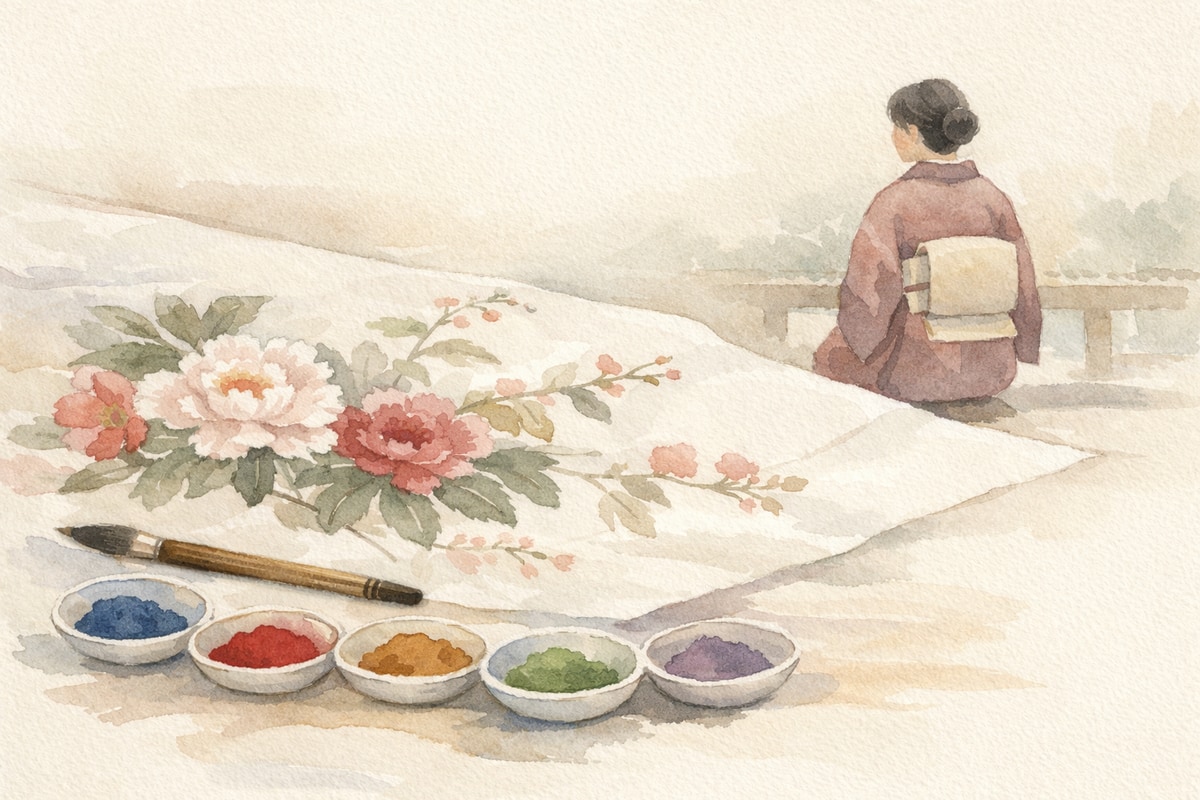
Kaga Yuzen is defined by its “Kaga gosai,” a palette of five colors: indigo, crimson, ochre, grass green, and ancient purple, used to create calm, realistic floral and plant motifs. A key point for telling it apart is its “outer shading,” applied in the opposite direction from Kyo Yuzen. Kyo Yuzen fades color from the center of a motif outward toward its outline, whereas Kaga Yuzen fades from the outline inward toward the center. Another realistic touch unique to Kaga Yuzen is its “mushikui,” tiny ink-colored dots that represent the marks left by insects nibbling on leaves. It’s a wonderfully clever idea, perhaps born from an impulse to capture nature’s passing moments directly within the pattern. Kaga Yuzen is also often noted for using little to no gold leaf, shibori, or embroidery, in contrast to Kyo Yuzen.
A Note on the Connection to Auspicious Motifs
Yuzen dyeing, with its many floral and natural motifs, is closely tied to auspicious monyou (a traditional motif) such as pine-bamboo-plum and crane-and-tortoise designs. Knowing the meaning behind a monyou adds another layer of enjoyment to choosing a kimono. For more, see A Dictionary of Auspicious Motifs: Cranes, Tortoiseshell, Seven Treasures, and Pine-Bamboo-Plum.
The Stylish Sensibility of Edo Yuzen (Tokyo Yuzen)
Edo Yuzen, known today as Tokyo tegaki yuzen, traces its origins back to 1603, when Tokugawa Ieyasu established the Edo shogunate. Dyers and painters employed by feudal lords relocated from Kyoto to Edo, and a district of dyers gradually took shape along the Kanda River. While yuzen dyeing itself originated with Miyazaki Yuzensai in Kyoto, it did not fully blossom in Edo until much later, during the Bunka and Bunsei eras (roughly 1804–1827). It was designated a traditional craft in 1980.
Against the elegance of Kyoto and the realism of Kaga, Edo Yuzen carries a certain stylish, understated flair. This seems to reflect a preference, shaped by samurai culture, for subdued colors and reserved patterns. Having traveled from Kyoto to Edo over a long span of time and taken on the character of its new home—that is the story of Edo Yuzen.
Tips for Telling the Three Great Yuzen Styles Apart
Line the three up together, and each one’s character starts to come into focus. As a first rule of thumb, gold leaf and embroidery point to Kyo Yuzen, while outer shading and mushikui suggest Kaga Yuzen. Since the direction of the shading can be hard to spot without a close look, it’s a good idea to check the certification stamp or artist’s seal as well for certainty.
There’s no fixed rule for choosing between them, but Kyo Yuzen’s decorative flair suits festive occasions, while Kaga Yuzen’s quiet, realistic florals appeal to those who enjoy a subtler beauty. When considering a houmongi or tsukesage, it helps to first check a quick-reference chart of overall kimono formality and types, which makes choosing a yuzen pattern much easier. You’ll find an overview in A Quick-Reference Guide to Kimono Types and Formality.
A Small Story Behind Today’s Kimono
When the breeze turns cool enough for an unlined kimono again, try taking a yuzen piece out of the drawer and studying the outlines of its painted flowers and leaves—you might just find a small clue as to whether it’s Kyoto, Kaga, or Edo. Behind a single certification stamp lie hundreds of years of layered craftsmanship. Knowing that alone might make the kimono you slip into feel just a little more dear.