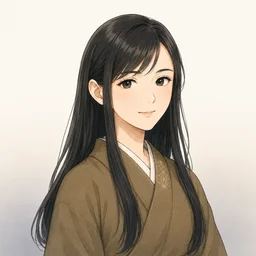
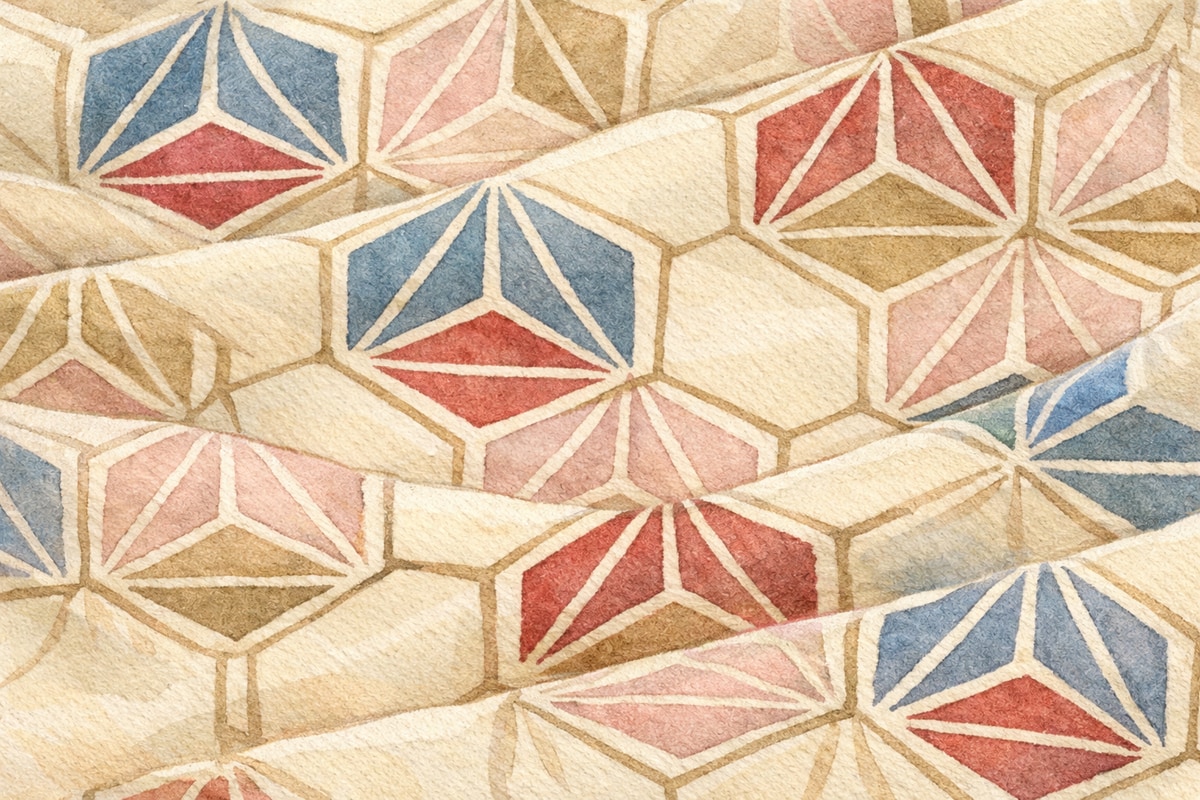
Walking past a photo studio around Shichi-Go-San (a celebration for children aged 7, 5, and 3) season, you’ll often spot children dressed in fabric printed with rows of hexagons in red or pale blue-green. This is the asa-no-ha (hemp leaf) monyou (a traditional motif) — and it raises a question: why has this pattern been chosen so often for children’s formal kimono? Unravel the story, and you find it involves both the way the hemp plant grows and a chapter of Edo-period stage history.
What Is the Asa-no-ha Pattern? The Hemp Leaf Hidden in a Hexagon
The asa-no-ha pattern is built from a regular hexagon divided into six triangles, and is also known as asagara. It came to be called this — resembling the leaf of the hemp plant — only in the early modern period, but the pattern itself is far older than its name. Examples appear as early as the Heian period, decorating Buddhist statues with kirikane (cut-gold-leaf) work, and by the Kamakura and Muromachi periods it was used as a background pattern on esoteric Buddhist images and mandalas. It’s known to have been used as a continuous hexagonal motif on the robes of a Buddhist statue at Daihoonji Temple in Kyoto (from around 1220) and on the Aizen Myoo statue at Saidaiji Temple in Nara (1247).
Long before it had its current name, this shape had already been living quietly within Japanese design — that is the asa-no-ha pattern.
Why It Has Been Chosen for Baby Kimono and Shichi-Go-San
Hemp is a remarkably vigorous plant, growing to as much as four meters in just four months with little effort needed to raise it. Because of this sturdy, fast-growing nature, the asa-no-ha pattern came to be used on ubugi (baby kimono). It has also been widely used on nagajuban (an under-kimono) and obi (the wide sash tied around a kimono). Because insects tend to avoid hemp, the pattern is also said to carry wishes for healthy growth, and some point out that, being a geometric design, it was also thought to ward off evil. There is even a belief that the asa-no-ha pattern itself holds the power to dispel evil spirits — meaning that wishes for a child’s growth and prayers for protection from misfortune have long been layered into this single motif.
The fact that the asa-no-ha pattern is still widely used today on baby kimono, children’s kimono, and first-festival attire shows that this wish is still very much alive. The way a kimono is tailored — with tucks taken at the shoulders and waist — differs depending on the child’s age for Shichi-Go-San; that preparation process is laid out in Kimono and Preparation Checklists for Shichi-Go-San at Ages 3, 5, and 7.
The Edo-Era Stage Trend Known as “Osome-gata”
What actually sparked the pattern’s leap into wide popularity was, in fact, the stage. The costume for the kabuki play “Yaoya Oshichi” featured an asa-no-ha pattern in scarlet and pale blue-green kanoko shibori (tie-dye). In 1809, when Iwai Hanshiro V played the role of Oshichi, he wore an asa-no-ha pattern in kanoko shibori on a pale blue-green ground; it became known as “Hanshiro’s kanoko” and started a trend among the women of Edo.
During the Bunsei era (1818–1830), the Osaka actor Arashi Rikan adopted the same pattern for the role of Osome in “Imose Kadomatsu,” and it became known as “Osome-gata,” gaining popularity in Kyoto and Osaka as well. Edo-period theatergoers had a custom of wearing kimono patterned after those of their favorite actors. The idea of a stage costume becoming a popular pattern in its own right — rather like today’s fan merchandise — turns out to be part of the stylish, playful spirit of Edo kimono culture too.
Asa-no-ha on Yukata and Summer Kimono
From there, the asa-no-ha pattern naturally found its way into summer dress as well. On today’s yukata (a light cotton summer kimono), you’ll find the traditional continuous hexagonal pattern arranged in neat rows, as well as bold, enlarged versions of the motif, and designs that combine it with flowers or flowing-water patterns. For more on choosing summer patterns in general, see Goldfish, Morning Glories, and Seigaiha: Unraveling the Cool Stories Behind Summer Kimono Patterns.
Variations in Color and Design
Both the number of colors and the scale of the design vary widely, ranging from traditional Edo-period color combinations like scarlet and pale blue-green to softer, more contemporary palettes. The pattern’s geometric, rhythmic structure has also made its way beyond wasou (traditional Japanese dress) into bags, interior items, and other Western-style goods as a “wa-modern” design. It’s likely thanks to this versatility that the pattern feels familiar even to people who know little about kimono.
Pairing Asa-no-ha with Other Auspicious Motifs
The asa-no-ha pattern carries meaning on its own, but it is also frequently combined with other auspicious motifs such as shippo (seven-treasures) or kikko (tortoise-shell hexagons). Learning what each motif represents reveals the layered wishes woven into a single kimono. Details can be found in A Dictionary of Auspicious Motifs: Crane, Kikko, Shippo, and Shochikubai.
Whether it’s the season when you start longing for the breeze through a single-layer kimono, or the season for choosing formal wear for Shichi-Go-San — in this pattern of hexagons growing steadily side by side, wishes for a child’s growth are quietly woven in. The more you learn about it, the more it may catch your eye. May today’s kimono carry a small story of its own.