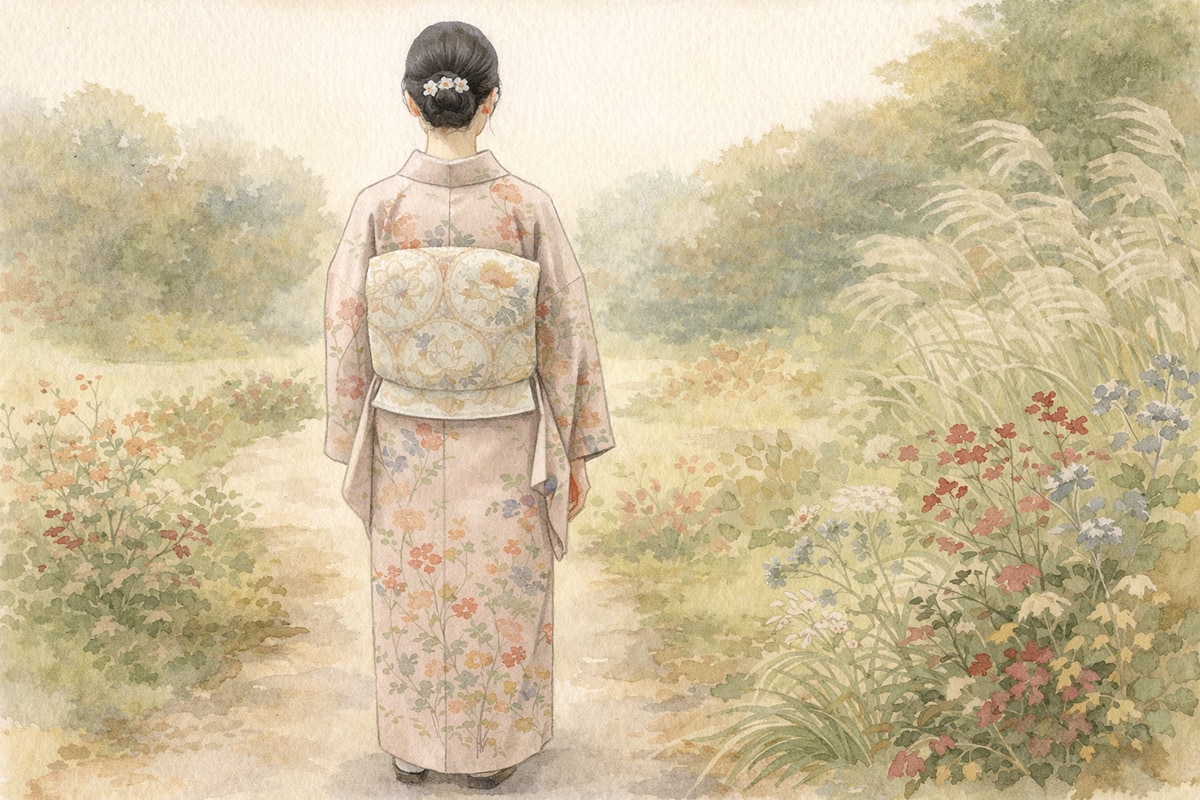
In shops during the lingering late-summer heat, you might come across a kimono where bush clover and Chinese bellflowers sway coolly across the fabric. Even while the cicadas are still singing, why an autumn pattern? Have you ever paused on that small question? Unravel it, and you find something quietly woven in—the way Japanese people have long gazed upon the seasons.
What Is Akikusa Monyou? Its Origins and Development
Akikusa monyou (“autumn grasses” motifs) refers to a design that gathers the seven autumn grasses—kikyo (Chinese bellflower), hagi (bush clover), ominaeshi (maiden flower), nadeshiko (wild pink), kuzu (arrowroot), susuki (pampas grass), and fujibakama (boneset)—together with other autumn wildflowers like chrysanthemum and gentian, rendered as a traditional motif (monyou). Interestingly, even a design showing just a single type of flower is sometimes still called akikusa monyou. Rather than picturing one particular bloom, it helps to think of akikusa monyou as a portrait of the autumn field itself—once you see it that way, the kimono patterns start to look a little different.
The Seven Autumn Grasses, and the Chrysanthemum and Gentian That Join Them
Among the seven autumn grasses, nadeshiko is a classic, refreshingly cool motif often seen on summer kimono. Beyond the native Japanese variety known as Yamato nadeshiko, there is also kara nadeshiko (a fringed pink), which arrived from China during the Heian period—and in fact, the nadeshiko commonly seen on kimono and yukata is often this Chinese variety. The name “nadeshiko” is said to come from the image of a small, adorable child one would want to stroke (naderu). Its neat, delicate presence has long been cherished as a symbol of Japanese womanhood.
The chrysanthemum that so often accompanies it is no ordinary autumn flower, either. It was brought from China during the Nara period as a medicinal herb, believed to ward off evil and bring long life. It is also said—though accounts vary—that because Retired Emperor Go-Toba favored it, the flower became the crest of the Imperial family. On September 9th, the Chrysanthemum Festival (Choyo no Sekku) is still observed as a day to celebrate the flower. So within akikusa monyou, the chrysanthemum carries not only the color of the season but also the weight of good fortune.
Since When Has It Been Worn?
One clue to when akikusa monyou began appearing in dress is a maki-e lacquerware piece decorated with an autumn-grasses design, dating to the Momoyama period, preserved at Kodai-ji Temple in Kyoto. It’s believed that from this period onward, the seven autumn grasses came to be used as a kimono motif. The design is thought to express the fleeting, impermanent nature of passing time—perhaps the people of the Momoyama era, too, found beauty in these wildflowers that bloom briefly and scatter just as quickly. Keeping the Momoyama period onward in mind as a rough benchmark helps the motif’s background come into clearer focus.
Wearing a Season Ahead of Time
It’s considered standard practice to wear kimono patterns slightly ahead of the actual season. Akikusa monyou follows the same rule: it has long been worn during the harshest late-summer heat, bringing a hint of coolness by anticipating autumn before it arrives. The reason akikusa monyou appears so often on summer kimono, obi, and yukata while the heat still lingers is precisely this aesthetic of getting ahead of the season. Wearing a touch of autumn just a little early, right at the threshold between summer and fall—that’s what makes akikusa monyou so stylish.
When people think of autumn motifs, maple leaves and grapevines often come to mind as well, but those are considered better suited to the height of the season, from October into November—their timing overlaps only partly with akikusa monyou. The chrysanthemum, meanwhile, is also an auspicious motif carrying meanings of eternal youth and long life, which gives it the versatility to appear even in winter celebrations. Even among motifs grouped together as “autumn patterns,” each has its own range of fitting seasons—the more you learn, the more fascinating it becomes. For a broader look at how seasonal motifs are thought about, you might also enjoy When Should You Wear Cherry Blossom Motifs? Seasonal Pattern Thinking and Various Theories.
Chrysanthemum Isn’t Just Part of Akikusa Monyou
As we’ve seen, the chrysanthemum is a member of akikusa monyou, yet it also stands on its own year-round as an auspicious motif in its own right. Paired with bush clover and Chinese bellflower, it tells the story of an autumn field; depicted alone, it speaks of a wish for eternal youth and long life. There’s something quite subtle and refined in how a single flower can tell a different story depending on its context. If you’re curious about auspicious motifs more broadly, A Dictionary of Auspicious Motifs: Crane, Tortoiseshell, Shippo, and Pine-Bamboo-Plum is worth reading alongside this, to see the chrysanthemum’s place within that larger picture more clearly.
A Small Story for Your Autumn Dress
Akikusa monyou is, in a sense, a portrait of the autumn field itself—the seven autumn grasses of hagi, nadeshiko, and kikyo, joined by chrysanthemum and gentian. Believed to have taken root from the Momoyama period onward, wearing it a season early, in the lingering late-summer heat, is a way of dressing that has been passed down for generations. When you start to long for the breeze through a single-layer kimono, try choosing a cluster of autumn grasses for your sleeve—it may be just enough to make a still-warm day feel wrapped in a slightly cooler story. Let today’s outfit carry a small story of its own.