
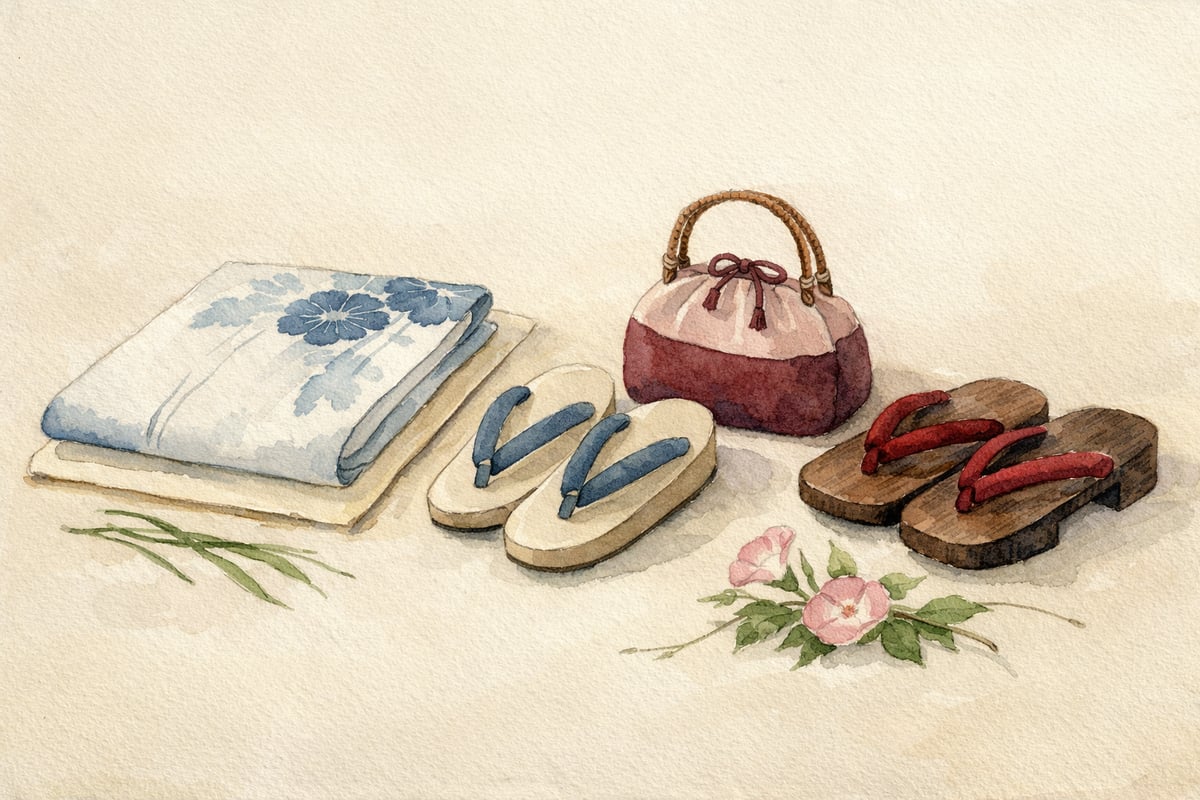
Getting ready to wear your yukata (a light cotton summer kimono), have you ever paused in front of the shoe cabinet, wondering, “Wait, should this be geta, or would zori be better?” Actually, even though these two look similar, their roles are quite different. Today, let’s pull everything together so you can decide at a glance whenever you’re unsure.
Geta vs. Zori: What’s the Basic Difference?
Geta (wooden sandals) and zori (flat kimono sandals) both have hanao (the thongs) — the cords that go over the top of the foot — in common. But their materials and shapes are clearly different. Geta are made mainly of wood, with two raised “teeth” on the sole. That clip-clop sound you hear comes from those teeth. Zori, on the other hand, are made from leather, rush grass, cork, and similar materials, with a flat sole. This structural difference directly shapes which occasions each is worn for.
Thinking in Terms of Formality Makes Choosing Much Easier
There’s no strict rule, but the general convention is geta for everyday wear and zori for formal occasions. Zori tend to give a more refined impression and are often worn at weddings, seijin-shiki (the Coming-of-Age ceremony), parties, and other formal settings. Here’s a little insider tip: the biggest clue when you’re unsure is the height of the sole. With zori, a higher sole is considered more formal — as a rough guide, about 6cm for formal wear and about 3cm for casual wear, so the visual difference is quite noticeable. White enamel zori soles are considered especially formal among all the colors, so keep that in mind when pairing zori with tomesode or houmongi (a semi-formal kimono).
Geta Actually Come in Many Styles
When you think of geta, you might picture a simple pair meant for yukata, but there’s actually quite a variety. There’s ukon geta with rubber soles that are easy to walk in, funagata geta shaped somewhat like zori and dressy enough for more formal use, rounded komachi (atomaru) geta, traditional koma geta and senryo geta, tall taka geta, and the pokkuri style familiar from Shichi-Go-San (a celebration for children aged 7, 5, and 3) — with several types distinguished by the shape of the sole. The fact that geta are chosen according to purpose is itself proof of how deeply they’ve been woven into everyday life as casual footwear.
Comparing Coolness, Sound, and Ease of Walking
The great appeal of geta is, above all, the breathability that comes from having teeth. Worn barefoot in summer, they feel wonderfully cool. Geta made of paulownia wood are especially effective in this way — the wood absorbs and releases moisture depending on humidity, and because it doesn’t conduct heat easily, your feet stay warmer in winter, too. Paulownia from the Tohoku region, such as Aizu paulownia from Fukushima Prefecture, tends to have fine, light grain and is often used for high-quality geta. That said, because of the teeth, the sound can echo loudly on paved roads, and some people find geta hard to walk in until they get used to them. Zori, with their flat soles, are often said to offer more stable footing than geta.
Which Suits Yukata Best? Thinking About Formality
Since yukata are among the more casual kinds of kimono, geta are generally the more fitting match. With their distinctive clip-clop sound, geta have long been chosen as a way to enjoy the atmosphere of summer. That said, depending on the occasion, some people do pair yukata with zori — for a slightly more formal dinner, for example, or a day of sightseeing that involves a lot of walking. It’s less about which is “correct” and more about picturing the occasion and how much walking you’ll be doing that day. If you’re also unsure about which obi (the wide sash tied around a kimono) to choose for your yukata, it’s worth reading this article as well: “Hanhaba Obi or Heko Obi for Yukata? Comparing Ease of Tying and Look” — it will make putting together your whole outfit much easier.
Which Is Better for Long Walks or Rainy Days?
If you’re planning to walk around a sightseeing spot all day, many people find flat-soled zori less tiring than geta with their teeth. On the other hand, because geta have a distinctively higher center of gravity, they’re also easy to slip on for short trips or a quick outing.
One thing that’s easy to overlook is rainy-day preparation. Zori are, by their structure, not well suited to rain, so if you want to wear your usual zori anyway, one option is to attach a zori cover, either with or without teeth. The toothed type is less slippery and also helps prevent mud from splashing onto your kimono. Geta, meanwhile, have a dedicated rain version called ame-geta, with thin teeth made of magnolia or oak wood, and a higher build so as to reduce splashing. That said, because the tooth material is hard, some people find these harder to walk in on today’s paved roads; lacquered geta repel moisture on their own, so attaching a tsumakawa cover to your regular geta lets you use them in both sun and rain. For more on preparing for rain in kimono in general, see “Rainy-Day Kimono Prep: Rain Coats, Tabi Covers, and Zori Covers” — it’s worth bookmarking for peace of mind.
A Quick Checklist for When You’re Unsure
Let’s organize everything above from a practical, decision-making point of view. Once you know what to compare, you’ll spend a lot less time standing in front of the shoe cabinet.
- Formality of the outfit — geta for yukata or everyday wear, zori for more formal kimono
- Time spent walking — flat-soled zori are often easier on the feet for long walks
- Weather — if rain is forecast, use a zori cover, or attach a tsumakawa cover to lacquered geta
- Seasonal feel — choose geta if you want to enjoy the coolness and sound of summer
Just comparing these four points will usually settle what to wear on any given day. Don’t worry — just remember these two things: “formality” and “weather”, and the rest becomes easy. From there, simply fine-tune according to the season and how far you’ll be walking.
Geta and zori both trace back to the same family of footwear with hanao. Knowing how they branched off from there makes choosing between them feel much less confusing. The next time you’re planning an outing, try picturing the formality of your outfit and how much walking you’ll be doing. That alone should make it clear which one — geta or zori — gets to make its appearance that day.