
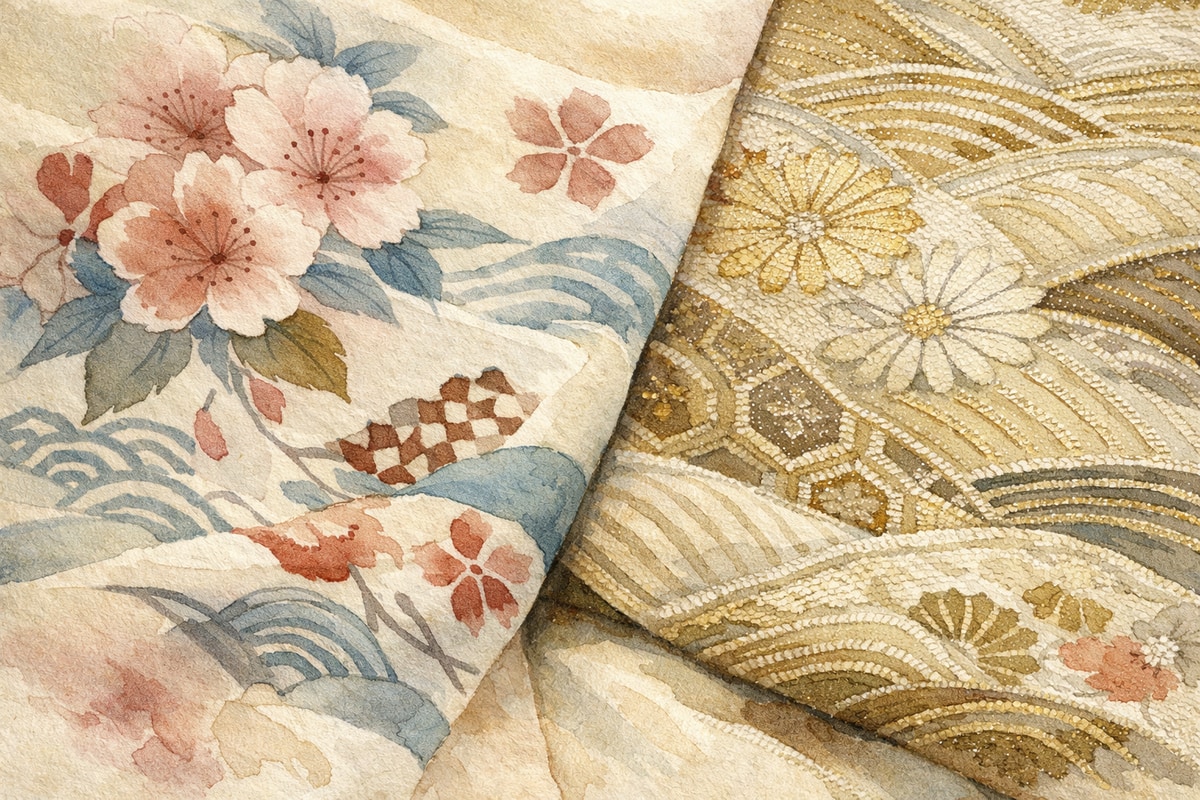
Both are born in Kyoto, so why is kimono fabric usually dyed while obi fabric is usually woven? Standing in a specialist kimono shop (gofukuten) looking at bolts of tanmono (a bolt of kimono cloth), this question sometimes pops into mind. To give away the answer up front: Kyo Yuzen and Nishijin-ori are made in completely different ways from the start — and that difference is directly connected to the different roles kimono and obi (the wide sash tied around a kimono) play.
In a nutshell: Kyo Yuzen is “dyeing,” Nishijin-ori is “weaving”
Kyo Yuzen is a technique for dyeing patterns onto plain white cloth. Paste is used to block off areas as color is added bit by bit, so it helps to picture a blank piece of fabric gradually turning into a painting. Nishijin-ori, on the other hand, starts by dyeing the thread first, then weaves that thread into patterns. Whether you dye the cloth and then paint on a pattern, or weave a pattern using already-dyed thread — this difference in order is the single biggest thing that separates Kyo Yuzen from Nishijin-ori.
What is Kyo Yuzen? A Kyoto dyeing technique that paints patterns onto white cloth
Kyo Yuzen refers specifically to Yuzen dyeing produced in Kyoto. It has two main streams: tegaki Yuzen, in which each pattern is hand-painted piece by piece, and kata Yuzen (also called Kyo komon), which uses paper stencils. Kata Yuzen has evolved toward a distinctive, delicate beauty achieved by layering many stencils in the dyeing process. The work is done by division of labor, passing through many artisans’ hands — sketching the design, applying paste, adding color, covering with paste again, and dip-dyeing — before a single bolt of kimono cloth is complete. Incidentally, Kyo Yuzen, Kaga Yuzen, and Tokyo Yuzen are known together as the three great Yuzen traditions of Japan, each technique named after its production region (you can compare the differences among the three in this article). Kyo Yuzen was designated a Traditional Craft by Japan’s Ministry of Economy, Trade and Industry in 1976.
What is Nishijin-ori? A Kyoto weaving tradition that weaves patterns from pre-dyed thread
Nishijin-ori is the general term for patterned textiles woven from pre-dyed thread, produced in the Nishijin district in the northwest of Kyoto city. “Pre-dyed” means the thread is dyed before it is woven. Rather than adding color to already-woven cloth as in Yuzen, Nishijin-ori builds its patterns by intricately combining colored threads, which is why it is considered a labor-intensive, high-end silk textile. It, too, goes through numerous stages — planning and design, thread dyeing, warping, and setting up the heddles (sokou, the loom parts that the warp threads pass through) — before it’s finished. Nishijin-ori was also designated a Traditional Craft in 1976, and remarkably, it includes as many as 12 nationally designated categories, such as tsumekaki hon-tsuzure-ori, tatenishiki, donsu, shuchin, and shouha. It may bring to mind obi first, but Nishijin-ori is in fact also woven into omeshi, tsumugi (a textured, hand-woven silk), and kasuri-patterned kimono cloth (kijaku, bolts of fabric for kimono) — the fact that it’s used not just for obi but as kimono fabric too is a surprising discovery the more you learn about it.
How to tell them apart: how the pattern appears, and the character of the thread
Kyo Yuzen produces patterns that look as if they were painted directly onto the cloth. Look for gradations of color and the soft bleeding effect of a brush stroke. Nishijin-ori, by contrast, gets its color from the thread itself, so the pattern can appear to shift in expression depending on how the light hits it. The texture also differs: dyed fabric tends to feel smooth and flat, while woven fabric can feel slightly textured because of the gold and silver threads woven in. Comparing them by touch makes the difference very clear. The distinction between hand-painted and stencil-dyed Yuzen is explored in more detail in this article.
How to pair them: the classic combination of a Kyo Yuzen kimono with a Nishijin-ori obi
In the world of kimono, there’s a saying: “a woven obi for a dyed kimono, a dyed obi for a woven kimono.” The idea is to pair dyed kimono such as komon (a casual kimono with a small repeating pattern), tsukesage, or houmongi (a semi-formal kimono) with woven obi like Nishijin-ori or Saga nishiki, which incorporate gold and silver thread. For obi, the ranking of formality runs opposite to that of kimono — woven obi are considered more formal than dyed ones — so the standard practice is to pair formal dyed kimono, such as black tomesode or furisode (a long-sleeved formal kimono), with a woven maru obi or fukuro obi. Pairing a woven obi with a dyed kimono makes the kimono’s pattern stand out crisply, which is likely another reason this combination has become the classic choice. It’s a wonderfully stylish division of labor.
In closing: even within the same Kyoto, dyeing and weaving are entirely different crafts
Kyo Yuzen is the work of painting patterns onto white cloth; Nishijin-ori is the work of weaving patterns from dyed thread. Even though both techniques grew up in the same city of Kyoto, the paths they’ve followed are completely different. It’s no coincidence that kimono are so often dyed and obi so often woven — the pairing grew naturally out of the different roles each technique is suited to. Like a walk through Kyoto in fresh greenery, every bolt of cloth and every obi carries within it a small story of its own. May today’s outfit carry a small story too.