
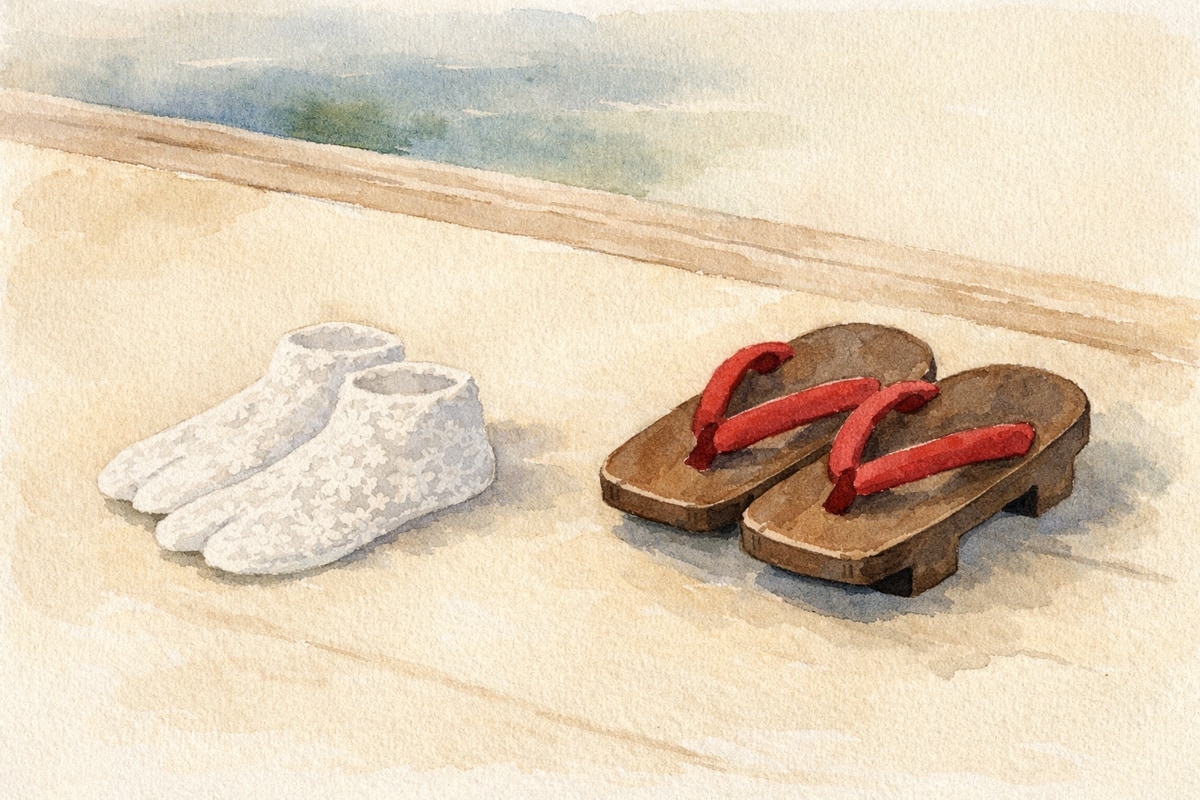
Have you ever gotten ready to head out to a fireworks display in your yukata (a light cotton summer kimono), only to pause when it came to your feet? You’ve heard that “yukata means bare feet with geta (wooden sandals),” but the air conditioning might make your feet cold, and you’re worried about blisters from the geta. Would tabi (split-toe socks) look strange? Many people find themselves torn over this. The short answer is: pairing tabi with a yukata is not a mistake. That said, which combination suits you best depends on the look you’re going for, so let’s work through it step by step.
Why Bare Feet and Geta Are Considered the Basic Yukata Look
The yukata is said to have originated from the yukatabira (a hemp bathing robe) worn by aristocrats during bathing in the Heian period, and by the Azuchi-Momoyama period it had spread as a cotton robe worn after bathing or as sleepwear. Once public bathhouses became widespread in the Edo period, more people began wearing their after-bath yukata straight out into the street, which is thought to be how it evolved into outdoor wear. The Tenpo Reforms, which banned the wearing of silk, also helped cotton yukata take root among ordinary people.
The story of footwear ties into this same history. Zori (flat kimono sandals) were once a luxury item, and it was only in the late Edo period that geta spread as footwear ordinary people could wear casually. Because geta became common among the general population somewhat later than the yukata itself, the pairing of bare feet with geta in summer naturally took hold without tabi. In other words, “bare feet with geta” isn’t so much a rule of formal etiquette as something that simply developed out of everyday life among commoners. The fact that the yukata was originally something worn casually, much like a robe for lounging around, is also part of why bare feet came to be seen as perfectly acceptable.
Occasions Where Tabi Are Fine
As long as you’re not in a setting that calls for the formal etiquette of wasou (traditional Japanese dress), such as a wedding or funeral, there’s nothing wrong with pairing tabi or socks with a yukata. One kimono magazine even quotes a stylist’s view that “wearing tabi with yukata isn’t common, but it isn’t a mistake.” Apparently it’s not unusual to see people who practice Japanese classical dance, or older individuals accustomed to kimono, wearing tabi even at fireworks displays or summer festivals.
Tabi are especially worth considering when you want to style your yukata more like a summer kimono. There’s a common teaching that adding a han-eri (a half-collar) and tabi allows a yukata to be worn as a summer kimono, and depending on the fabric and grade of the yukata, dressing it up this way with tabi is considered a perfectly valid choice. If you’d like to wear a yukata to something slightly more formal, like a theater outing or a dinner, this styling approach can be a reassuring option. That said, dressing up a simple yukata of the kind found at inns in this more formal style isn’t really what it’s meant for. And of course, when the air conditioning makes your feet cold, or when you’re worried about blisters from the hanao (the thongs) on your geta, tabi can offer some peace of mind.
How to Choose a Combination That Suits You
Once you’ve decided to wear tabi, the next question is material and color. Ordinary cotton tabi tend to look heavy against a summer yukata, no matter what. If you want to keep that sense of coolness, choosing lace tabi will give the look a lighter, airier feel. These come in a few color combinations, such as white on white, black on black, white on black, and black on white, and broadly fall into two types: one with an elastic opening you slip on like socks, and another with a traditional clasp (kohaze) and a cotton-jersey lining layered underneath so the skin doesn’t show through as easily. There are also stretch tabi made with flower lace, sock-style without the clasp, marketed as fashion tabi suited to yukata, hitoe (an unlined kimono worn in warmer months), and summer kimono.
The choice of footwear also shifts depending on the look you’re going for. If you want to enjoy the classic, bare-foot-feeling yukata style, pairing an asa (linen/hemp) hanhaba obi (a narrow half-width sash) with geta is the standard choice. On the other hand, if you’re styling it more like a summer kimono, examples include pairing white asa tabi with zori made of summer materials such as panama, asa, shina cloth, or ro-tsuzure (a loosely woven ro). Thinking of it as “do I want this to read as yukata, or as summer kimono” makes the choice of footwear much easier. If you’re curious about the difference between geta and zori themselves, it’s worth reading What’s the Difference Between Geta and Zori? A Gentle Guide to Choosing for Yukata and Kimono as well.
Combinations to Avoid
One thing to watch out for is pairing a sheer, lightweight yukata with sturdy white tabi that have a clasp. If you pair a yukata tailored to be worn barefoot with thick tabi, the result tends to look heavy rather than cool. If you want to dress it up as a summer kimono, it’s safer to choose a double-layered tabi that doesn’t show skin through as easily.
Choosing the geta themselves also calls for some care. Pairing geta with tight hanao and thick tabi puts extra pressure on your toes, which can cause blisters. If you’re planning to wear tabi with geta, it’s best to choose geta with hanao that have a little more give, or to pair them with thinner tabi such as lace tabi.
In Summary
Bare feet with geta isn’t an absolute rule for yukata footwear — it’s simply a combination that took hold through everyday life in the Edo period. What matters most is deciding in advance how you want to style your yukata that day. For a relaxed day at a fireworks display or summer festival, bare feet with geta suit best; for a more dressed-up look at the theater or a dinner styled like a summer kimono, lace tabi or white tabi with zori are the way to go. Keeping these two directions in mind should make choosing your footwear much less confusing. If you’re unsure about tabi sizing or material, you might also find Tabi Sizing and Selection: A Gentle Guide to Materials, Colors, and Tabi Covers helpful.