
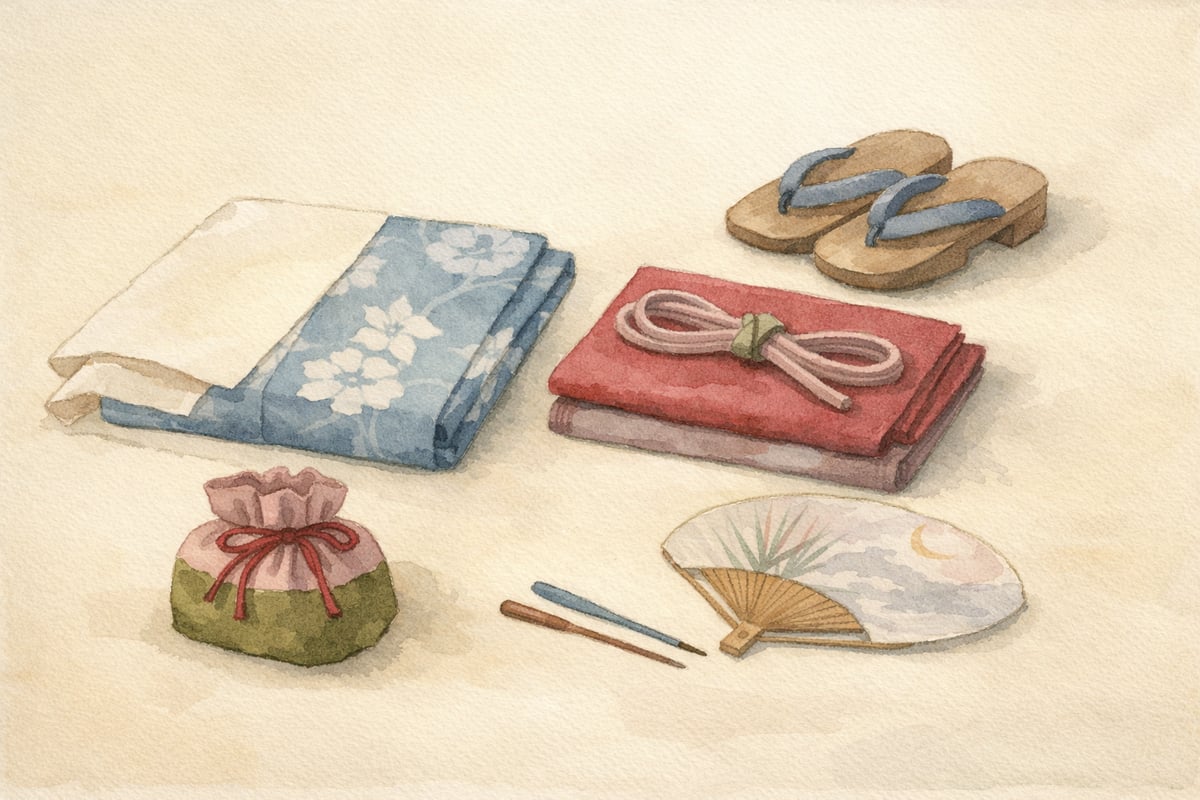
Have you ever stood in front of the obi section at a yukata shop and paused, thinking, “Wait, should I get a hanhaba obi or a heko obi?” They can look similar at a glance, yet the prices and tying instructions differ, which makes choosing surprisingly tricky. Actually, once you understand the difference in material and width, the choice becomes much clearer. Today, let’s sort out how to tell them apart, together with Iroha.
Hanhaba Obi and Heko Obi: Starting with the Basics
Obi worn with a yukata (a light cotton summer kimono) generally fall into two types: the hanhaba obi (a narrow half-width sash) and the heko obi. The hanhaba obi is made from a firmer material and finishes at about 15cm wide. It’s narrower than a fukuro obi or Nagoya obi, and can be tied with a casual, everyday feel — obi manufacturers’ descriptions give dimensions of roughly 16.5cm in width and about 400cm in length. There are two types: hitoe obi (a thin, single-layer version) and kobukuro obi (a pouch-style version), and materials range from pure silk (shoken) to polyester, cotton, and asa (linen/hemp).
The heko obi, on the other hand, is defined above all by being made from a single soft piece of fabric. Because it has no obi-shin — the stiffening material placed inside an obi to help it hold its shape — it’s thinner and more flexible, giving it a completely different texture from the firmer, thicker fabric of a hanhaba obi or Nagoya obi. The fabric may be synthetic (polyester), cotton, or habutae (silk), but synthetic fiber is the most commonly used.
Comparing Ease of Tying and Resistance to Coming Loose
“I finally put on my yukata, and the obi came loose right away” — this is a common frustration, and honestly, it might be the biggest point of hesitation when choosing. Because the hanhaba obi is already the right width to use as-is, there’s no need to fold it first, and it holds its shape well not only in classic styles like the bunko musubi (bow knot) and ribbon knot, but also in more kimono-like knots such as the kai-no-kuchi (shell-mouth knot) and tsuno-dashi (horn-shaped knot). Thanks to this range of arrangements, it can be styled anywhere from casual to slightly more formal, depending on the knot.
The heko obi, by contrast, is described as soft and easy to tie, making it approachable even for beginners — one reason for its popularity. However, the very softness that gives it such flexibility also means the shape is harder to hold firmly. While it can be freely arranged into a fluffy ribbon knot or even flower-like shapes, if you want a neat, crisp finish, the hanhaba obi is likely the better choice.
Tendencies by Age and Body Type
The bunko musubi is often described as looking cute when tied by younger people and more composed and elegant when tied by older people — it’s presented as a knot that suits any age. The same goes for the ribbon knot with a heko obi: younger generations tend to favor a fuller, more voluminous style, while many others prefer a simpler, more adult arrangement. That said, this is only a general tendency, not a fixed rule — it’s said that you can choose freely according to your own taste and to match your kimono or yukata. There’s no need to feel locked into one choice based on age or body type.
Choosing by Occasion
With that in mind, some general guidelines by occasion start to emerge. If you’ll be moving around a lot, as at a natsumatsuri (a summer festival) or Bon Odori (a communal summer dance honoring ancestors), the hanhaba obi holds its shape well and offers peace of mind. It may also help to read this article about Bon Odori and yukata styling to get a clearer picture of what to expect on the day. On days like a fireworks display, when you’ll spend a lot of time sitting comfortably, the soft, fluffy knot of a heko obi won’t constrain your body and will let you relax. For a meal out or an outing with friends, when you want a slightly more polished look, tying a hanhaba obi in a kai-no-kuchi style gives a composed, put-together impression.
Tips for Choosing Your First Obi
Don’t worry — there are only two things to keep in mind. One is whether you want to tie it firmly yourself and keep a defined shape; the other is whether you’d rather prioritize ease of tying and a soft, relaxed look. Thinking along these two lines naturally points you toward whether to start with a hanhaba obi or a heko obi. For those tying a yukata obi for the first time, the hanhaba obi is often recommended because it’s ready to use as-is and easy to handle, but if you’re not put off by soft materials, starting with a heko obi is perfectly fine too. If you’d also like to think about accessories to go with your yukata, take a look at this article on choosing accessories for summer kimono and yukata.
In Summary
The hanhaba obi, made of firmer material, offers a wide range of arrangements and suits those who want to keep a defined shape. The heko obi, a soft single piece of fabric, is easy to tie and suits those who want to enjoy a soft, relaxed look. Rather than choosing based on price or appearance alone, weighing the nature of the material against how you’ll actually spend the day should make the decision feel much lighter. Iroha’s recommendation is to actually try tying each one yourself first, and find the one that feels most natural in your hands. Keep this in mind, and it should give you peace of mind the next time you choose a yukata, too.