
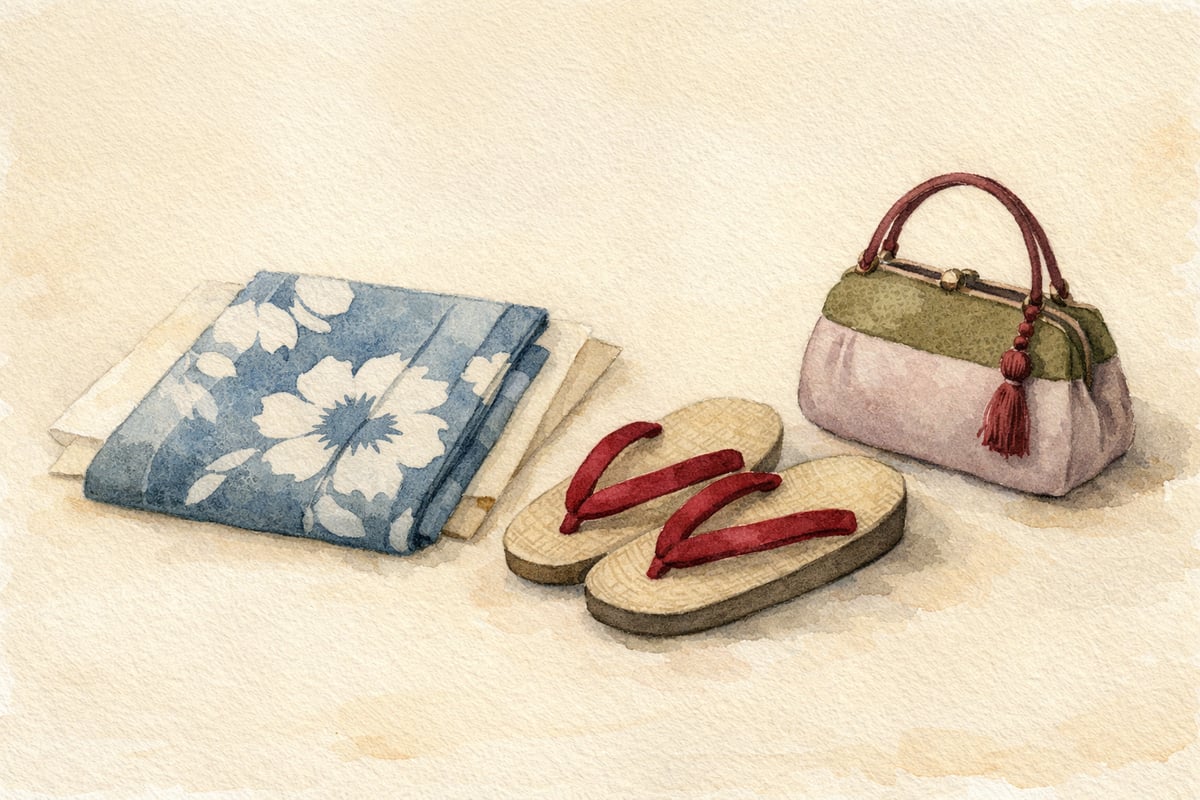
Have you ever stepped outside in your yukata (a light cotton summer kimono), only to feel the blazing sun and think, “Oh no, I forgot my parasol”? Iroha nearly cried over exactly this at last year’s summer festival. The truth is, parasols, sensu (folding fans), and basket bags are often chosen almost by accident, but their material and formality level actually make a big difference to both their effectiveness and how they look. Today, let’s pull together the trickiest points about summer kimono accessories into one neat guide.
The short answer: choose a parasol by material, a sensu by formality, and a basket bag by season
Before getting into the details, let’s start with what matters most. A parasol’s UV-blocking power comes down to the material itself, a sensu should match the formality of your kimono, and a basket bag has a general seasonal window worth knowing. If you keep just these three points in mind, you’ll spend far less time agonizing in the shop. Let’s go through them one by one.
Parasols: the material makes a bigger difference than you’d think
When choosing a parasol, many people just check whether it has a “UV-blocking finish” — but that’s not the whole story. Among the materials themselves, polyester offers the highest UV-blocking effect, while nylon, cotton, and silk let more ultraviolet rays through and therefore need a UV-blocking finish. It’s a fun bit of trivia that even clear vinyl umbrellas offer some degree of UV protection.
Polyester is durable and water-resistant, while cotton and asa (linen/hemp) are more breathable. Since it’s easy to work up a sweat in kimono, Iroha recommends choosing based on whether you’d rather prioritize coolness or UV protection.
Here’s one thing worth remembering: parasols with a UV-blocking finish gradually lose their effectiveness as the coating wears off over time. There are two types of parasols: those made from UV-blocking material itself, and those with a UV-blocking finish sprayed on afterward — and the finished type is said to lose effectiveness over the years. If you’ve been using the same parasol for several years, it might be time for a new one.
Sensu and suehiro: matching formality is honestly the trickiest part
A sensu adds a lovely cool touch to yukata and summer kimono, but which one to choose actually depends on the formality of your kimono. Honestly, this is the point people struggle with the most.
Let’s look at the “suehiro” — a formal fan used for celebratory occasions. For tomesode, the most formal attire for married women, it’s common to pair it with a suehiro featuring gold or silver paper, and a black-lacquered frame is considered the most formal choice. Meanwhile, everyday “fashion sensu” are generally paired with kimono that aren’t overly formal, such as houmongi (a semi-formal kimono), tsukesage, or iromuji, and are considered a mismatch for komon (a casual kimono with a small repeating pattern) or more casual kimono, so it’s best to avoid them in those cases.
The color of the frame carries meaning too: a suehiro with a white frame is considered less formal and best avoided for occasions requiring the highest formality, such as an itsutsu-mon (five-crest) iro-tomesode, whereas for a mitsu-mon (three-crest) or simpler iro-tomesode, houmongi, furisode (a long-sleeved formal kimono), or crested iromuji, either a black or white frame is considered acceptable. Don’t worry, there are really just two rules to remember: “suehiro for formal occasions, fashion sensu for everyday outings.” Keep that in mind and you won’t go wrong.
If you would like a sensu of your own after reading this, one made in Kyoto is a good place to start: the folding and the paper are done by makers who have been doing this for a long time, and a quieter design works with both yukata and summer kimono. Availability changes, so please check the product page for current details.
Basket bags: cool and breezy, but there’s a seasonal guideline
Pairing a basket bag with yukata looks cool and summery. That said, it helps to know there’s a general seasonal guideline. Basket bags carry strong summer associations, and as a rough guideline many people use them from around April through mid-September, though some suggest being flexible depending on the climate and your own mood. There’s also a survey finding that many people consider roughly April through October a season when a basket bag doesn’t feel out of place, and it’s interesting that opinions vary between mid-September and October. Rather than a strict rule, it seems more realistic to judge based on the actual weather each year.
Don’t forget the parasol’s role in beating the heat
We’ve been talking mostly about styling so far, but the original reason for carrying a parasol on summer outings is to guard against the heat. When heading out in yukata during the day, using a parasol to block direct sunlight is said to help lower the risk of heatstroke. It’s not a guarantee, of course, but it’s a simple precaution worth keeping in mind.
As for the season for wearing yukata itself, it’s said to make more sense to judge by temperature rather than by calendar month, with reminders to avoid overdoing it on hot days — the goal being to avoid anything as serious as being taken to the hospital for heatstroke. To fully enjoy your yukata, Iroha thinks it’s just as important to know when to hold back on especially hot days. If you’d like to dig deeper into managing sweat, you might also enjoy Sweat Care for Yukata and Summer Kimono: Gentle Tips for Before, During, and After Wearing.
Summary
A parasol’s UV-blocking power depends on its material, and finished-type parasols lose effectiveness over time. For a sensu, choose a suehiro for formal occasions and a fashion sensu for everyday outings, matching the formality of your kimono. For a basket bag, use it roughly from April to mid-September or October, adjusting for the weather. Keep these three points in mind, and you’ll spend far less time second-guessing your accessories before a summer outing. If you’re planning to head to a summer festival, take a look at Bon Odori and Yukata: A Small Story Woven into Summer Festival Style as well. Here’s to enjoying kimono with a cool, composed smile this summer too.