You’ve just breathed a sigh of relief after booking the kimono for Shichi-Go-San (a celebration for children aged 7, 5, and 3), but then a new worry creeps in: how cold will it be on the day? November shrine visits often come with chilly mornings and evenings, and many parents wonder, “Is it really okay to send my child out in just the kimono?” This article is for anyone wondering how much extra cold-weather gear to add on top of the kimono for a child’s Shichi-Go-San at age 3, 5, or 7.
To get straight to the point: a Shichi-Go-San kimono does offer some warmth on its own, but it isn’t designed to fully withstand cold outdoor air in winter. How warm it keeps your child depends on their age and the style of the outfit, so the safest approach is to add extra layers suited to your child. Let’s go through this step by step.
Does the hifu for a 3-year-old provide warmth?
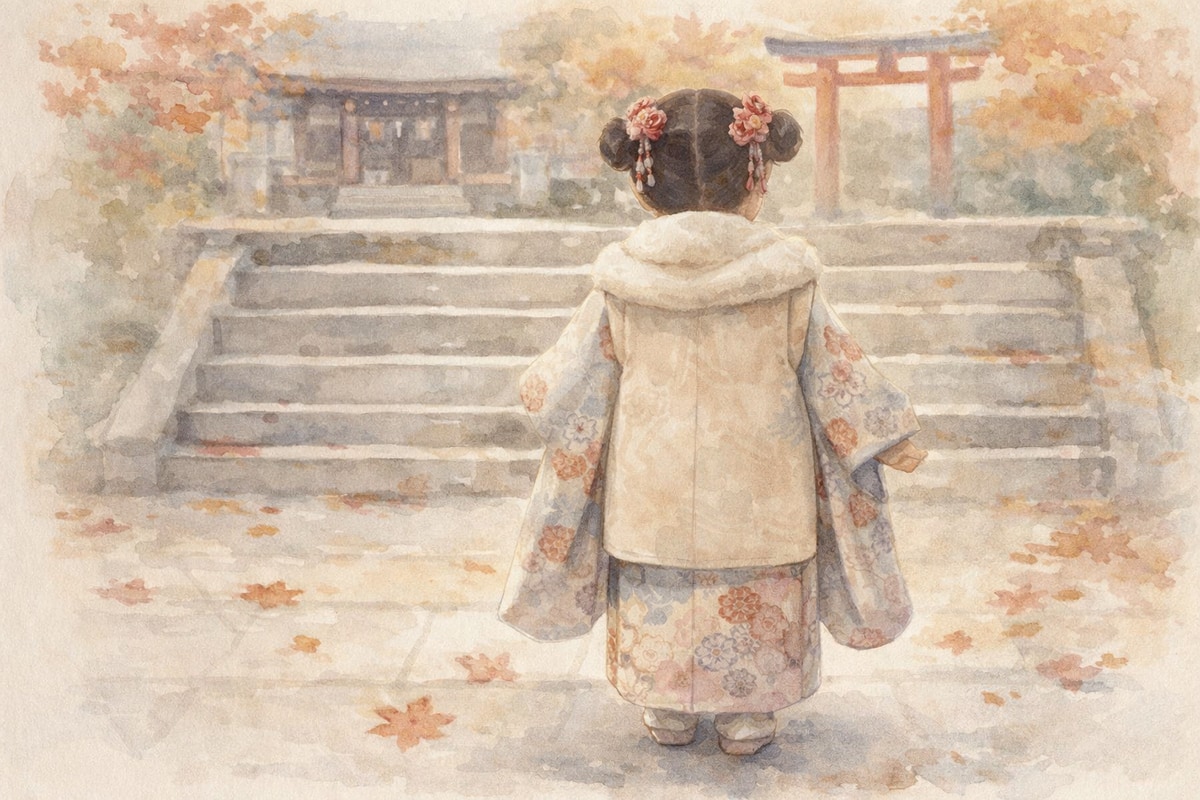
For a 3-year-old girl, a vest-like garment called a “hifu” is layered over the kimono in place of an obi (the wide sash tied around a kimono). Since a full obi would be uncomfortable and restrict movement for such a young child, it’s common practice to secure the kimono with a heko obi (a soft, single-cloth sash) or simple ties, then hide that part under the hifu. The hifu is said to have its roots in the Edo period, when men such as tea masters and monks wore a similar garment as a cold-weather coat. Today’s hifu is mainly decorative, but since Shichi-Go-San often falls in November, it does provide real warmth as well. A padded, coat-style hifu in particular offers both visual volume and solid warmth.
That said, the hifu only covers the chest and back. The arms, neck, and feet remain exposed to the outside air, so rather than assuming “the hifu will keep her warm enough,” it’s wise to add a cape or a thin inner layer depending on the day’s temperature. The differences between the kimono worn at ages 3, 5, and 7 are also organized in Shichi-Go-San at Ages 3, 5, and 7: Kimono and Preparation Checklists for Each Age, which is worth a look as well.
Is the haori hakama warm enough for a 5-year-old boy?
A 5-year-old boy wears a haori (a traditional jacket layered over the kimono) together with hakama (pleated trousers). Besides adding formality for occasions like Shichi-Go-San and seijin-shiki (the Coming-of-Age ceremony), the haori also functions as a cold-weather garment. Because of this, the upper body tends to stay warmer than with the hifu. However, the hakama is cut like a skirt around the legs, so children who aren’t used to it sometimes say it feels drafty. On cold days, adding leggings underneath can ease the chill.
Many families also add a scarf or stole, which not only helps with the cold during visits from late October through November but also works as an accent color in the overall look. Some parents find it helpful to keep a large towel on hand to drape over a sleeping child during car rides or waiting periods, so it’s worth adding to your list of things to bring.
What about the 7-year-old girl’s kimono with obi?
At age 7, the look becomes a fuller kimono style with an obi tied around the waist. Since there’s no outer garment like the hifu layered on top, the chest, back, arms, and neck are all more exposed to the outside air, making cold more noticeable. For autumn and winter shrine visits, rather than piling on thick layers underneath the kimono, it works better to combine a thin inner layer with an easy-to-remove cape or stole — this helps prevent the kimono coming loose (kizukure) while still making it easy to adjust to the temperature.
Keeping feet and neck warm
Regardless of age, the areas most prone to feeling cold are the parts of skin left bare and the places where the kimono doesn’t sit snugly against the body. Leggings help with the legs and feet, while a stole or cape covering the neck is the basic approach. Mornings and evenings can feel quite cold, but temperatures often rise by midday, sometimes making the kimono alone feel too warm. For this reason, it’s more manageable to avoid heavy layering under the kimono and instead adjust with an outer layer that’s easy to put on and take off. For areas prone to cold, such as the feet and around the waist, disposable heat packs can also help.
General temperature guide for the day
In Tokyo, November daytime temperatures typically run around 14–18°C, dropping to roughly 7–12°C in the morning and evening. Even within November, regional differences are significant: in Hokkaido, overnight lows can dip into single digits later in the month, while early November in Tokyo can still see highs close to 20°C. In inland areas like Nagano Prefecture, average temperatures in early November may hover around 10°C but can fall to around 5°C by late in the month. Since the right amount of cold-weather gear depends heavily on your region and the timing of your visit, it’s best to check the forecasted temperature for the day shortly beforehand and decide what to bring accordingly.
Handy items to bring on the day
- A stole or cape (to cover the neck and shoulders)
- A blanket that can double as a lap cover (for travel and waiting time)
- Disposable heat packs (for the feet and around the waist)
- Thin inner layers such as leggings (for forecasts of especially cold weather)
- A large towel (also useful for warmth if your child falls asleep)
What you’ll need varies depending on the season and region of your visit, so pack a bit extra if you expect a long wait on shrine grounds. If your child isn’t used to walking in zori (flat kimono sandals), it’s also worth preparing for comfort on their feet — see When a 3-Year-Old Says “My Zori Hurt” at Shichi-Go-San: How to Help Them Walk and How to Choose Zori-Style Shoes for more guidance.
In summary
Whether it’s the hifu, the haori hakama, or the kimono worn with an obi, each Shichi-Go-San outfit offers a certain degree of warmth, but none of them fully covers the feet or neck. Understanding the features of each age’s kimono, then adding a stole or heat packs according to the day’s temperature, is the most realistic way to stay warm while still preventing kizukure. Having walked through all these steps, what matters most is that your child can enjoy the shrine visit with a smile, without worrying about the cold. A single extra layer can make a big difference to how comfortable the day feels. We hope you have a warm and wonderful day.