
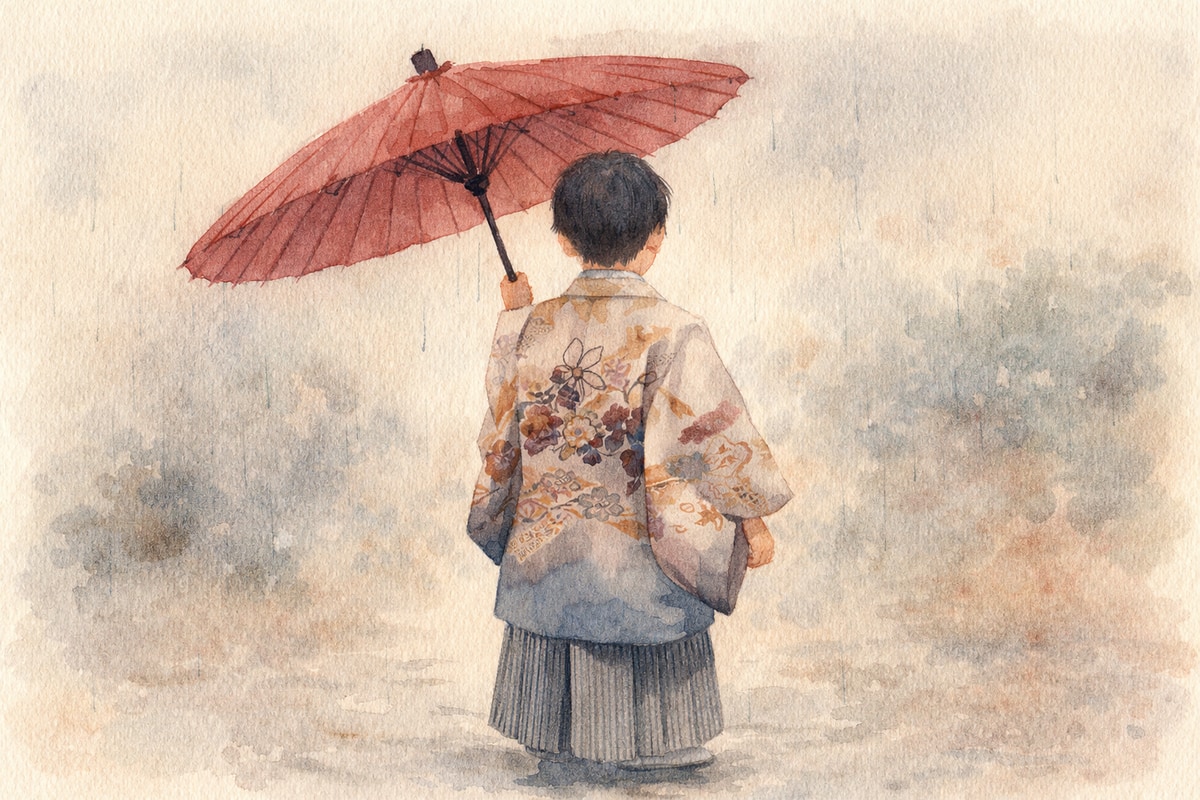
Just when you’ve finished booking everything for Shichi-Go-San (a celebration for children aged 7, 5, and 3) and breathed a sigh of relief, a glance at the weather forecast can bring a new wave of worry: “What if it rains?” Will the carefully prepared kimono get soaked? Will your child have trouble walking and end up cranky and upset? Once you start thinking about it, the concerns can pile up endlessly. This article walks through, step by step, how to protect the kimono if it rains on Shichi-Go-San day, and how to choose the raincoats, zori (flat kimono sandals) covers, and other gear you’ll need.
The short answer: unless the weather is truly severe, it’s fine to go ahead as planned
To get straight to the point, unless it’s dangerous-to-travel weather like a typhoon or violent storm, the basic approach is to take rain precautions and proceed as scheduled. The prayer ceremony itself, the main event of Shichi-Go-San, almost always takes place indoors, in the shrine’s main hall or a dedicated prayer room, and things like writing on ema (votive plaques) or handing over the hatsuho-ryo (ceremonial offering) are usually done under a roof or inside a building, so light rain alone won’t cancel the visit. Some shrines even set up tents from the parking lot to the main hall so visitors can walk without getting wet.
That said, there’s no need to push through everything by force. You could split your schedule by postponing only the prayer ceremony to a day with better weather, while keeping plans that take place entirely indoors, such as a photo studio session or a meal, on the originally planned rainy day. Many shrines don’t require advance reservations for the visit itself, which makes it easier to rearrange your schedule and gives some peace of mind. If a typhoon or violent storm makes travel itself difficult, it’s best not to force things and instead postpone everything.
Do kids need a raincoat? Things to watch for when layering one over a kimono
Once you’ve decided to go ahead, the first things to think about are footwear and outerwear. For getting your child around, the basic approach is to prepare a long children’s raincoat or poncho, the kind made for regular clothes, that’s long enough to fully cover the hem. One thing to watch for here: if you use a raincoat in your child’s usual size over a kimono, the extra bulk from the kimono can make it too tight, so the sode (sleeves) and hem may not fit properly. A poncho-style option gives more room in width, but then length becomes the concern, and in fact, blogs written by parents who have been through Shichi-Go-San visits mention exactly this worry: “the width is fine, but I’m not sure about the length.”
Here are some guidelines for choosing one:
- Since it will be worn over a kimono, choose a size one notch larger than usual
- Choose a poncho style that fully covers the hem, or a longer raincoat
- Look for water-repellent, water-resistant fabric, and check the fit of the hood and cuffs beforehand
- Children around 2 to 3 years old can’t really manage an umbrella, so a raincoat that frees up both hands is safer
For accompanying adults, a longer raincoat that covers down to the hem is convenient. Since the needs differ for children and for parents or guardians, prepare accordingly based on each person’s role on the day. For more detail on choosing rain coats and tabi covers, see our article on rainy-day kimono measures: rain coats, tabi covers, and zori covers, which is worth checking alongside this one for peace of mind.
Choosing zori and tabi covers — for children, rain boots are the practical substitute
Footwear is one area where it helps to think about adults and children separately. Zori covers made for children are rarely sold, so a practical approach is to have your child wear rain boots for getting around before the ceremony, and switch into zori only for the prayer ceremony and photos. Zori can be uncomfortable for children who aren’t used to wearing them, and complaints like “it hurts” or “I’m tired” tend to come up even on dry days. We’ve covered this in more detail in What to do when your 3-year-old says zori hurt at Shichi-Go-San: preparing them to walk and choosing zori-style shoes, so take a look if this is a concern. On rainy days especially, rather than insisting your child wear zori the whole time, it’s easier on them to switch footwear depending on the situation.
A modern style of pairing boots with kimono has also become popular lately, with the advantage that feet stay dry and walking is easier. Switching into zori just for the prayer ceremony and photos lets you keep both a proper formal look and easy walking.
For accompanying adults, meanwhile, it’s reassuring to prepare zori covers (rain covers). These keep zori and tabi from getting soaked in puddles, and choosing a type with a non-slip sole helps keep footing stable on wet shrine grounds. Waterproof zori covers come in L and M (one-size) versions, so you can choose one to fit your own zori. Shrine grounds tend to form puddles on rainy days, so it’s worth checking in advance for a route that avoids them, and guiding your child along the easiest path to walk on the day is also part of good preparation.
Kitsuke adjustments that help on a rainy day
There are also a few things you can do at the kitsuke (dressing in kimono) stage to prepare for rain. One common technique is dressing the kimono with the hem a bit shorter than usual. This reduces the area of fabric that touches the ground, making it easier to avoid splashes and dampness. Also keep in mind that layering a rain coat or poncho over the kimono can cause the fabrics to rub against each other, which can lead to the kimono coming loose (kizukure) more easily. Before putting on the outer layer, double-check how snugly the koshihimo (waist cord) and obi (the wide sash tied around a kimono) are tied, and make a habit of lightly checking the hem and eri (collar) each time you move, so there’s only minimal adjusting needed once you arrive at the venue.
Other options include adding non-slip pads to zori or covering tabi, using a long umbrella or a traditional wagasa so you can walk in a posture that keeps the hem drier, and applying waterproofing spray to the kimono ahead of time. If you’re using a rental kimono, be sure to check with the shop whether waterproofing spray is allowed before using it. Policies vary from shop to shop on this point, so confirming in advance saves you from scrambling on the day.
Changing at the venue and a packing checklist
To avoid forgetting anything, check the following before heading out:
- Check the weather forecast in the days leading up to the event, so you know the chances of rain
- Check the shrine’s rainy-day route for the visit (whether there are covered walkways, etc.)
- If using a rental kimono, check what compensation applies if it gets dirty or damaged
- If you’ve booked an on-location photographer, check their policy for rain (such as whether they can move indoors)
- Pack zori covers, rain boots, a towel, and an oversized raincoat or poncho suited for wearing over a kimono
As this list shows, what matters most for a rainy Shichi-Go-San is being ready to quickly dry off or change shoes when things get wet. It’s tempting to think one towel is enough, but having separate towels for feet and hands means you won’t be caught off guard when switching from zori to rain boots.
If you do decide to postpone, letting people know early is key
Depending on the weather, postponing may sometimes be the more reassuring choice than going ahead. If you do change the date, it’s essential to let grandparents, relatives, and anyone else invited to the celebration know as early as possible. For anyone traveling from farther away, this also affects their transportation and lodging bookings, so it’s best to communicate a decision to postpone as early as you can. Since the difficulty of rearranging plans varies depending on each person’s circumstances, sharing information within the family early on helps everyone avoid a last-minute scramble on the day.
In closing
Having gone through each point in turn, if you’re unsure what to do about rain on Shichi-Go-San day, the safest approach is this: “unless the weather is truly severe, take rain precautions and go ahead as planned.” For your child, combine an oversized raincoat or poncho that fully covers them with rain boots for getting around and a switch into zori when needed; for accompanying adults, prepare zori covers and a longer raincoat. With these in place, much of the day’s worry should ease considerably. That said, after all these details, what matters most, rain or shine, is that your child gets to greet the day with a smile. Even walking together across wet shrine grounds will likely become a warm page in your memories when you look back on it later.