Did you know that Shichi-Go-San (a celebration for children aged 7, 5, and 3) kimono are actually completely different for each of the three ages? To cut to the chase, each age carries the meaning of its own distinct ceremony. Here’s a guide to the kimono for each age, along with what you’ll want to have ready.
🌸 The quick version (for those in a hurry)
Age 3 calls for a mitsumi kimono (a small child’s kimono) with a hifu (a sleeveless padded vest worn over the kimono); age 5 (boys) calls for hakama (pleated trousers) with a haori (a formal jacket); and age 7 (girls) calls for a yotsumi kimono (a child’s kimono cut in a larger size) with a fukuro obi (a formal, fully patterned obi).
Each age has its own distinct ceremony
| Age | Kimono | Ceremony origin |
|---|---|---|
| 3 | Mitsumi kimono + hifu | Kamioki no gi (a rite celebrating the start of growing out one’s hair) |
| 5 (boys) | Kimono + kaku obi (a narrow, stiff men’s sash) + hakama + haori | Hakamagi no gi (a rite celebrating wearing hakama for the first time) |
| 7 (girls) | Yotsumi kimono + fukuro obi | Obitoki no gi (a rite celebrating tying an adult-style obi for the first time) |
*This is a general summary. Practices vary by region and family.
With attire needs changing this much across ages 3, 5, and 7, putting together a full outfit for each stage can be surprisingly demanding. If you’d rather not commit to owning a full set you’ll only wear once, a home-delivery (mail-order) rental that ships an age-appropriate outfit straight to your door can be a convenient option.
Age 3: hifu or obi?
At age 3, you’ll choose between a kimono with a properly tied obi, or one paired with a hifu that conceals the obi.
- Choosing a hifu — This is dressed with just a koshihimo (a simple waist cord), making it easy to put on and simple to fix if the kimono starts coming loose (kizukure). It’s also a special outfit that can only be worn at age 3. That said, many hifu are padded with cotton wadding, which isn’t always ideal in hot weather.
- Choosing an obi — This shows off both the kimono’s pattern and the obi, making for a more festive look, but it takes longer to dress and is somewhat harder to fix if it comes loose.
Age 5: the first hakama
For boys turning 5, the standard attire pairs a kimono with a kaku obi, hakama, and haori. This comes from Hakamagi no gi, a rite celebrating a boy wearing hakama for the first time. Children sometimes carry an accessory shaped like a sword, said to symbolize becoming a member of society.
Age 7: the first adult-style obi
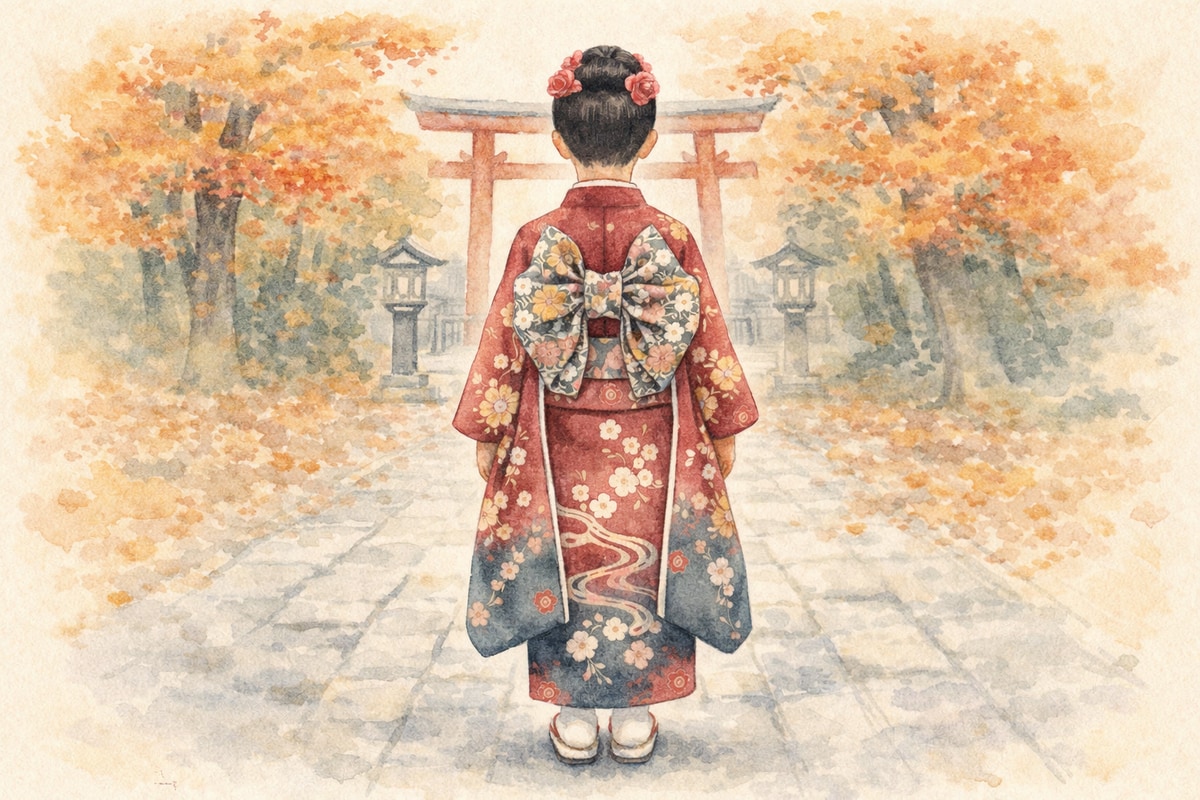
Girls turning 7 wear a kimono tailored in a children’s size known as yotsumi, paired with a child-sized fukuro obi or a pre-tied obi. The type of obi is the same fukuro obi an adult would wear, but instead of the adult otaiko knot, it’s tied in a decorative children’s knot or uses a pre-tied form. This comes from Obitoki no gi, a rite celebrating tying an adult-style obi for the first time, and the number of dressing accessories — obijime (a cord tied over the obi), obiage (a fabric accent above the obi), and so on — increases to match adult dressing. Be sure to also check the items checklist.
Frequently Asked Questions
Q. For age 3, would you recommend a hifu or an obi?
A. Both are commonly chosen. If ease of dressing matters most, go with a hifu; if you want to show off both the kimono and obi patterns, choose the obi style. It’s also worth factoring in the day’s temperature.
Q. Can a 5-year-old boy skip the haori?
A. Going without a haori is perfectly fine. That said, for a fully formal look, it’s generally considered standard to include the haori.
Q. At age 7, is the obi tying exactly the same as an adult’s?
A. The type of obi (fukuro obi) is the same as an adult’s, but the tying style differs — instead of the adult otaiko knot, a child-sized fukuro obi or pre-tied obi is used in a decorative knot. It’s also tailored in a children’s size called yotsumi, unlike adult kimono. For how to use the various dressing accessories, it’s best to follow the guidance of the shop or the person doing the dressing.
Summary
- Shichi-Go-San kimono carry a different ceremonial meaning at each age
- Age 3: mitsumi kimono + hifu; age 5: hakama + haori; age 7: yotsumi kimono + fukuro obi
- At age 3, choosing hifu or obi changes both how easy the dressing is and how festive the look appears
- With each age, the attire moves a little closer to adult dress
Having walked through the attire for each age, what matters most, in the end, is the beaming smile of the child wearing that outfit. Wishing you a wonderful day.
For guidance on choosing the mother’s kimono, see this article.
For kimono choices at other occasions — shrine visits for newborns, school ceremonies, weddings, and more — see our guide to kimono for special occasions.