
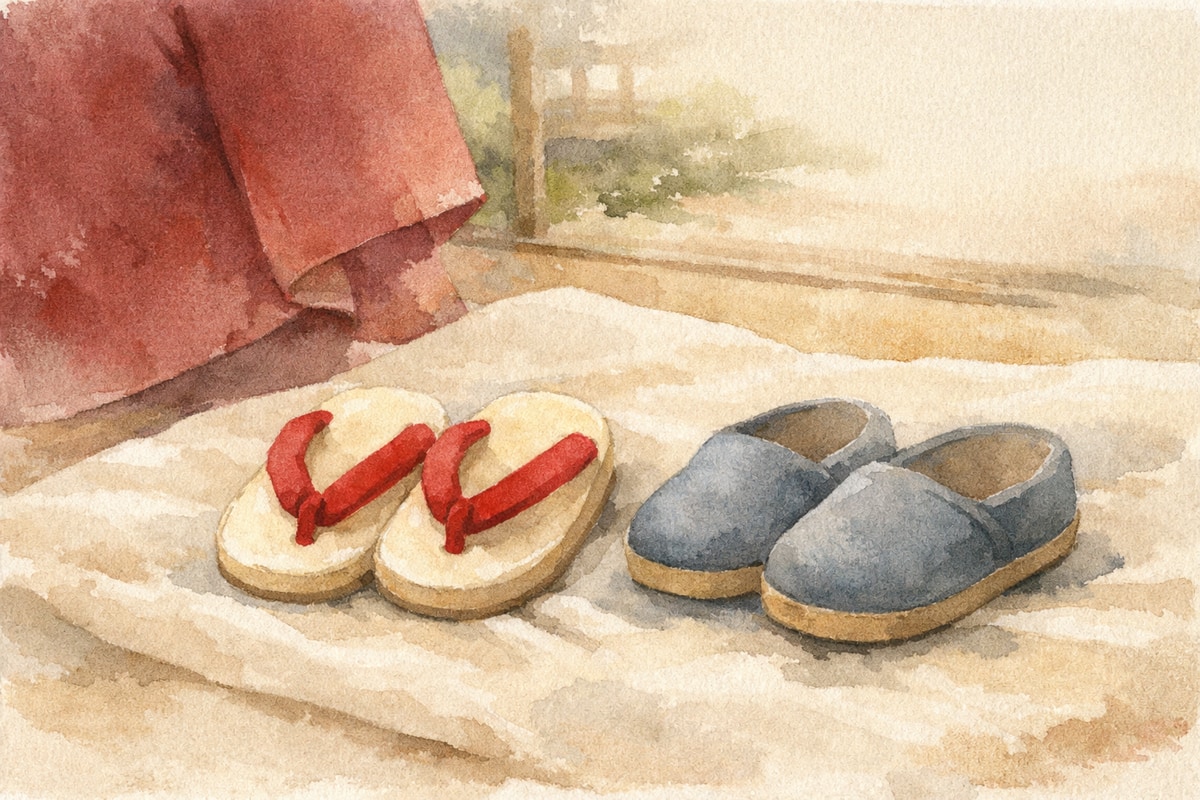
The moment you slip the zori (flat kimono sandals) onto your child’s feet in the shrine parking lot, they cry “it hurts” and pull their foot back. They beg to be carried. Even in that adorable hifu (a child’s formal overcoat), they won’t take a single step across the gravel — for 3-year-olds at Shichi-Go-San (a celebration for children aged 7, 5, and 3), the biggest stumbling block is often not the kimono, but the footwear.
It’s tempting to feel frustrated and say, “We bought these, so please just wear them.” That’s completely understandable. But for a 3-year-old’s feet, the thongs (hanao) of a zori are an entirely new sensation. It’s perfectly normal for them to resist, and not being able to wear zori isn’t a failure — and it’s certainly not a discipline problem.
In this piece, we’ll cover zori fixes you can try at home first, and the point at which switching to “zori-style shoes” makes sense if things are still difficult. By the end, you’ll be able to decide how to prepare your child’s footwear for the day, based on what suits your own child.
It’s not unusual for a 3-year-old to resist zori
If you compare the guidance from photo studios and kimono shops, one thing comes up again and again: 3-year-olds simply aren’t used to wearing zori or geta (wooden sandals), so it’s only natural that they’ll find them hard to walk in and get fussy. Add an unfamiliar kimono, an unfamiliar place, and the stares of unfamiliar adults, and then on top of all that, stiff hanao — it’s no wonder their mood falls apart.
So there’s really no need to feel down and think “it’s just my child.” Whether or not a child can wear zori comfortably is a matter of preparation, not personality. At Koromogoyomi, we believe that simply shifting your mindset on this point beforehand softens the expression on a parent’s face on the day itself — and children read their parents’ faces very closely.
What you can try with the zori itself first
That said, if you’d still like to capture some photos of your child walking in zori, here are steps you can try at home, in order. Almost none of them require special tools.
Sizing guide: the heel should rest on the sole, or just barely overhang
For adults, the proper way to wear zori is with the heel slightly overhanging the sole. For a 3-year-old, though, many wasou (traditional Japanese dress) accessory shops and photo studios recommend choosing a slightly larger size so that the heel sits fully on the sole, with “just a little overhang” as the outer limit. This isn’t a snug, foot-pushed-all-the-way-in style of footwear, so it’s fine if it feels a bit larger than their everyday shoes. As long as the toes catch on the hanao and the heel is resting on the sole, that’s the right fit.
On the other hand, if the heel is hanging far off the back of the sole, the zori are too small — the sole will keep slipping away from the foot with every step, making your child more likely to trip.
How to loosen stiff hanao
The hanao on brand-new zori feel quite stiff even to an adult’s touch. Off the record, the single most effective thing you can do is soften them up before your child ever puts the zori on. The steps recommended by wasou accessory shops and photo studios generally come down to the same three things:
- Press the base of the hanao outward. Open up the part that will touch the foot so it feels soft and loose.
- Slide a finger between the hanao and the sole and stretch it little by little. Work it gently rather than yanking it all at once.
- Hook a finger around the front knot (the part of the hanao that sits between the toes) and stretch it slowly. Since this isn’t footwear meant to be jammed tightly between the toes, it’s fine if there’s a little slack.
Even after loosening the hanao, it still takes time for a child’s feet to get used to them. That’s exactly why the next step — wearing them at home — matters so much.
Before the big day, let them practice wearing zori at home
Just a few minutes a day is enough — have your child walk around the house in their zori. Keep this up for several days, and the hanao will gradually mold to their feet, greatly reducing the chance of “it hurts” on the day itself. Be sure to have them wear tabi (split-toe socks) at the same time. Wearing hanao directly against bare skin tends to cause chafing between the toes. Choosing tabi made of a stretchy material makes them easier for a 3-year-old to accept (we cover tabi materials in more detail in our guide to tabi sizing and how to choose them).
Incidentally, opinions are split on “practicing in flip-flops” — some photo studios recommend it, while others say it’s pointless and even a bit risky, since despite the similar structure, they’re a different type of footwear. At Koromogoyomi, our recommendation is to practice in the real zori for short stretches at home. Above all, getting used to the actual footwear they’ll wear on the day is the surest shortcut.
One more small thing that really helps: tell your child ahead of time, “Soon we’re going to go out wearing shoes like these.” Show them a photo, and if possible, let them choose the color themselves. Even a 3-year-old can build up some mental readiness this way, and it changes how they accept the footwear on the day.
What to bring on the day: adhesive bandages and a spare pair of familiar shoes
Even with preparation, the day itself is the day itself. Pack a few adhesive bandages to protect the skin between the toes, plus a pair of shoes your child is already used to wearing. For children whose heels tend to slip out, a “heel band” that attaches to the hanao can also help. Wearing zori for photos, but familiar shoes for walking and visiting the shrine — this split-use approach is a classic strategy recommended by photo studios too. If you walk in regular shoes to just outside the shrine grounds and switch into zori right before entering, the distance your child actually has to walk in zori becomes very short.
The Shichi-Go-San guidance from ibiskan (Niigata City), a shop affiliated with Koromogoyomi’s operating company, also recommends traveling in familiar shoes right up until the time of the shrine ceremony. Spending long hours in kimono is, in itself, quite a burden for a 3-year-old. We’ve put together a full packing list in our guide to Shichi-Go-San kimono and preparation for ages 3, 5, and 7.
If it’s still difficult: the zori-style shoe option
You’ve tried it at home, and your child still pulls their foot away — maybe even cries at the sight of the hanao. In that case, there’s no need to force the issue with real zori. Over the past few years, “zori-style shoes” have clearly emerged as a popular option for Shichi-Go-San footwear.
They’re “shoes,” but the name still says zori
Zori-style shoes are children’s shoes designed to look like zori. There’s no hanao — instead, the foot is enclosed. Interestingly, in how they’re marketed, online stores often list them under names like “Shichi-Go-San zori shoes” or “zori-style shoes,” deliberately including the word zori in the product name. That tells you something about how shoppers search: as “one option among zori,” essentially. Some are made as unisex styles for 3-year-old boys and girls alike.
Why parents choose them: “no pain, harder to slip off”
Looking through product descriptions, the selling points are largely the same across the board: no hanao means no pain between the toes, less chafing, easier walking, and less likelihood of slipping off. Some even have an elastic strap across the instep so they stay on even if a child runs. It’s essentially a design that flips every frustration of zori on its head. As a sizing guide, some products even follow the same convention as zori, suggesting the heel should slightly overhang the sole.
As for how to actually choose among these shoes — our recommendation at Koromogoyomi is not to match them too closely to the color of the hifu or kimono. Choosing one pair in an easy-to-match color like white, red, or beige means it can be worn with any kimono on the day, and can even be passed down for a younger sibling’s Shichi-Go-San later on.
How they look in photos, and switching between shrine visits and travel
In photos taken from the front, zori-style shoes are almost indistinguishable from real zori. One approach is to switch into real zori only for full-body shots where the feet are clearly visible. For visiting the shrine and getting around, though, shoes are the clear choice with no hesitation. Deciding in advance that “zori for photos, shoes for walking” means you won’t have to make that call on the spot on the day itself.
If you’re substituting a pair of sneakers your child already owns, watch out for velcro straps — the loose end can stick to the kimono’s hem and damage the fabric, so it’s safer to tuck the ends in neatly rather than leaving them loose.
If you’re still not sure, use this as a guide
For those still wondering “so which one is right for us?” after reading this far — the most reliable way to decide is based on how your child reacted during at-home practice, combined with your plans for the day.
| Reaction when tried at home | Plans for the day | Recommendation |
|---|---|---|
| Can walk for a few minutes | Mostly photos, with only short distances to walk | Go with zori. Bring familiar shoes for getting around |
| Can walk for a few minutes | Long stone steps or gravel paths at the shrine visit | Zori for photos; zori-style shoes or familiar shoes for travel and the shrine visit |
| Takes them off right away, cries | Either case | Go with zori-style shoes and leave the zori at home |
| No time to practice | Only a few days until the event | Rely mainly on zori-style shoes, and bring the zori just for photos |
The line for switching over comes down to this: “try it two or three times at home, and see if your child still resists wearing them.” At Koromogoyomi, our view is that if the day looks like it will be painful for your child, switch to shoes without hesitation. A photo of your child walking and smiling will bring you far more joy looking back on it later than a photo of them in tears.
Frequently asked questions
Should we bring both zori and zori-style shoes?
If your child managed a few minutes of walking at home, bringing both gives you peace of mind — zori for photos, shoes for getting around. If they resisted at home, zori-style shoes alone are enough. It lightens your load, and saves you from wavering on the day and thinking “maybe we should have brought the zori after all.”
Will the hifu look strange paired with shoes?
In photos from the front or from the waist up, it’s barely noticeable. If you’re worried about full-body shots that show the feet, you can simply switch into zori for that one photo. Choosing a calm color like white or beige, rather than matching too closely to the kimono, will look at home with any kimono.
Does the same apply to 5- and 7-year-olds?
The same style of zori-style shoes is sold as unisex, for ages 3 through 7. That said, by age 5 or 7, a much larger share of children can manage to walk comfortably in real zori after some practice at home. As a rule of thumb, the older the child, the more worth it is to lean toward “try zori first.”
In closing
If your child says “it hurts,” start by reviewing the size and the hanao, then have them practice wearing the zori for a few minutes at a time at home. Tabi and a heel band can be real allies here. If it’s still difficult, switching to zori-style shoes and using the “zori for photos only” strategy works perfectly well. There are really only two things to remember: try it at home first, and if the day looks painful for your child, don’t hesitate to switch.
Even the child who pulled their foot back in the parking lot will smile properly once they’re walking the shrine grounds in shoes they’re used to. It’s fine if they can’t manage zori. For a 3-year-old’s Shichi-Go-San, being able to walk and smile is already a perfect score.