
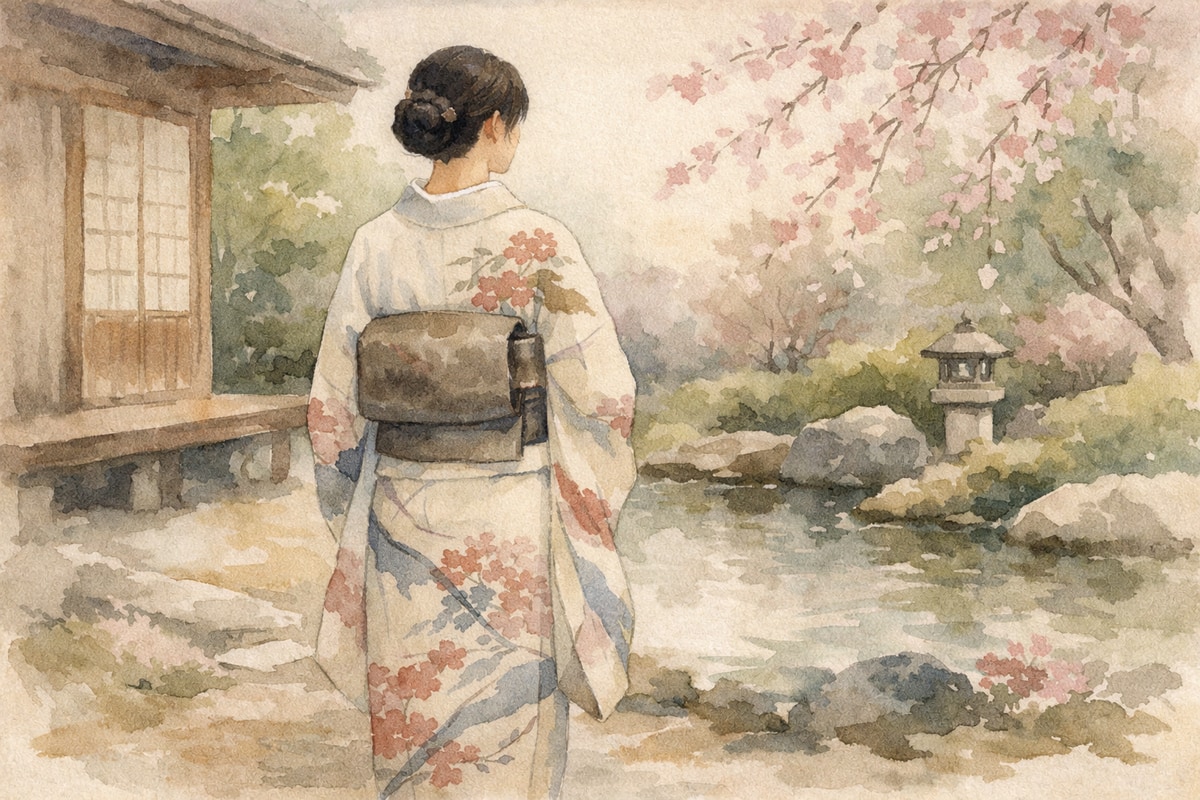
You’ve been invited to a wedding and need a houmongi (a semi-formal kimono), but you have no idea when you’d wear one again. Rent it or buy it? It’s a surprisingly tricky question. When you actually look into it, a houmongi turns out to be worn for far more than weddings alone — entrance and graduation ceremonies, shrine visits for newborns, tea gatherings, and more. That’s exactly why our approach is to first think about how many times you’re likely to wear one, and only then look at the cost. In this piece, we’ll lay out typical price ranges alongside how to choose based on the occasion.
What occasions call for a houmongi?
A houmongi ranks as semi-formal kimono, worn across a wide range of settings from formal to somewhat casual social occasions — wedding receptions, dinner parties, class reunions, entrance ceremonies, graduation ceremonies, and more. It’s also a welcome choice for social occasions like tea gatherings, concerts, parties, and dinner shows, and it’s often chosen by mothers accompanying their children at events like shrine visits for newborns, Shichi-Go-San (a celebration for children aged 7, 5, and 3), and nursery or kindergarten entrance and graduation ceremonies.
At formal ceremonies, it’s common to wear a tomesode, a houmongi, or a crested solid-color kimono. After weddings, the next most common occasions are ceremonies like entrance and graduation ceremonies, and for a formal tea gathering, a houmongi with a single crest and a restrained, classic pattern is recommended. Seen this way, a houmongi isn’t so much a “once in a lifetime” garment as one you might wear “once every few years, across many different occasions.”
How much does renting differ from buying?
The price is naturally the first thing on your mind. Rental prices for a houmongi vary depending on the source, but a full set typically runs roughly 10,000 to 30,000 yen as a rough guide. A home-delivery (mail-order) rental can sometimes be had for around 10,000 yen, while rentals affiliated with hotels or wedding venues often start from 20,000 yen. Branded houmongi rentals can run around 100,000 yen, but even then it’s usually cheaper than buying.
Rentals often carry a separate kitsuke (dressing in kimono) fee on top, typically around 7,000–12,000 yen at a hotel or 5,000–7,000 yen at a hair salon. When weighing the total cost of renting, it’s reassuring to factor in the kitsuke fee alongside the rental fee itself.
Purchase prices, on the other hand, vary considerably depending on the source. Some put the going rate at around 100,000 yen, others at 200,000–300,000 yen, and depending on the shop it can run 300,000–600,000 yen. Secondhand pieces can sometimes be found for around 30,000 yen. This wide range makes sense once you consider the differences in fabric, dyeing, and tailoring.
Who is renting suited to, and who is buying suited to?
If you won’t be wearing a houmongi very often, renting is said to suit you better. If you’re only wearing it once, for a wedding, with no idea when the next occasion will be, renting each time spares you the worry of storage and cleaning.
Buying, on the other hand, has the advantage of a garment tailored exactly to your size, and the more often you wear it, the lower your total cost becomes over time. The downside is the substantial upfront cost, plus the ongoing effort of storage, airing out, and cleaning. Whether you expect to wear it many times is the single biggest factor separating renting from buying. For a broader framework that applies to kimono in general, not just houmongi, see Rent or Buy a Kimono? Five Questions to Help You Decide.
Same houmongi, different occasion — what actually changes?
Because a houmongi suits such a wide range of occasions, it’s easy to get stuck on which one to choose for which setting. Thinking it through occasion by occasion makes the criteria clear, whether you’re renting or buying.
For a wedding reception, the first rule of thumb is to be more understated than the bride and groom. Bold, classic patterns are welcome at such events, but as a guest it’s more composed to choose a piece that doesn’t draw too much attention. The formality expected also differs depending on whether you’re attending as a friend or standing as a relative — relatives sometimes choose a tomesode instead. Guidance for each of these roles is laid out in Wearing Kimono as a Wedding Guest: Choosing by Your Role (Relative, Friend, Colleague).
Entrance and graduation ceremonies differ from weddings in one key way: the child is the star of the occasion. At such ceremonies it’s common to wear a tomesode, a houmongi, or a crested solid-color kimono, and a piece in a soft color with a pattern that doesn’t dominate is generally the easiest choice. The same thinking applies to a mother’s dress for a child’s event, such as a shrine visit for a newborn, Shichi-Go-San, or a nursery or kindergarten entrance or graduation ceremony.
A tea gathering has a somewhat different character. For a formal tea gathering, a houmongi with a restrained, classic pattern is recommended. Since a tea gathering involves a lot of standing, sitting, and reaching, it’s reassuring to also consider where the pattern falls and how easy the sode (sleeves) are to manage. Even though both are occasions for wearing a houmongi, it helps to remember that some call for more brilliance while others call for restraint.
What about family crests? Today, an uncrested houmongi is the norm
A houmongi can be worn without a crest, and adding one raises its formality. Some sources note that adding three crests brings it up to semi-formal rank. That said, almost no one has three crests added to a houmongi today, and when a crest is added, it’s typically just a single sewn crest on the back. Rental houmongi in particular are almost always uncrested, so if you’re planning to rent, there’s little need to agonize over the number of crests. It’s only worth considering whether to add a single crest if you’re buying and plan to wear the piece for years to come. The broader thinking behind crests is covered in Kimono Crests Explained: What Changes with Five, Three, or One — Family Crests, Women’s Crests, Dyed and Sewn Crests.
A checklist for when you’re undecided
- Do you have a concrete next occasion in mind, or is it just “someday”?
- Are you likely to wear it more than once a year? (The more often, the more buying tends to pay off.)
- Can you keep up with storage, airing out, and cleaning over time?
- Is the occasion clear? (The criteria differ for weddings, entrance ceremonies, and tea gatherings.)
- Are you comparing totals that include the kitsuke fee, not just the garment cost?
Looking at price alone, renting a houmongi looks like the clearly simpler, more affordable choice. But the more often you wear one, buying can end up cheaper in the long run. What matters isn’t the size of the price tag, but deciding upfront how many times, and for what occasions, you expect to wear it. Keep these price ranges and occasion-by-occasion guidelines on hand, and the choice will be much easier to make when the time actually comes.