“A furisode (a long-sleeved formal kimono) with a big pattern might overwhelm my figure and not suit me at all” — this is a worry many people have when choosing a furisode for their seijin-shiki (the Coming-of-Age ceremony). Standing in front of the fitting-room mirror, hesitating in front of a bold, classic design, is a very understandable feeling. But what actually determines whether a pattern suits you or not isn’t the size of the pattern itself.
To get straight to the point: what shapes the overall impression of a furisode is not so much the size of the pattern as where it’s placed and how much of the garment it covers. Even the same size of floral motif will look completely different depending on whether it’s scattered across the whole garment or concentrated toward the hem. Let’s walk through this step by step.
What Is “Eba Moyou,” the Pattern Layout Used on Furisode?
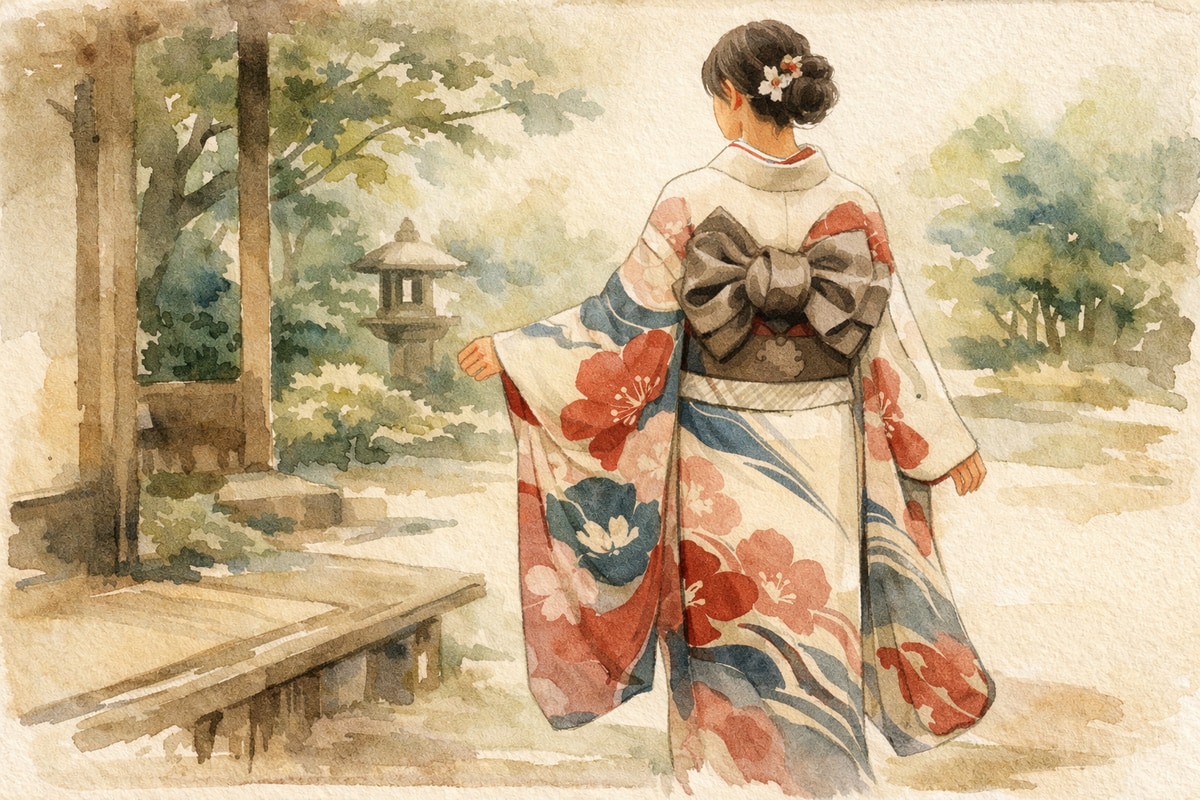
Furisode patterns use a distinctive layout technique called eba moyou. In this method, the kimono is first temporarily basted together, a design is sketched directly onto that basted shape, and the dyeing is then done to follow the sketch. This is a high-status technique used for tomesode, furisode, and houmongi (a semi-formal kimono), and its defining feature is that the pattern flows unbroken across the seams, so the whole garment reads like a single continuous painting.
Matching the pattern precisely across each cut piece of fabric requires great skill, which is why this technique is difficult to produce — and why the resulting garments tend to carry higher status and higher prices. On a furisode, the pattern isn’t limited to the area around the hem; it also extends up into the eri (the collar), chest, shoulders, and sode (the sleeves), giving the whole garment a lavish, unified look. This is actually the answer to the question of why furisode patterns can feel so large: it’s not that the motifs themselves are oversized, but that the entire kimono is being used as the canvas for a single design.
How Placement and Composition Change the Impression
For a furisode worn to a seijin-shiki, it’s not just the type or size of the pattern that shapes the impression — the composition and placement matter just as much. Even with the same floral motif, a design scattered evenly across the garment and one that spreads outward toward the hem will read very differently. The overall mood also shifts depending on whether motifs are concentrated at key points — the cuffs, shoulders, and hem — or distributed evenly across the whole surface.
In other words, it isn’t that “a bigger pattern means a flashier look” — rather, where the pattern is concentrated determines how that vividness comes across. A design where the pattern gathers at the hem lowers the visual weight when you’re standing, giving a calmer impression, while a design where the pattern continues up through the shoulders and chest creates a stronger sense of brilliance when viewed from the front. Neither approach is better or worse — it’s simply useful information to help you choose according to the mood of the venue on the day and your own personal taste.
What to Check During Fittings and Maedori
The impression created by pattern placement becomes much easier to judge if you move a little in front of the mirror. Check the garment both with your arms lowered and with your sode gently spread out, paying attention to how the pattern connects from the shoulders into the sleeves. Sitting is also a surprisingly common pose at seijin-shiki ceremonies and during maedori (a pre-ceremony photo shoot), so it’s worth checking the impression while seated as well as standing.
In maedori photos, the impression can look quite different between a full-length shot and a close-up of the upper body. In a full-length shot, the way the pattern spreads across the hem takes center stage, while in an upper-body close-up, the pattern at the shoulders and chest becomes the main focus. For more on choosing an outfit for wasou (traditional Japanese dress) maedori or photo weddings, see What Is Wasou Maedori / Photo Wedding? Choosing an Outfit and What to Check Before Booking.
When Should You Book? Timing That Keeps Your Options Open
Having enough time is the single most important factor if you want to carefully compare patterns and placements before deciding. It’s generally recommended to start researching a furisode two and a half to two years before the seijin-shiki, with an actual rental booking typically made one and a half to one year ahead. Specialist shops that include a photo plan often accept bookings starting one and a half years out, factoring in the timing of maedori, while online shops offering only full rental sets tend to open bookings around one year ahead.
Once you’re within six months of the seijin-shiki, kitsuke (dressing in kimono) and hair-and-makeup appointments begin filling up first, and the range of available patterns starts to narrow. In particular, January through March is when furisode used at the previous year’s seijin-shiki are returned, undergo maintenance, and come back into stock — a period when there’s a wider selection of colors, patterns, sizes, and preparation time slots. The more you want to carefully compare pattern placement, the more booking early works in your favor to keep your options open. For more on booking timing, see When Should You Book a Furisode Rental? Choosing by Season.
In Summary
It’s easy to fixate on the size of a pattern, but what really shapes the impression of a furisode is where the pattern is placed and how much of the garment it covers. Understanding the mechanics of eba moyou design makes it clear what to look for during a fitting. Take your time checking how the pattern connects from the shoulders to the sleeves, how it spreads toward the hem, and how it looks in both full-length and upper-body views.
Having walked through all these steps, though, what matters most is finding the one garment that makes you smile naturally when you see yourself in the mirror. That garment is what will make the day of your seijin-shiki feel truly special.