
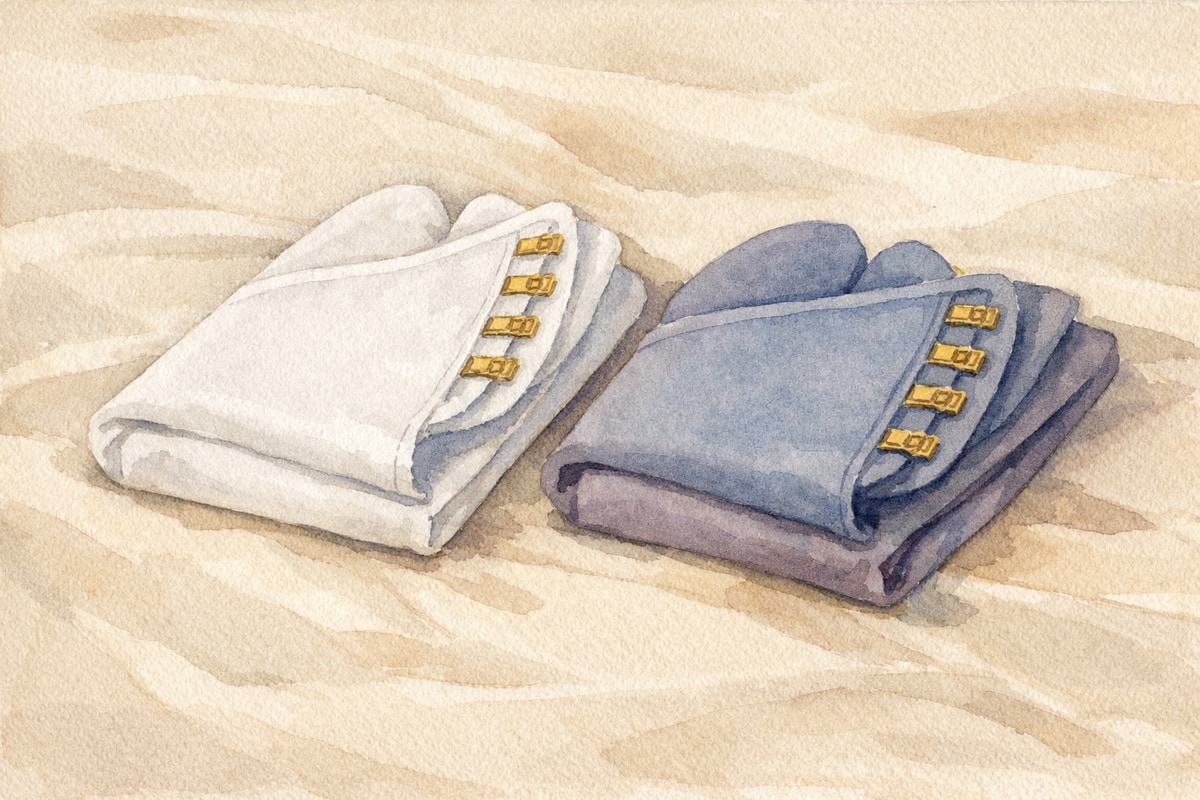
Has this ever happened to you: you’re at a shop and someone asks, “Aren’t those tabi a bit tight?” — and only then do you realize you hadn’t really thought about the size at all? It’s a surprisingly common slip-up. If you pick tabi the same way you’d pick shoes, you can end up with sore toes after walking around, or the opposite problem — a heel that keeps popping loose. Tabi quietly support your feet in kimono, yet they tend to get less attention than they deserve. Today, let’s work through the points that most often trip people up when choosing tabi.
How do you measure tabi size? How is it different from your everyday shoe size?
Tabi are built from separate pieces — the sole, the inner side of the foot, and the outer side — stitched together, and they have almost none of the stretch you’d find in a sock. That’s why if the size is off, the seams press against your foot and it directly affects how comfortable they feel. Simply going by your usual shoe size often doesn’t translate well here, so it’s worth being careful.
A good rule of thumb is checking whether both your heel and your toes are fully settled inside. If your toes poke out when your heel is properly seated, or if there’s zero give at all, that’s a sign the tabi are too small. On the other hand, if there’s more than about 0.5 cm of extra room past your toes, they’re too big. It might seem like a looser fit would be more comfortable, but baggy tabi actually make walking harder too. This is usually the trickiest part for beginners, so if you’re at a shop where you can try them on, it’s worth actually putting them on your feet to check.
There’s another number worth checking, next to the size label: “4 kohaze” or “5 kohaze.” Kohaze are the thin metal clasps at the opening of the tabi, which hook onto paired loops of thread to fasten them. They’re arranged vertically, so the more there are, the higher up the ankle the tabi covers — each additional clasp adds roughly 2 cm of coverage. As a general guideline, 4-kohaze tabi are common for everyday wear, while 5-kohaze tabi, which cover more of the ankle, are often chosen for formal or dressed-up occasions. That said, this isn’t a hard rule — it can come down to regional habits, such as a preference for 5-kohaze in the Kansai region and 4-kohaze in the Kanto region, or simply personal comfort. Some people find 4-kohaze tabi easier around the ankle on days with a lot of sitting in seiza (formal kneeling).
Tabi sizing is personal, and single listings sell out quickly. This Amazon.com search for tabi socks shows what is in stock right now; use the measuring steps above to pick your size before you order.
Choosing by material: the differences between karako, broadcloth, and stretch
Once you’ve settled on a size, the next thing to think about is material. Tabi fabric generally falls into three types: cotton karako, cotton broadcloth, and stretch fabrics. Each has its own strengths depending on the occasion, and knowing the differences makes choosing much easier.
Cotton karako is a plain weave with the warp and weft threads in roughly equal proportion, giving it a fine, beautiful weave. It’s thin and light, with no sheen, producing an elegant white — which is why white cotton karako is considered the proper choice for formal occasions. Because it’s gentle on kimono fabric through friction, it’s also considered well suited to formal dress for that reason.
Cotton broadcloth uses more warp threads than weft, which gives it good stretch widthwise. It’s soft and resists wrinkling, making it a good choice for long hours of wear or days with a lot of standing up and sitting down. That said, compared to karako, the weave is a bit more visible and it tends to have more sheen, so for a more understated look, karako still wins out.
Stretch tabi are made from synthetic fibers such as polyester or nylon, and offer the most stretch of the three types. Because they’re less likely to cause pain between the toes, they’re often recommended for people with bunions. That said, keep in mind that the synthetic material tends to have a slightly bluish-white sheen, so for formal white tabi, karako is still considered the better choice. For casual kimono or busy, active days out, though, stretch tabi are a reliable ally.
Choosing by color and pattern: when to wear white tabi versus colored or patterned tabi
After material comes color and pattern — and don’t worry, there are really just two rules to remember. For formal and semi-formal kimono such as kurotomesode, irotomesode, furisode, houmongi, and iromuji, white tabi are the fixed rule. At formal occasions such as weddings and funerals, wearing white tabi is considered proper etiquette, so if you’re ever unsure, white is always a safe choice.
On the other hand, for casual everyday kimono such as komon, omeshi, tsumugi, momen, or wool, colored or patterned tabi are perfectly fine to wear — and of course, white tabi work just as well too. More and more people are enjoying colored and patterned tabi simply as a way to broaden their style. As mentioned in our article on tsumugi, formality and price are two separate things. When it comes to dressing your feet, it’s easier to decide once you think in terms of the occasion’s formality — formal versus casual — rather than anything else.
If you are putting together a formal kimono outfit, this is the classic option the section above describes: white tabi with four kohaze clasps, made in Japan, in an easy-care polyester-cotton blend. Sizes come and go, so please check the product page for current details.
How tabi covers differ, and the basics of washing tabi
By the way, there’s an item with a very similar name to tabi called a “tabi cover.” Think of it as a jacket worn over your tabi. In the past, when going out in wasou (traditional Japanese dress), it was considered proper manners to change into a fresh pair of tabi before stepping onto someone else’s tatami floor, so as not to soil it. These days, many people use tabi covers instead of changing tabi altogether.
Tabi covers are made like an even thinner version of stretch tabi, and come in various styles — some with kohaze, some with elasticized openings, and some with water-repellent finishing. Since white formal tabi show dirt easily, wearing a tabi cover over them offers peace of mind. They’re easy to manage too, since all you need to do is take them off before stepping into someone’s home. In winter, they also double nicely as a way to keep your feet warm. On rainy days especially, having a tabi cover makes a real difference to your peace of mind, so it’s worth also checking our guide on dealing with kimono on rainy days.
Summary
When choosing tabi, there are three things worth keeping in mind: size, material, and color/pattern. For size, look for a fit where both your heel and toes settle in snugly. For material, choose cotton karako for formal occasions, and broadcloth or stretch for busier, more active days. For color and pattern, let the formality of the occasion guide you. Thinking it through in this order should help you stand in front of a shelf of tabi at a shop without getting stuck. Our suggestion is to keep one pair of white cotton karako on hand for formal occasions, then gradually add colored and patterned tabi for casual wear — it’s a small way to expand the enjoyment of kimono. Storing them properly will also give you peace of mind.