
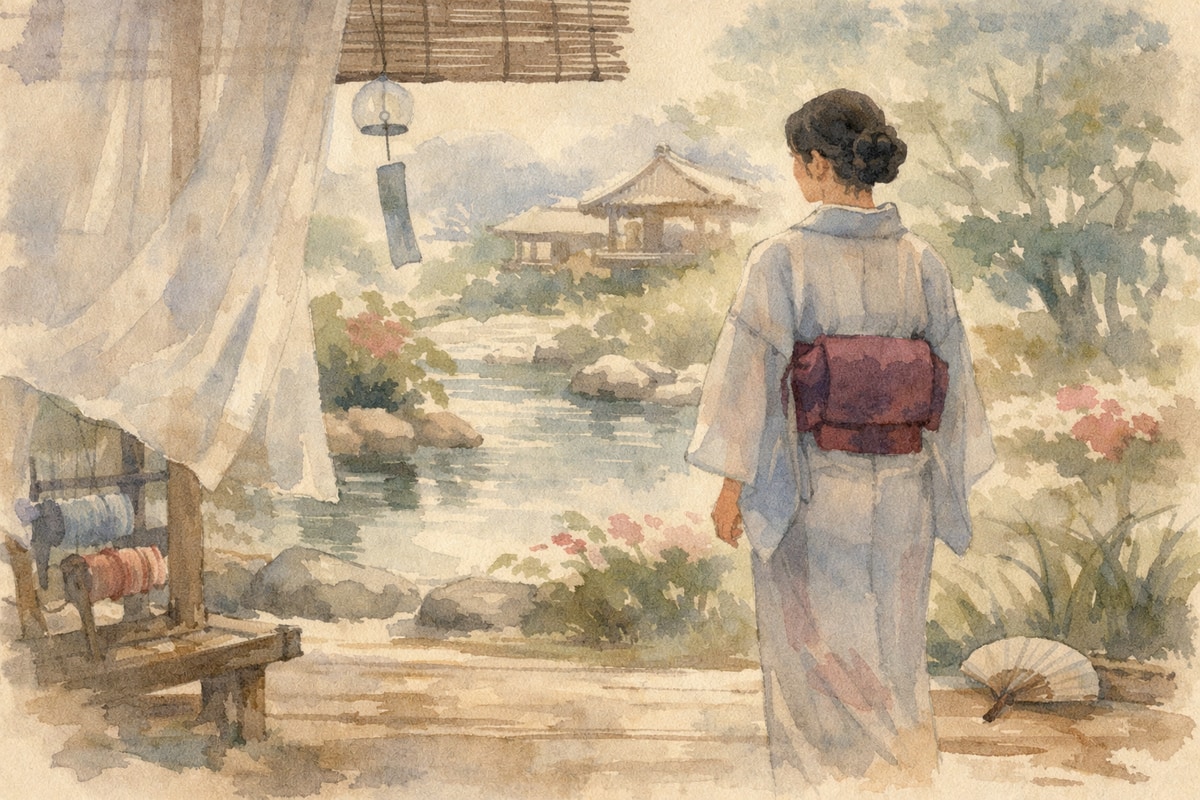
When the breeze of single-layer kimono starts to feel appealing, kimono talk always turns to sheer fabrics. Ro, sha, and asa (linen/hemp) — all three chase the same idea of coolness, yet each carries its own story of weaving.
What Are Ro and Sha? Understanding These Weaving Techniques
Ro (a sheer, gauzy summer silk) and sha (a light open-weave sheer silk) are both thin fabrics woven using a technique called “karami-ori” (leno weave). Looking closely, this method twists neighboring warp threads and uses the crossing points like little stoppers to create deliberate gaps in the weave — it’s not simply a matter of spacing the threads further apart. In sha, two warp threads are twisted around every single weft thread, producing an even, all-over gap that gives a strong sense of transparency. In ro, the warp threads are crossed at odd-numbered weft intervals and combined with plain weaving, which results in a somewhat more subdued transparency.
Ro originally combined sha with plain weave, and is said to have emerged during the Edo period. An older technique called “ra” exists as well, with a complex structure in which the warp threads cross continuously throughout — it even has a history of being dedicated to the Shosoin Repository. Sha is said to have developed from ra, and because it could be woven on an ordinary loom, it became hugely popular around the Heian period. Ro, in turn, is a further variation on sha, woven by crossing the warp threads with the weft at every 7th, 5th, or 3rd thread — a remarkably painstaking process.
A Note on Materials
Ro and sha aren’t woven only in pure silk (shoken) — cotton and polyester versions exist too. Even with the same weaving method, the feel of the fabric in your hands can vary quite a bit.
The Character and History of Asa (Linen/Hemp)
Asa is highly absorbent and quick-drying, and in the Edo period, before cotton kimono became widespread, it was worn by ordinary people as everyday dress regardless of the season. Before cotton arrived in the Muromachi period, asa was even used as underwear by aristocrats and samurai, and by the Edo period, under the era’s status-based dress regulations, it became standard for commoners to wear asa and cotton across both summer and winter.
The Azuma Kagami, a historical chronicle from the Kamakura period, records that Minamoto no Yoritomo presented a thousand bolts of Echigo jofu (a fine asa cloth) as a gift, suggesting that the production and use of asa cloth grew within samurai society from the Kamakura through the Muromachi period. The use of asa in Japan can also be traced back to items unearthed from Jomon-period archaeological sites, and since asa textiles known as jofu appear frequently among the treasures of the Shosoin Repository, the material is thought to have been used by the imperial court as well. What quietly catches the eye here is the sheer resilience of this fabric, asa, which has continued unbroken across so many eras.
The Japanese Aesthetic of Sheer Fabric as an Expression of Coolness
Rather than the close, clinging weight of silk against the skin, it’s the engineered gaps that let the breeze pass through — that’s the shape of coolness found in ro and sha. What feels quite endearing is that this pursuit of coolness ended up producing a highly decorative kind of beauty in the transparency itself. The more you learn about it, the more you realize that the weaving technique itself is what sustains seasonal dress.
Differences in Formality and Season of Wear for Ro, Sha, and Asa
Opinions vary on exactly when to wear each type, but traditional etiquette has generally held that awase (lined kimono) are worn from October to May, hitoe (single-layer kimono) in June and September, and usumono (sheer summer kimono) during the height of summer in July and August. Ro is often said to be worn from June through the end of August, and sha mainly in July and August; taken together, ro and sha are often centered on July and August but sometimes worn more broadly from around June through September. In recent years, shifting climate patterns mean that practices around timing have become more varied, and views can differ depending on region and occasion.
As for formality, it depends not only on the material and weave but also on whether there are crests and how the piece is tailored, so it’s difficult to generalize. If you’d like an overview of kimono formality as a whole, it may help to look through this quick-reference guide to kimono types and formality, which can make it easier to see where sheer fabrics fit in.
Enjoying Summer Kimono Today
With recent warming trends, it’s said that the traditional windows for wearing these fabrics are gradually widening. Rather than feeling boxed in by strict rules, choosing according to today’s temperature and the mood of the occasion is, perhaps, a gentler way to enjoy summer kimono.
Heading somewhere in cool, sheer dress, a quiet museum gallery isn’t a bad choice either. Take a look at Visiting Museums in Kimono: What to Wear and How to Enjoy It as you savor the comfort of sheer fabric.
From hitoe to sheer summer wear, the seasons gently nudge us toward a change of dress. May today’s kimono hold a small story of its own.
If you’re now on the hunt for a cool, sheer kimono of your own, you might also find Kimono: Is It Better to Rent or Buy? useful.
For more articles on summer materials, motifs, and dyeing techniques, see our guide to textiles and motifs.