
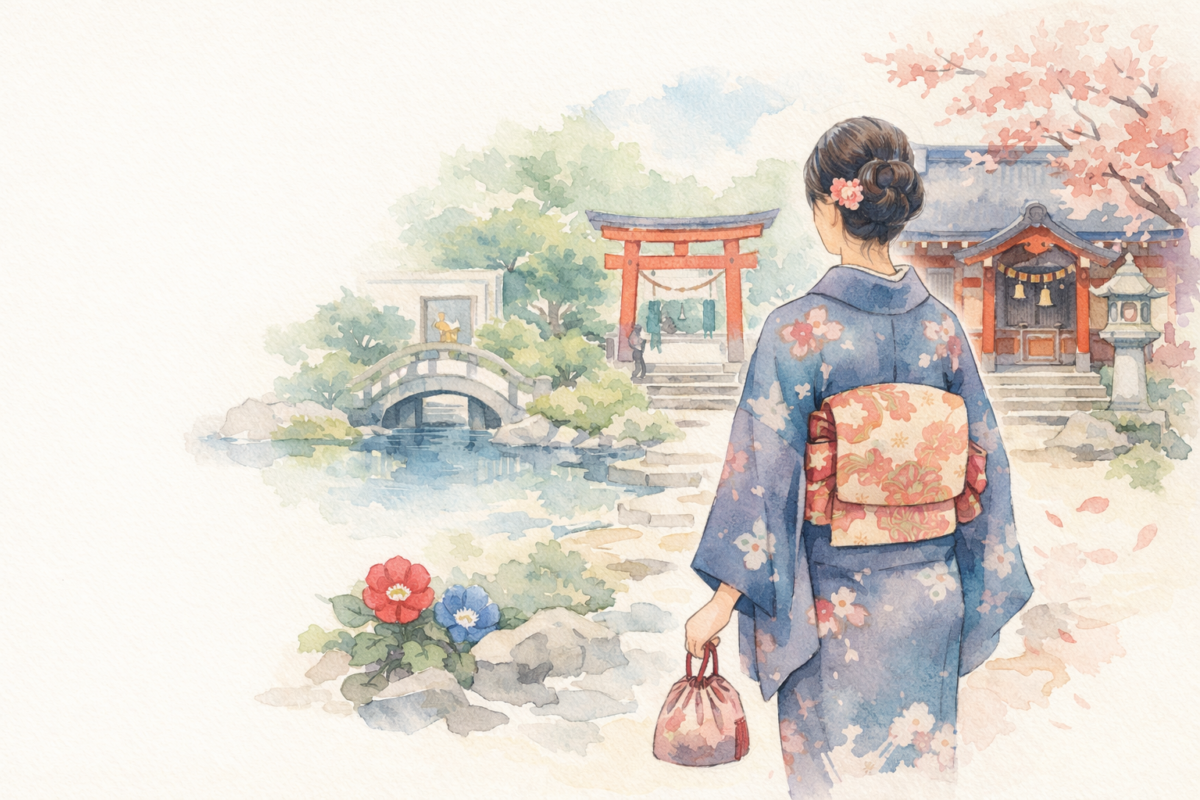
Around the time you start missing the breeze through an unlined kimono, you may find yourself longing for the sound of footsteps on the paving stones of a shrine or temple approach. When visiting a shrine or temple in kimono, there are said to be two quiet principles at heart: “respect” and “purity.” On the grounds, one should avoid speaking loudly or running. Before taking photos, it’s worth checking the signage for any areas where photography is discouraged, such as in front of the main hall or the principal image of worship — small, unspoken promises that gently protect the spirit of a visit.
Unpacking the Differences Between Shrines and Temples
When you look closely, shrines and temples are said to differ in several points of etiquette. At shrines, it is considered good manners to walk along the edges of the approach path, while temples apparently have no such rule. The temizu (purification) ritual at the water basin is shared by both: purifying the left hand, then the right hand, then the mouth, and finally the left hand again. But the way of paying respects differs — at shrines, it’s two bows, two claps, and one bow, while at temples, one quietly presses the palms together in gassho without clapping. When passing through a temple’s sanmon gate, it is considered proper manners not to step on the threshold. The more you learn, the more you notice that each gesture carries its own reason.
On Conduct and Attire Within the Grounds
Worship includes both ordinary visits and what is known as a formal visit (seishiki sanpai), a special occasion for which proper, more formal attire is considered fitting rather than everyday clothing. In both cases, it is considered important to avoid overly flashy colors, patterns, or designs, and to avoid hard-to-walk-in items like high heels. It is said to be proper manners to remove hats, sunglasses, and masks before passing through the torii gate or sanmon gate. Eating, drinking, and smoking on the grounds are also gently discouraged. It’s also worth noting that one should avoid using the main hall or the votive flowers — objects of worship — as a photo background, and refrain from using selfie sticks or tripods. Since customs can vary somewhat by region and by shrine or temple, when in doubt, it may help to quietly check the guidance posted on the grounds.
On Being Prepared as You Walk, and the Kimono Coming Loose
When walking around the grounds during occasions like the first shrine visit of the New Year (hatsumode), those less accustomed to wearing kimono are said to be more prone to the kimono coming loose (kizukure). In seasons when the chill around the knees is a concern, wasou (traditional Japanese dress) stockings or leggings can help. Using the restroom takes a little more time in kimono, so it’s reassuring to take care of that beforehand. When you do use one, it helps to tie the sode (sleeves) together in front so they don’t hang down, tuck them into the obi, or secure them with a clip; in a Western-style toilet, the trick is said to be sitting shallowly toward the front so the obi doesn’t bump against the toilet lid. After using the restroom, it’s reassuring to make a habit of glancing to check that the eri (collar) forms a neat Y-shape and that the obi and ohashori (the fold at the waist) haven’t come out of place. For more on fixing kizukure when it happens, see our detailed guide, How to Fix a Kimono Coming Loose: A Scene-by-Scene Guide.
A Small Story Behind Today’s Visit
For a kimono worn to visit a shrine or temple, perhaps what you bring matters even more than what you wear. If you’re wondering whether you’ve forgotten anything, it may be worth flipping through our Beginner’s Preparation Checklist. As you settle into the quiet of the shrine or temple grounds, the hem of your kimono sways ever so slightly — and that small presence, too, feels like part of the moment of worship itself, a subtle touch of elegance worth savoring.