
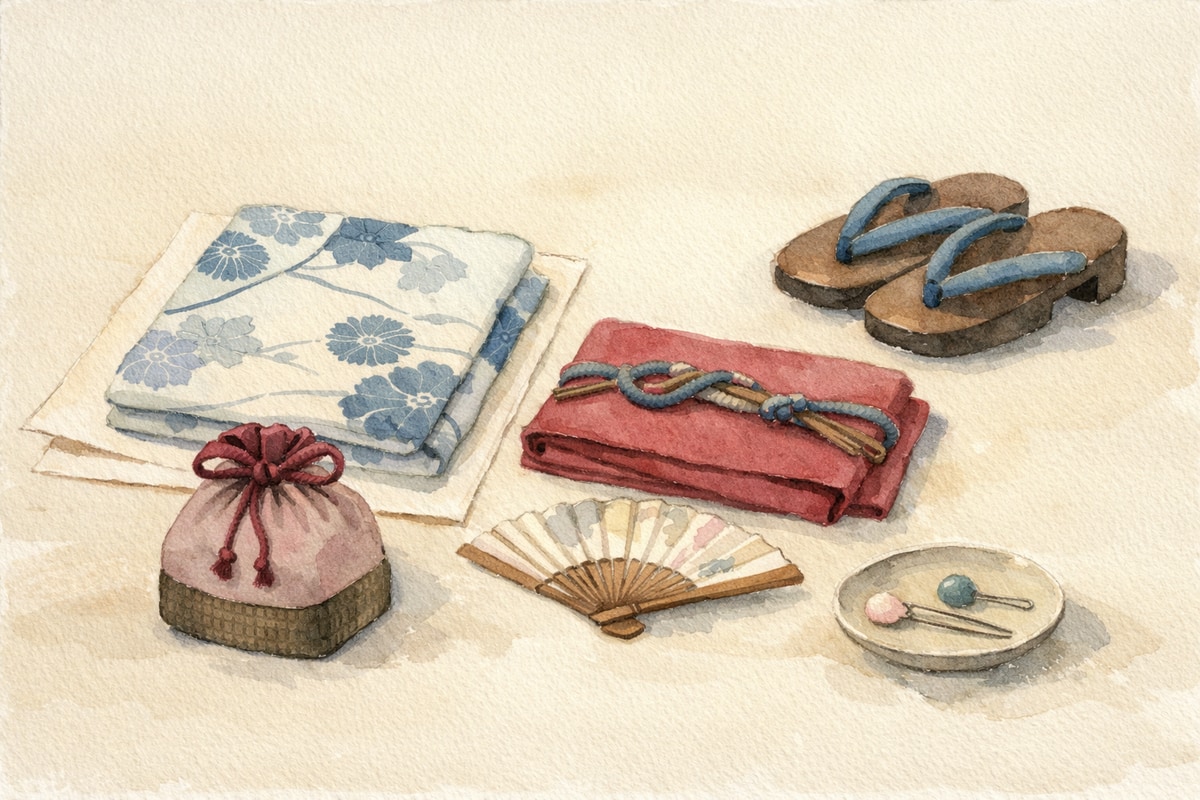
Have you ever gone to buy a yukata (a light cotton summer kimono), only to be confronted with a wall of numbers on a sizing chart and no idea which one to pick? It’s a common stumbling block for men shopping for a yukata for the first time. Too short, and too much ankle shows; too long, and it looks sloppy. But don’t worry — there are really only five things to think about: overall length, sleeve length, pattern and color, the obi (the wide sash tied around a kimono), and footwear. Go through them one at a time, and choosing becomes much easier.
How does men’s yukata sizing differ from women’s?
The first thing to know is that, unlike women’s kimono, a men’s yukata isn’t tailored with an adjustable fold (oharai) to fine-tune the length — instead, you generally wear the size that matches your height, as is. Because there’s no oharai fold to tuck up at the waist as there is with women’s kimono, your initial size choice has a much bigger effect on how the finished look turns out. If you’re curious about the difference between yukata and kimono themselves, it’s worth also reading What’s the Difference Between Yukata and Kimono?.
The basics of sizing: how do you determine length and sleeve length?
This is honestly the part people agonize over most. But the rule of thumb is simple: aim for a length that’s roughly 26–30 cm shorter than your height. For example, if you’re 175 cm tall, a length of around 149–151 cm is considered right for you, and if you’re on the slender side, you can go with a length close to 30 cm shorter and still look neat.
Gauging the right length
If you can try one on in the shop, the general guideline is that, with the yukata simply draped on, the hem should just barely brush the floor, or almost. Once the obi is tied, a natural silhouette has the hem just covering the ankles, or nearly so. Some sources use a slightly different guideline — height plus 5 cm, with about ±5 cm of leeway — but rather than chasing an exact number, it’s more reliable to judge by how it looks and feels once you try it on.
Gauging yuki (sleeve length)
Yuki (the sleeve length from center-back to wrist) is the measurement from the shoulder to the cuff, and ideally it should reach about to the wrist bone when your arm hangs naturally at your side. Some say it looks sharpest if the wrist bone is just visible when the arm is lowered at a slight angle, while others say the cuff should just cover the wrist bone when the arm is raised about 45 degrees to the side — sources vary a bit here. Since the sode (the sleeve) itself is typically 20–30 cm long, it’s a good idea to use that range as a starting point and then judge in the mirror once you’ve actually put it on.
How to think about pattern and color
Once the size is settled, next come pattern and color. Navy, black, and gray might seem like the “safe” choices, but for a traditional-looking men’s yukata, these are exactly the colors that create a mature, composed impression. In solid colors, black, gray, and navy all look refined and understated, and patterns like vertical-striped shijira weave, sayagata (a key-fret motif), or asa-no-ha (a hemp-leaf motif) add even more character. Shibori-dyed patterns suit those who want a more distinctive look.
Darker tones give a crisp, put-together impression and don’t show dirt as easily, which makes them a reassuring choice for a first yukata. White or off-white, meanwhile, feel clean and fresh but are also visually expanding colors, so they’re generally considered a bit more advanced to pull off. None of the sources draw a clear line about which colors or patterns suit which age group — they’re presented as suitable for any age — so feel free to choose based on your own taste.
Tying the kaku obi: let’s learn the kai-no-kuchi knot
The way the obi is tied has a huge effect on the overall impression a yukata makes. When it comes to men’s kaku obi knots, learning the “kai-no-kuchi” knot first will see you through most situations. It’s the most common men’s obi knot, and on its own it’s enough for a kinagashi look (kimono worn without hakama).
To tie it: fold the end of the obi in half, wrap it around the waist two or three times, fold back the excess and cross it over, then wrap it around twice or three times more to finish. Once you get the hang of it, it takes about a minute, three minutes at most — so a bit of practice at home beforehand will save you from fumbling on the day.
Choosing yukata footwear: setta or geta?
Japanese footwear falls broadly into three types: setta, zori (flat kimono sandals), and geta (wooden sandals). The general convention is zori or setta with kimono, and geta with yukata, but outside of formal dress there’s no strict rule, so either choice is perfectly fine.
As for the difference between setta and zori, a handy rule of thumb is that setta are made only for men, while zori are unisex and worn by both men and women. Setta are made by backing a woven bamboo-bark sole with animal hide such as cowhide, with a metal piece called a shiritetsu fitted at the heel — think of them as the thin, lightweight footwear men wear with a yukata. If you’d like to understand the difference in more detail, it’s worth also reading What’s the Difference Between Geta and Zori? A Simple Guide to Choosing for Yukata and Kimono.
In closing
Chasing exact numbers alone can leave you feeling lost when choosing a men’s yukata, but if you use a length 26–30 cm shorter than your height, and a yuki that reaches about to the wrist bone as your baseline, you’ve got a solid foundation. Pair that with calm, understated colors and patterns, and once you can tie the kai-no-kuchi obi knot in about a minute, the whole look — right down to your choice of footwear — comes together beautifully. Our suggestion: try one on first, and let how you look and feel in the mirror be the final deciding factor. Treat the numbers as guidelines only, and look for the one that feels genuinely comfortable to wear.