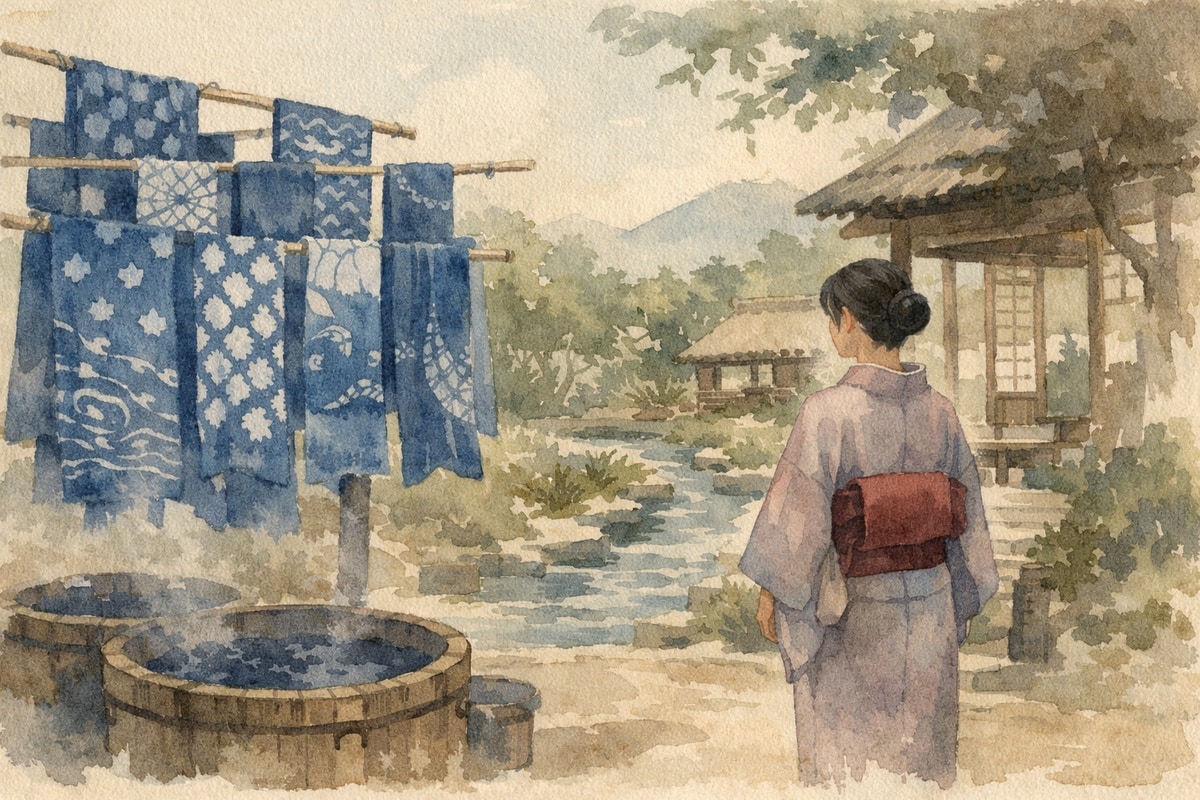
Around the time you start longing for the breeze of a lined-free summer kimono, a piece in deep indigo catches your eye. That deep blue looks so cool and refreshing, somehow endearing — so what exactly is aizome (indigo dyeing)? Let’s unravel a small story behind today’s single garment.
What kind of dyeing technique is aizome?
The indigo used in aizome is said by some to be humanity’s oldest dye. It was originally prized as a blue dye around eastern China, the Korean Peninsula, and the central Japanese archipelago. It’s said to have been brought to Japan from China by way of Korea about 1,500 years ago, during the Nara period. Tracing this history, we realize that what reaches our hands today has traveled an extraordinarily long road.
There are actually several methods of dyeing. There’s “namaha-zome” (fresh-leaf dyeing), which uses raw indigo leaves as they are, and “aidate-zome,” in which “sukumo” — leaves that have been dried and fermented — are reduced by microorganisms in a strongly alkaline solution. The principles behind the two are completely different. Sukumo is a natural dye made from the leaves of indigo plants in the knotweed family, and its main component, indigotin, is said to have the same molecular structure, chemically speaking, as synthetic indigo. The more you learn, the more you’re struck by the depth hidden within this single color, blue.
The historical connection between indigo and Japanese life
The earliest appearance of something resembling aizome in Japanese history is said to be in the kingdom of Yamataikoku. Items believed to be indigo-dyed have also been unearthed from Kofun-period sites, though it seems there is still debate over whether the dye used at that time actually came from Japanese indigo (tadeai).
In the Tenpyo era, aizome was used for wrapping treasured items, since the dyeing process alone made cloth more durable and gave it insect-repelling properties. By the age of the samurai, indigo dyeing — valued also for its antibacterial qualities — became a necessity for warriors constantly engaged in battle. It’s well known that samurai wore indigo-dyed undergarments beneath their armor, and recent research has found that natural indigo contains an antibacterial compound called tryptanthrin, whose antibacterial effects have reportedly been demonstrated. Perhaps this is why indigo blue was chosen not just for its beauty, but as a piece of everyday wisdom.
Research into its effects on the skin
Research from the Faculty of Education at Hirosaki University reportedly found that natural indigo contains components with therapeutic effects on skin conditions such as atopic dermatitis. That said, claims about insect- and snake-repelling effects tend to rest more on folklore and empirical tradition than on solid academic backing, so it’s worth keeping in mind that the strength of evidence varies. Not wrapping everything up into one tidy narrative feels like its own kind of honesty.
Why aizome has long been favored for summer kimono and yukata
The deodorizing, insect-repelling, and antibacterial properties attributed to aizome are reassuring indeed during the season when we sweat the most. The fact that so many yukata (a light cotton summer kimono) are indigo-dyed may owe not only to their cool, refreshing appearance but also to this practical usefulness layered underneath. For more on the difference between yukata and kimono, see Do You Know the Difference Between Yukata and Kimono?, which lays it out gently. The pairing of sheer kimono fabrics with indigo is also a distinctly summery sight. Take a look also at Ro, Sha, and Asa — The Cool Beauty Hidden in Sheer Kimono, and the wisdom behind dressing for coolness will come into even fuller view.
The difference between natural indigo and chemical dye
The term “pure indigo” might lead many people to imagine something natural, but in fact it refers to a synthetic dye made from petroleum. Synthetic indigo was successfully synthesized chemically by a German chemist in the latter half of the 19th century and went on to be industrialized. Dyes made using actual indigo plants are called “hon-ai” or “natural indigo,” and are distinguished from the synthetic kind. Since price and appearance alone can make it hard to tell the two apart, checking the place of origin and production method seems to be one useful clue when choosing.
If the indigo cloth in this story made you want to see it up close, this book follows where much of it ended up: boro textiles pieced together over generations, and the sashiko stitching that holds them. The photographs are large enough to study the stitches themselves, which is hard to do from a museum case.
Regional character in indigo patterns and origins — the story of Awa indigo
Tokushima Prefecture’s Awa indigo is renowned as a center of indigo production. “Awa-ai” refers to the indigo dyeing carried out in Tokushima Prefecture (the former Awa Province), or to the tadeai plants and sukumo used as its raw material there. It flourished under the protection and encouragement of the Tokushima domain and came to dominate Japan’s indigo-dyeing market. In 1903, the area under indigo cultivation in Tokushima peaked at roughly 15,000 hectares, but afterward, imports of precipitated indigo from India and synthetic indigo from Europe increased, and production plummeted. From the late Meiji era onward, it declined under pressure from imported goods.
Today, the beauty and texture of natural indigo are being reappraised, and the tradition is being carried on through the efforts of dyers known as “aishi.” Even so, there seem to be no shortage of challenges: the aging of producers, a lack of young successors to carry the work into the future, the difficulty of large-scale industrial production, and fewer everyday opportunities to encounter aizome. Perhaps this is the question of how to carry forward, from here, a path that indigo has quietly followed for so long.
When you wear a touch of indigo blue in your summer attire, it carries within it the long span of time since the Nara period, layered together with the handiwork of Tokushima’s indigo dyers. Thinking of the story woven into that single indigo garment that happens to catch your eye brings a certain quiet, stylish pleasure.
Articles on aizome, summer materials, auspicious motifs, and other topics in dyeing and weaving are gathered in the Guide to Textiles and Patterns.