
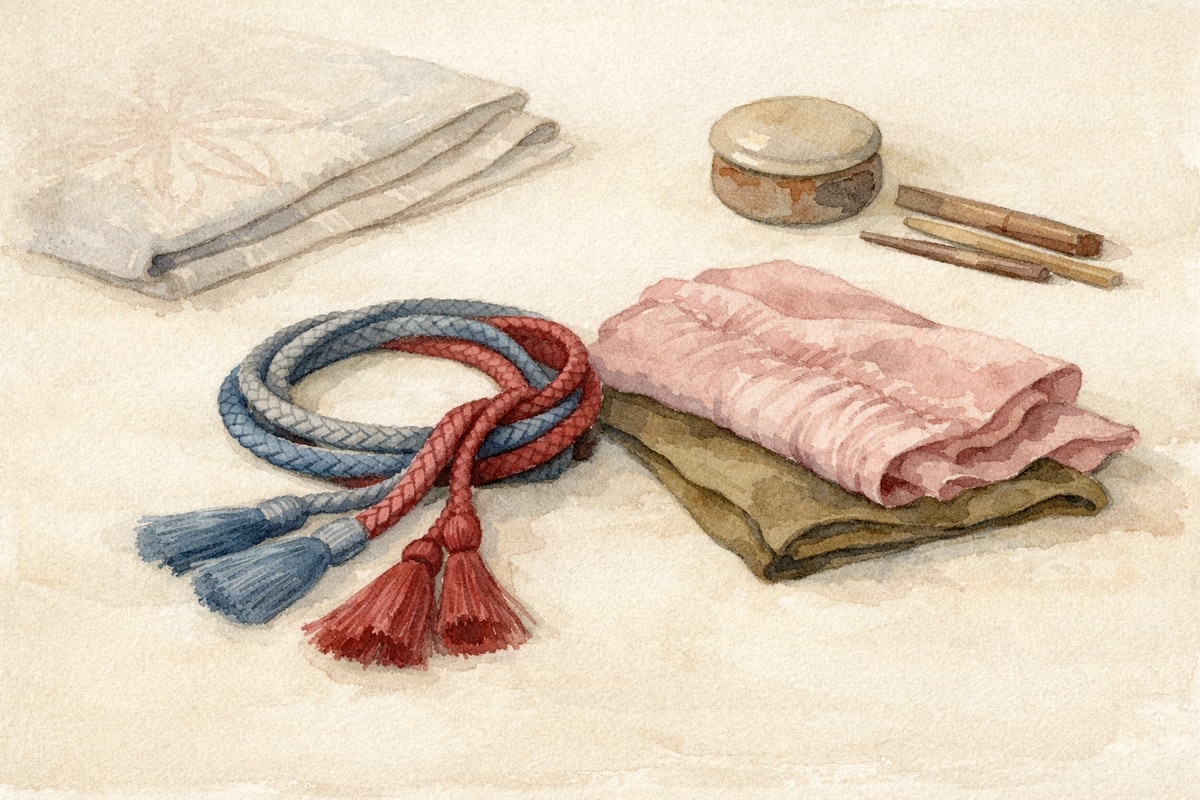
“When it comes to obijime (a cord tied over the obi) and obiage (a fabric accent above the obi), what color should I actually choose?” You’ve settled on your kimono and obi, but then you get stuck on these final accessories. For anyone in that position, here’s a rundown of how to choose based on formality and how to think about color matching.
🌸 The quick answer (for those in a hurry)
For formal wear (furisode or tomesode), the basic rule is hira-gumi or maru-gumi braids for the obijime, and white, gold, or silver for the obiage. For casual kimono, you’re free to choose any color or pattern. When it comes to color matching, picking up a color already in the obi is the safest approach.
Obijime: Differences by Formality
The braiding style of an obijime gives a rough indication of its formality level. For formal wear such as furisode (a long-sleeved formal kimono) or tomesode, choose the wider, more dignified hira-gumi, koma-gumi, or maru-gumi braids. For everyday kimono like houmongi (a semi-formal kimono) or komon (a casual kimono with a small repeating pattern), kaku-gumi or maru-kuge styles are more common.
| Braiding style | Formality level | Suitable kimono |
|---|---|---|
| Hira-gumi / Koma-gumi | Formal (high formality) | Furisode, tomesode, houmongi |
| Maru-gumi | Formal | Furisode and other formal wear for unmarried women |
| Kaku-gumi / Maru-kuge | Everyday wear | Komon, tsumugi, cotton |
*The above is a general guideline. Actual standards of formality can vary by shop, region, or school of kitsuke (dressing in kimono).
Obiage: Choosing by Occasion
For the most formal attire (such as black tomesode), the basic rule is to use only white, gold, or silver for the obiage. For furisode, showier options like shibori (tie-dyed) obiage are often chosen. For casual kimono, on the other hand, you have quite a lot of freedom with color and pattern.
Materials have their own uses too. Shibori creates a soft, gorgeous look and suits furisode; rinzu has a lustrous sheen and a calm, elegant impression suited to formal wear; and ro (a sheer, gauzy summer silk) and sha (a light open-weave sheer silk) have a translucent quality used for summer pieces (roughly June through September).
Thinking About Color Matching: There Are Several Schools of Thought
There are actually several approaches to matching obijime and obiage colors. The most commonly cited method is to pick up a color already present in the obi or kimono, but some kitsuke teachers instead suggest that pairing a contrasting (complementary) color to the obi looks more authentically “kimono-like.” Both approaches have their merits — there isn’t a single correct answer.
If you’re unsure about color matching, it helps to stand about 2 to 3 meters from a mirror and look at the overall balance. Rather than judging the obijime or obiage on their own, it’s easier to get it right if you evaluate the total impression once you’re actually dressed.
Frequently Asked Questions
Q. Should the obijime and obiage match in color?
A. Coordinating them in the same color is a popular, easy-to-follow approach, but it isn’t a strict rule. Some kitsuke teachers recommend pairing contrasting colors to sharpen the overall impression. Feel free to choose based on your own taste and the balance of the whole outfit.
Q. Can I use a formal obijime with an everyday kimono?
A. There’s no strict rule against it, but a high-formality obijime can sometimes feel a bit too showy for everyday wear. Choosing according to the occasion makes it easier to keep the whole look balanced.
Q. I find obiage knots difficult.
A. The basic knot is called “hon-musubi,” characterized by a symmetrical finish. There’s also the “ichimonji-musubi,” which stretches horizontally. It’s a good idea to start by practicing the hon-musubi first.
Summary
- For formal wear, aim for a dignified obijime such as hira-gumi or maru-gumi; for everyday wear, kaku-gumi or maru-kuge is the guideline
- For the most formal occasions, white, gold, or silver obiage is standard; for casual kimono, both color and pattern are free choices
- Matching the obiage and obijime to a color already in the obi is the safest approach — though pairing contrasting colors is another recognized approach (opinions vary)
- When in doubt, the most reliable method is to get dressed and check the overall balance in person
If you’d like to start from the basics of choosing the obi itself, see also The Difference Between Nagoya Obi and Fukuro Obi, and When to Wear Each 🌸 For other accessories like zori (flat kimono sandals) and bags, take a look at Choosing Zori and Bags: What’s Different for Formal vs. Casual Wear as well 🌸