
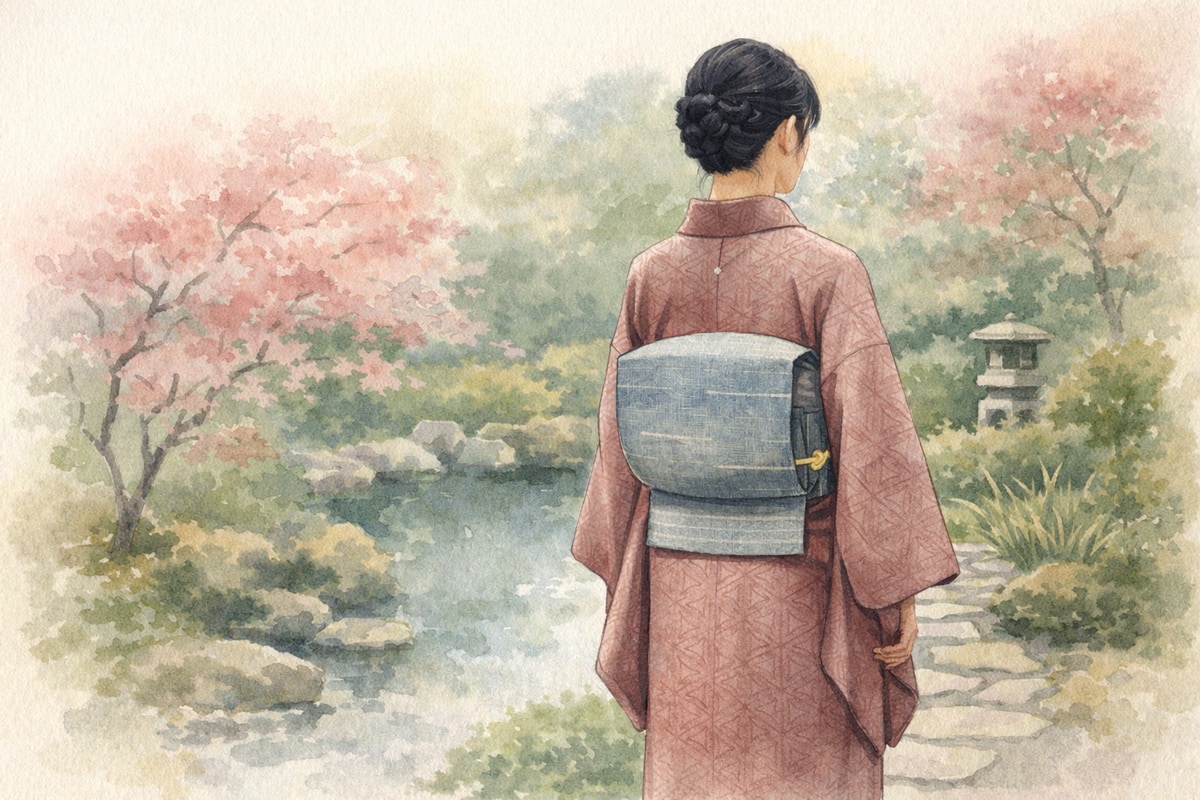
“I heard that switching to a stiffer collar stay gives you a crisp, beautifully opened emon—but doesn’t it end up hurting your neck?” Have you ever found yourself torn over this kind of question when choosing a collar stay for your nagajuban (an under-kimono)? The collar stay is such a tiny accessory, yet it has a surprisingly big effect on both how cleanly the emon opens at the back of the neck and how comfortable your neck feels over a half-day of wearing kimono. In this piece, we’ll sort out how collar stays differ by stiffness and material, and how to choose the right stiffness for you—useful for anyone who wears kimono.
Why Do We Use a Collar Stay in the First Place? A Quick Refresher
A collar stay is a long, slender insert that slides into the collar (eri) of a nagajuban. It’s made somewhat stiff on purpose, precisely so the collar doesn’t collapse or go limp. Nagajuban made of pure silk (shoken) are especially soft and prone to wrinkling, so inserting a collar stay helps keep the collar area crisp and resistant to the kimono coming loose (kizukure). The basic rule when choosing one is to pick a stay that’s long and wide enough to fill the full width of the nagajuban’s collar. If it’s too short or too narrow, even a nicely stiff stay won’t transfer that firmness to the collar properly.
Collar Stay Materials and Stiffness: Getting the Big Picture First
Collar stays generally come in three stiffness levels—hard, medium, and soft—and the range of materials is surprisingly wide too: plastic types, rinzu (a glossy, yarn-dyed silk-like fabric), mesh, cloth, paper, and even metal or wire-reinforced versions. Let’s run through the basic characteristics of each.
- Plastic (poly) collar stays: The most commonly used, standard option. Thin but with just the right amount of stiffness, and smooth on the surface. Affordable too—this is the one beginners typically pick up first.
- Rinzu collar stays: The stiffest and firmest of the materials, and also pricier. Considered well-suited to heavier, substantial kimono.
- Mesh collar stays: A breathable, net-like material that’s soft and offers good airflow.
- Cloth collar stays: Soft and pleasant against the skin, though they tend to wrinkle and take a while to dry.
- Paper collar stays: Breathable and good at absorbing sweat, but less durable and weak against water, so they require a bit of care in handling.
- Metal or wire-reinforced collar stays: Hold their shape firmly, but are heavier and more expensive as a result—a choice suited to formal occasions.
There’s no single “correct” material here—the right stiffness really comes down to the wearer’s preference, body type, and the occasion. With that in mind, let’s look more closely at exactly how stiffness affects the emon.
The Relationship Between Stiffness and How Cleanly the Emon Opens
Whether the emon—the spot where the back of the kimono collar is pulled slightly down and open—looks clean and crisp depends a great deal on the stiffness of the collar stay.
A hard collar stay, such as rinzu or rigid plastic types, makes the collar stand up crisply, giving a clearly defined emon. The catch is that if it’s too stiff, it can press against the neck and cause discomfort, or fail to follow your movements naturally, looking a bit stiff or unnatural. In fact, while rinzu collar stays are the firmest and give the cleanest emon, they also tend to feel tight around the neck, and some say they’re not ideal for people prone to shoulder stiffness. Hard plastic collar stays share a similar trait: they hold the emon up firmly but don’t conform easily to the neck and shoulders.
On the other hand, mesh collar stays are the softest, easiest on the shoulders, and well ventilated—but the trade-off is that they’re the weakest at holding the emon open. Think of it as “cool and comfortable, but a softer, less defined emon.” That said, some summer mesh-plastic collar stays manage to stay soft while still holding the emon up nicely, with the sides sitting close to the neck and moving naturally with the body—so it’s not quite right to assume “mesh always means a weak emon.”
Where you land on this balance—between “stiff equals crisp” and “soft equals comfortable”—is really the central question when choosing a collar stay.
Choosing by Kimono Type and Season
Now that we understand how stiffness affects the look, let’s go over some general guidelines for which type suits which occasion.
- Formal to semi-formal (furisode, houmongi, tomesode, etc.): A medium-to-hard curved stay is a good benchmark. For formal, substantial kimono like furisode (a long-sleeved formal kimono), a thick, firm rinzu-type stay is considered ideal, said to let the collar stand up beautifully while still being relatively gentle on the body.
- Casual (komon and other everyday kimono): A softer stay is the general guideline.
- Casual and summer wear (yukata, lightweight kimono, hot weather): A soft, clear or mesh stay works well. Breathable mesh materials are often chosen for midsummer kimono made of ro (a sheer, gauzy summer silk), sha (a light open-weave sheer silk), or asa (linen/hemp), though being soft, they’re not well suited to heavier lined (awase) kimono—so this is a point worth adjusting by season.
As a general seasonal thickness guide: in midsummer, one thin or mesh-type stay; during the typical Coming-of-Age ceremony season when lined and unlined kimono are most common, one standard-thickness rinzu-type stay; and in winter or for formal occasions, one thick stay, or even two layered together. Keeping the rough idea of “thin and soft for hot weather, thick and firm for formal occasions” in mind makes choosing much easier.
The material of the nagajuban itself also affects how the collar area turns out, so if you’re curious, it’s worth also checking out our gentle guide to choosing a nagajuban by material, type, and season.
Pairing with the Haneri, and Finding What Works for You
A collar stay isn’t used on its own—it slides inside the haneri (a decorative collar layered over the nagajuban’s collar). How easily it slides into the haneri is actually an understated but important factor in choosing one. Poly collar stays are said to be neither too stiff nor too soft, making them easy to slip inside the haneri—another reason they’re considered beginner-friendly. For more on choosing and attaching a haneri by material and season, take a look at our gentle guide to choosing and attaching a haneri.
With all this in mind, the basic approach to choosing a collar stay is simple: go firmer if you want a crisp, beautiful emon for formal occasions, and go softer if comfort matters more for long hours of wear or casual outings. That’s the core principle. From there, layer in seasonal and situational thinking—mesh for breathability in summer, thick rinzu or curved stays for winter and formal wear—and the choice becomes much less confusing.
Plastic collar stays are affordable and easy to handle, so starting with one of those, then gradually adding a rinzu type as formal occasions come up, and a mesh type for summer, is a sensible way to build up your collection bit by bit. Choose at your own pace, based on how your neck feels and the occasions you’ll be wearing kimono for.