
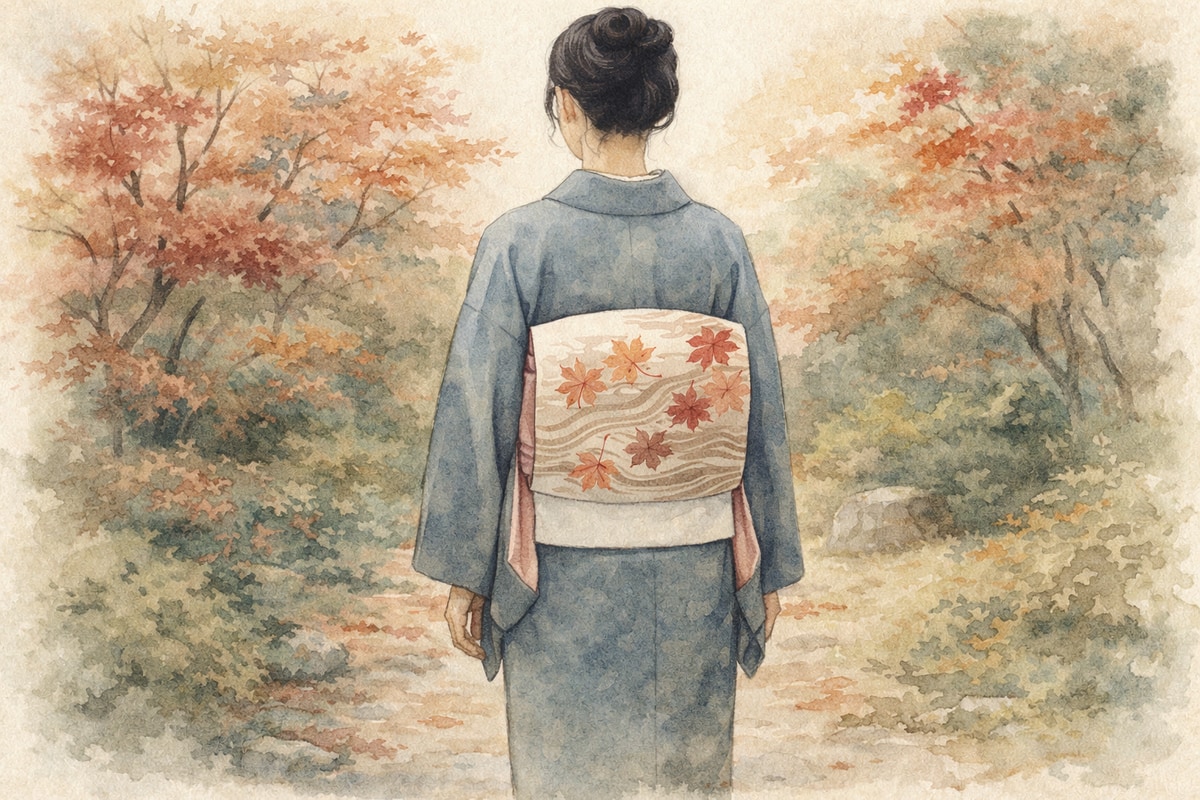
Every time you take a Tatsutagawa-pattern obi (the wide sash tied around a kimono) out of the drawer, you pause at the same question — how long is it really okay to wear this? The maple leaves have long since fallen, yet within the obi they’re still flowing in brilliant color. It’s the small hesitation that comes with wearing a kimono dressed in a seasonal motif (monyou). This article is for anyone who owns a Tatsutagawa-pattern obi, unpacking when it’s appropriate to wear one and the thinking behind it.
What is the Tatsutagawa pattern, and what scene does it depict?
The Tatsutagawa pattern is a traditional Japanese motif that renders maple leaves scattered and flowing across a river’s surface. The Tatsuta River, which runs through Ikaruga in Nara Prefecture, has long been famous for its autumn foliage and even appears in a waka poem by Ariwara no Narihira: “Even in the age of the gods, I have never heard of such a thing — the Tatsuta River tie-dyed deep crimson with water.” The poem likens the river’s surface, dyed a deep red, to tie-dyed cloth. That very scene became the pattern itself. The heart of the Tatsutagawa pattern isn’t the maple leaves alone, but the combination of maple leaves and flowing water.
If you’d like to learn more about the origin and meaning of the design, also read What Is the Tatsutagawa Pattern? An Autumn Kimono Story Woven from Maple Leaves and Flowing Water.
The general guideline for when to wear it
To get straight to the point, the Tatsutagawa-pattern obi belongs mainly to autumn, with October through the end of November as its core season. In the world of kimono, there’s an idea that it’s stylish to anticipate the season slightly ahead of time, so it’s considered fitting to start wearing autumn-leaf patterns from around early October, a bit before the foliage actually peaks. Given that the leaves tend to peak from mid- to late November in many regions, it makes sense for the obi to herald autumn a little early — a nicely balanced touch.
On the other hand, once the leaves have fallen and winter has set in from December onward, wearing the pattern starts to feel like “catching up late,” and it’s best avoided. Just as wearing a cherry-blossom pattern after the blossoms have scattered feels oddly wistful, a pattern worn after its season has passed inevitably looks behind the times. This is a principle that applies to seasonal motifs in general, not just the Tatsutagawa pattern: anticipating the season is stylish, trailing behind it is unrefined.
How the drawing style and colors change the thinking
That said, not every Tatsutagawa-pattern obi is confined to “October and November only.” This is where the pattern gets interesting: even within the same Tatsutagawa design, the sense of season can shift dramatically depending on how the maple leaves are rendered.
An obi where deep crimson maple leaves flow in a realistic style is the very symbol of autumn. Because the seasonal association is so clear, its wearable period narrows to October and November. On the other hand, an obi depicting green maple leaves still unturned — known as aokaede — alongside the red foliage is said to be wearable across a wider span, from early summer through autumn. Since aokaede is also used on its own as an early-summer motif, pairing it with autumn foliage lets it serve as a bridge between seasons. Because leaves still tinged green and leaves already turned crimson coexist in the same design, the wearable season widens too — that’s the depth and versatility of the Tatsutagawa pattern.
Furthermore, a design called “oka” that combines cherry blossoms and maple leaves is considered appropriate year-round. By letting the symbol of spring and the symbol of autumn share a single obi, the design is treated as one that isn’t tied to any particular season. A seasonal pattern that transcends the seasons — a wonderfully stylish idea.
Patterns where the maple leaves are rendered abstractly, or scattered together with various other plants in a “fukiyose” (windswept) arrangement, are also sometimes considered acceptable year-round. Whether the maple leaves in the obi assert “autumn itself” or blend in quietly as “a memory of autumn” seems to be what determines how wide a window the piece can be worn in.
The Tatsutagawa pattern also appears on summer garments
It may come as a surprise, but the Tatsutagawa pattern sometimes appears on summer pieces such as yukata (a light cotton summer kimono). Even a design with crimson maple leaves flowing by can be chosen as a way to evoke a cooling breeze, anticipating the autumn to come in the midst of summer’s heat — a motif selected for its sense of coolness. Letting your eye rest on maple leaves flowing a little ahead of their season, even in the depths of summer heat, is its own kind of refreshment within the world of kimono. If the maple leaves are rendered in blue-green tones, they fit even more naturally as an early anticipation of early summer.
That said, this applies within the context of yukata and other summer garments. When the obi itself takes center stage with a large, bold rendering of maple leaves, the seasonal association becomes unmistakable, so wearing a Nagoya obi with large, vivid crimson maple leaves in the height of summer may be a touch too premature. The scale of the pattern and the mismatch in season can surprisingly affect the overall impression.
Choosing for year-round versatility
If you’re choosing a Tatsutagawa-pattern obi, it helps to first decide how wide a seasonal range you want it to cover — that will make the choice much easier. If you want to enjoy it as a special piece just for autumn, look for a realistic combination of maple leaves and flowing water. If you’d like it to serve you from spring through autumn, consider a design paired with aokaede or combined with cherry blossoms (oka), or one with an abstract, stylized rendering of the leaves.
If you’re unsure what color kimono to pair with the obi, What Color Kimono Pairs with a Tatsutagawa-Pattern Obi? A Gentle Guide for When You’re Unsure may also help. Once you consider the overall coordination and not just the obi’s pattern alone, judging the season becomes much easier.
In closing
A Tatsutagawa-pattern obi is, in essence, an autumn piece — with October through the end of November as its main season. That said, the range can shift considerably depending on how the pattern is drawn: a design paired with aokaede allows you to start wearing it from early summer, while one paired with cherry blossoms (oka) is considered wearable year-round. The more realistic and vivid the coloring, the narrower the season; the more abstract the design, the wider the range. Keep this simple measure in mind, and you’ll spend less time hesitating in front of the drawer. As evenings grow shorter and word of the turning leaves begins to arrive, why not let today’s obi carry a small story of its own?