
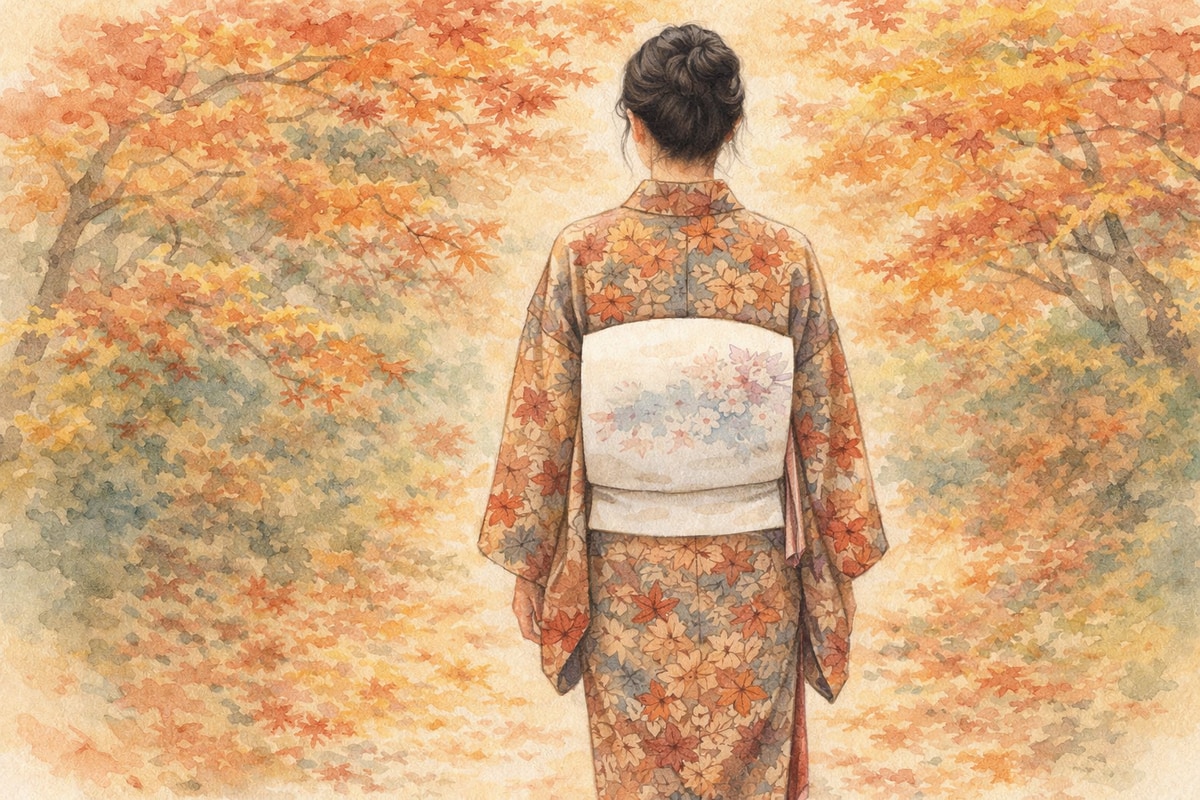
You’ve already settled on the Tatsutagawa motif for your autumn leaf-viewing kimono—good, that part’s done. But here’s where things get tricky: picture that same pattern on a komon (a casual kimono with a small repeating pattern) bolt versus a tsumugi (a textured, hand-woven silk) bolt, and you end up with two completely different garments. The motif is decided, but the choice of fabric brings you to a standstill. For anyone in that position, today we’ll unpack, one by one, the other motif options beyond Tatsutagawa and how to think through the komon-versus-tsumugi question.
Beyond Tatsutagawa, Many Motifs Speak of Autumn
The Tatsutagawa motif pairs flowing water with maple leaves. It’s a time-honored combination said to be based on a waka poem by Ariwara no Narihira in the Kokin Wakashu. But autumn kimono motifs don’t end there. There’s “chiri momiji” (scattered maple leaves), which depicts maple leaves alone, and “fukiyose,” which gathers nuts and fallen leaves into a single design—both of these speak to autumn in a quieter way.
There’s also the “autumn grasses” motif (akikusa monyou), which brings together the seven autumn grasses—Chinese bellflower, bush clover, maidenflower, pink, kudzu, pampas grass, and thoroughwort—often mixed with gentian and chrysanthemum. With so many flowers represented, it’s a wonderfully lavish design, almost as if a whole autumn meadow has been captured within a single garment. Unlike Tatsutagawa, it includes no flowing water, giving it a quieter, more understated impression. For guidance on the best time of year to wear each of these motifs, see our article Autumn Motifs Beyond Tatsutagawa: How to Choose a Seasonal Pattern.
Komon vs. Tsumugi: A Quick Refresher on the Difference
Once you’ve settled on a motif, the next step is choosing the fabric. You may know the names komon and tsumugi, but have you ever found yourself at a loss trying to explain the difference between them?
Komon is a “dyed-after-weaving” kimono: the white cloth is woven first, and the pattern is dyed on afterward. The same pattern repeats across the entire fabric, and it’s basically worn for non-ceremonial occasions—meals with friends or family, the theater, shopping, or lessons. In terms of formality it ranks relatively casual, classified as a dressy everyday kimono.
Tsumugi, on the other hand, is a “dyed-before-weaving” textile: the thread is dyed first, then woven. It’s enjoyed as a dressy or everyday kimono, but no matter how expensive a piece of tsumugi may be, in terms of formality it can never be worn to formal occasions such as weddings or tea ceremonies. Price is one yardstick, formality is another—the two run quietly side by side, and separately. This is the single most important fact to keep in mind when choosing tsumugi.
There are exceptions, though. Among Edo komon, the three patterns known as the “san-yaku” (three ranks)—same komon, kakudoshi, and gyogi—can be worn as semi-formal dress if a family crest is added. You likely won’t need to worry about formality to that degree for leaf viewing, but knowing this adds another layer to how you see kimono.
Choosing Komon or Tsumugi for Leaf Viewing
So which should you choose for a day of leaf viewing? The key clue lies in what comes afterward.
If your day is a casual one—strolling to view the leaves and then heading straight home—tsumugi is an easy, unpretentious choice that moves well with you. Because it’s a fabric suited to everyday wear, travel, and walking, it also suits the feel of stepping through fallen leaves. On the other hand, if your leaf-viewing outing is followed by a kaiseki meal or a somewhat formal tea gathering, komon fits the occasion better. As a dressy everyday kimono, komon is versatile enough to carry you from a walk through town to a meal or the theater.
In discussions on Yahoo! Chiebukuro, people have noted that the choice between komon and tsumugi often comes down to the venue and the type of meal involved. This lines up with the general principles of kimono formality, too: once you center your thinking on “where am I going after this,” the indecision clears right up.
How to Pair Motifs with Fabric
Some motifs suit both komon and tsumugi equally well. The wild goose motif, for instance, pairs easily with tsumugi, komon, and Edo komon alike, and is considered suited to autumn strolls, the theater, and other relaxed outings. The cockscomb flower motif also pairs well with komon, tsumugi, and solid-color kimono (iromuji), making it suitable for autumn outings, meals, and seasonal gatherings. Rather than letting the motif choose the fabric, it may be easier to let the occasion choose the fabric first, then let the motif follow—thinking in that order makes the combination far less daunting.
The maple-leaf motif (kaede-mon), which depicts the shift from green maple to red autumn foliage, is often used in komon and obi designs. It’s an easy pattern to work with, since simply changing the color of the obiage (a fabric accent above the obi) can shift the seasonal mood. Chrysanthemum motifs, meanwhile, are considered an auspicious pattern (kissho monyou), and when worked into a komon, can produce a piece wearable year-round regardless of season. If you’d rather choose a piece you can wear for years to come, rather than one made solely for leaf viewing, these more flexible motifs are worth considering too.
There’s also a subtler way to enjoy the season: rather than using a maple or autumn motif on the kimono or obi itself, you can tuck a maple motif quietly into an obidome (an obi clasp) or other obi accessory. Deer, persimmons, chestnuts, chrysanthemums, cosmos, or even a playful nod to Tatsutagawa rendered in a small accessory—this is the kind of playful touch favored by seasoned kimono wearers, and a world that only deepens the more you learn about it.
Planning Your Footing for the Day
Once the fabric and motif are decided, all that’s left is planning how you’ll spend the day. Leaf viewing often involves walking through hills and woods, and whether you’re wearing komon or tsumugi, managing the hem and guarding against stains are shared concerns. For details on staying comfortable underfoot and protecting your kimono from dirt, see our article Wearing Kimono for Leaf Viewing: Tips for Walking Comfortably and Avoiding Stains—worth a read before the day arrives.
As the trees deepen in color and fallen leaves gather underfoot, discovering that Tatsutagawa isn’t the only pattern for leaf viewing opens up a whole new world of choices. Decide on the motif, picture the occasion, then choose the fabric that suits it—keep that order in mind, and you’ll never again find yourself stuck between komon and tsumugi. Let today’s kimono carry a small story of its own.