
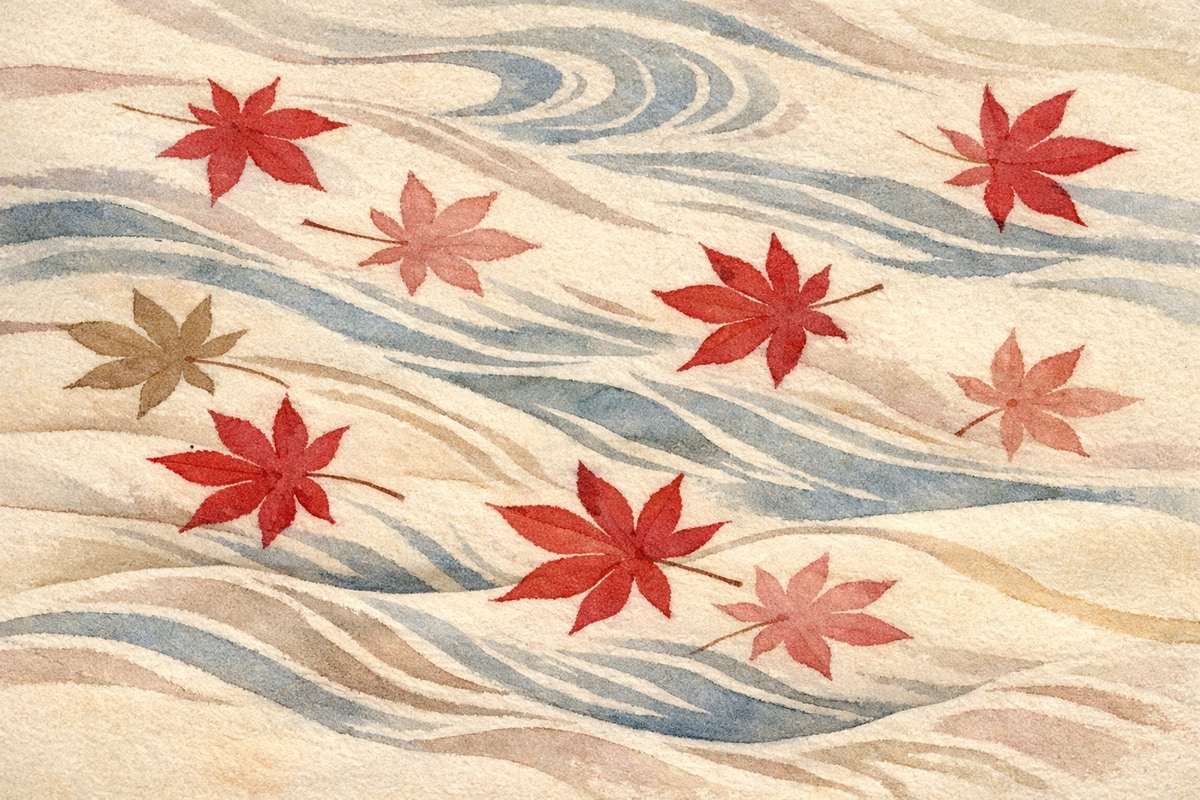
On your way home from leaf-viewing, have you ever noticed a red leaf drifting across the hem of someone’s kimono? That’s no accidental pattern — it’s a proper motif with a name: the Tatsutagawa motif. But why would a design of autumn leaves be named after a river? Unravel it, and you’ll find a classical poem hidden within.
Maple or Autumn Leaves — Why Two Names for the Same Tree
When talking about kimono patterns, the very same tree’s leaves can go by different names depending on the season. The green leaves before they change color are called “ao-kaede” (green maple), while the leaves that have turned red are called “momiji” (autumn leaves, or maple). In the world of kimono, the basic idea is that green maple belongs to early summer, and autumn leaves belong to autumn. A design that shows both green and red leaves together in a single motif is considered wearable in either early summer or autumn — a wonderfully versatile pattern that carries across seasons.
Unraveling the Tatsutagawa Motif: The Story Behind the Poem
Among autumn-leaf patterns, one of the most commonly seen is the motif called “Tatsutagawa.” It depicts fallen maple leaves seeming to float on a pattern of flowing water. Tatsutagawa is the name of an actual river that flows through the Ikoma mountains in Nara Prefecture. Known since ancient times as a famous spot for autumn foliage, it was celebrated by the 9th-century poet Ariwara no Narihira in his poem beginning with “Chihayafuru,” which describes the Tatsutagawa river dyed a brilliant red with scattered autumn leaves. This poem is the very origin of the name behind the Tatsutagawa motif. Rather than simply depicting autumn leaves, the design captures the entire scene of leaves drifting on the river’s surface by combining them with flowing water — that is the essence of the Tatsutagawa motif. Once you know the meaning behind the design, the same autumn leaves start to look different, and that’s part of what makes it so interesting.
When it comes to the connection between autumn leaves and kimono motifs, it’s also worth knowing about the autumn grasses motif (akikusa monyou), which broadens your options for autumn kimono choices. Featuring autumn flowers and grasses such as bush clover and Chinese bellflower, it offers a different expression of autumn compared to the Tatsutagawa motif.
When to Wear It: A Season Ahead of Nature
As for when to wear autumn-leaf patterns, the general guideline is from September through November. Actual autumn foliage reaches its peak around late November, but it’s considered more elegant to wear the kimono motif slightly ahead of the actual season. You put your sleeves through the design before the leaves themselves begin to change color — anticipating the season rather than following it. This idea runs throughout kimono pattern selection in general; for instance, wearing a cherry blossom motif starting in the depths of winter comes from the same way of thinking. Rather than chasing the real-world season, dressing just a step ahead of it — that’s part of the playful spirit unique to kimono.
That said, this rule doesn’t apply to every autumn-leaf design. If the autumn leaves are rendered realistically, you do need to be mindful of timing, but if the motif is abstracted, or combined with flowers from other seasons, it’s considered wearable year-round. The first step in choosing a seasonal pattern is figuring out whether the design depicts a specific, realistic scene, or whether it’s meant to be enjoyed as a stylized pattern.
Tatsutagawa is one of many kimono motifs drawn from poems and stories. If you’d like to explore more of them, this introduction arranges motifs by season and includes scenes from literature and history, with hundreds of photographs and notes on each. Please check the product page for current details.
In Summary: Wear It at Its Most Beautiful Moment, Just Before It Falls
The Tatsutagawa motif is not merely a pattern of autumn leaves — it’s a design that captures the scene of a river as sung in a Heian-era poem. Keep in mind the general timing — green maple for early summer, autumn leaves for autumn — alongside whether the design is realistic or abstract, and you’ll find it much easier to choose an autumn-leaf kimono with confidence. As the trees begin to turn color, quietly slip your sleeves through the pattern just a touch ahead of them — why not add a small story to today’s outfit?