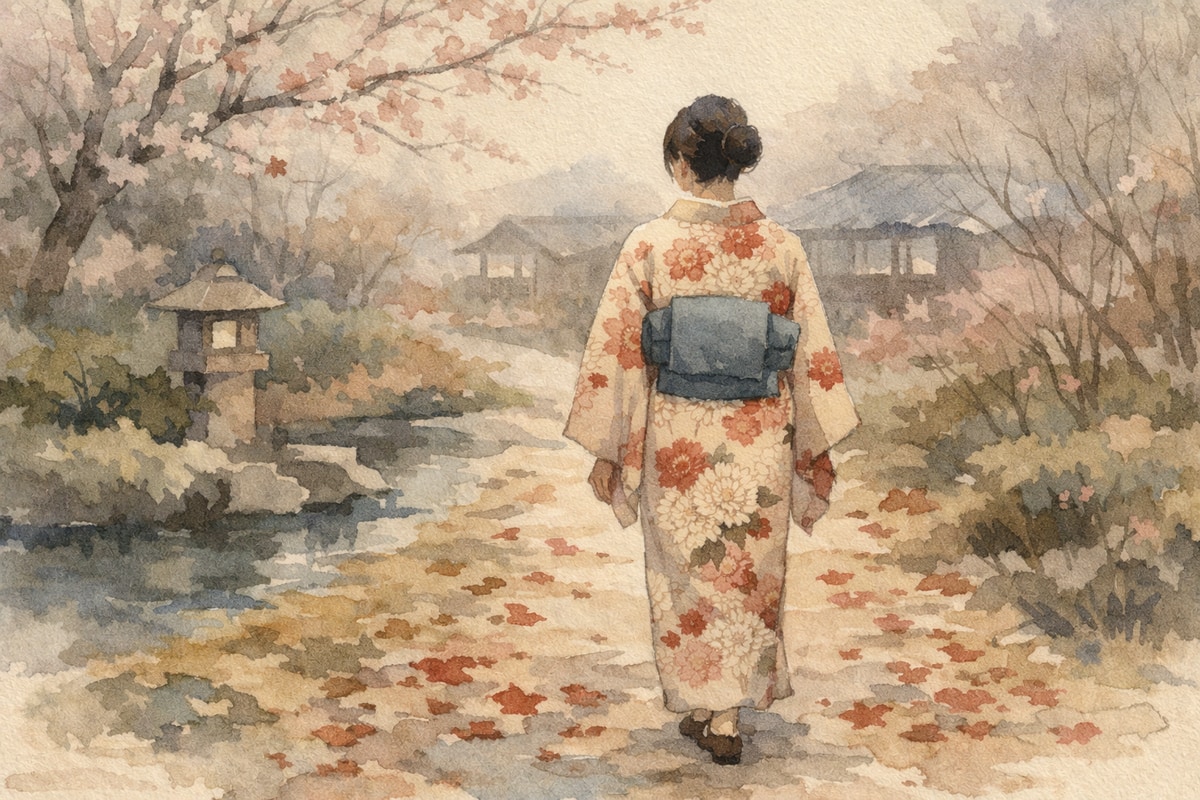
If you already know the Tatsutagawa pattern, this is especially for you. That motif pairing autumn foliage with flowing water is the star player of autumn kimono. But wear the same pattern again and again, and you may start to wonder what other designs are out there. Today, let’s set aside the story behind Tatsutagawa itself for a moment and turn our attention to other motifs that capture the essence of autumn.
What to wear after Tatsutagawa
The basic idea behind kimono patterns is to wear them a little ahead of the season — slipping into a motif before the real flowers are even in full bloom. That quiet, anticipatory elegance has long been part of kimono culture. Autumn, as it turns out, is a season remarkably rich in motifs. Beyond maple leaves, chrysanthemum, grapes, and the grasses and flowers known as autumn grasses each speak of the season in their own distinct way.
To cut to the conclusion: if you sort autumn motifs into three families — “maple-leaf motifs,” “chrysanthemum and auspicious motifs,” and “autumn-grass motifs” — choosing becomes much less confusing. Let’s unpack each one.
Motifs that express autumn, beyond Tatsutagawa
The first thing that catches the eye is a motif depicting maple leaves on their own. Tatsutagawa combined maple leaves with flowing water, but there are also quieter autumn motifs: “scattered maple leaves” (chiri-momiji), showing leaves alone, and “fuki-yose,” which gathers nuts and withered leaves together. These are often paired with sasanqua blossoms or pine needles, evoking the feel of a late-autumn garden.
Next is the chrysanthemum motif. It’s a flower that represents autumn, yet it also carries the face of a traditional motif (monyou) wishing for longevity. There’s even a combination called “kikusui” (chrysanthemum and water), inspired by a Chinese legend of someone who lived a long life after drinking dew gathered from chrysanthemums — the more you learn, the more you realize how many stories are layered into a single flower. Because of its auspicious nature, chrysanthemum is considered wearable year-round rather than belonging to autumn alone, which is part of its understated sophistication.
Then there’s a motif that’s easy to overlook: the grape pattern. Because grapevines bear so much fruit, they’ve long symbolized abundance and a wish for descendants to flourish, and have been cherished as an auspicious motif since the Nara period. The “grape arabesque” (budou karakusa), which combines grapes with scrolling vine patterns, is a classical design tracing back to the Shosoin treasure repository, and it too has the versatility to be worn all year round. It may look heavy at first glance, but it’s actually a reliable motif for any season — that duality is part of its charm.
And one more not to forget: the autumn-grass motif. It depicts bellflower, bush clover, maidenflower, wild pink, kudzu, Japanese pampas grass, and thoroughwort — together known as the seven autumn grasses — sometimes mixed with gentian or chrysanthemum. The story goes that this motif became established as a pattern for formal dress from the Momoyama period onward. Interestingly, because of the principle of wearing patterns ahead of the season, this motif of delicate, fleeting flowers is often actually used on summer kimono and obi. In other words, it’s worn to usher in the cool of autumn before autumn itself arrives.
Motif scale and rough timing guide
So when, roughly, should each of these be worn? Reference guides offer some general guidance.
- Bush clover: roughly mid-August to early September
- Bellflower: roughly early September to early October
- Chrysanthemum: roughly early September to early October (though as an auspicious motif, it can be worn year-round)
- Maple leaves: roughly early September to November (abstract renderings, or designs paired with spring flowers like cherry blossoms, can be worn year-round)
- Grapes: a wide range from July to November, with classical designs combined with scrolling vines wearable year-round
Laid out this way, it becomes clear that autumn motifs are basically worn a bit earlier than the actual season. You might picture the flow like this: bush clover and bellflower usher in autumn from the lingering heat of August; maple leaves and chrysanthemum take over from September into October; and from November, the baton passes to winter designs like pine-bamboo-plum or snow-ring motifs. Picture that progression, and it becomes a map for whenever you’re unsure which pattern to choose.
If you’re planning to go leaf-viewing, it can be fun to choose a slightly earlier motif so your kimono pattern doesn’t overlap too closely with the actual turning of the leaves. Factor in ease of walking and stain prevention for your outing as well, and the day’s outfit becomes even more enjoyable to plan.
What happens if you wear autumn motifs in spring or summer?
So conversely, what happens if you wear an autumn motif out of season? Wearing maple leaves or autumn grasses in the height of summer would indeed feel out of step with the season. But not every motif works this way. Chrysanthemum, classical designs like the grape arabesque, and abstractly rendered maple leaves carry the face of auspicious motifs that aren’t tied to a single season, so there’s nothing odd about wearing them year-round.
In short, “realistic motifs where the shape of the flower or leaf is clearly recognizable” are season-specific, while “motifs stylized as auspicious patterns” can be worn year-round — keep this yardstick in mind, and choosing a kimono becomes much easier. It’s a different measure altogether from whether something is expensive or inexpensive; it’s about the nature of the motif itself.
In closing
Beyond Tatsutagawa, autumn turns out to have a remarkably rich vocabulary of motifs: fuki-yose and scattered maple leaves depicting the foliage itself, chrysanthemum wishing for long life, grapes symbolizing abundance, and autumn-grass motifs celebrating fleeting beauty. In every case, it’s true to kimono tradition to slip into these patterns a little ahead of the actual season. The next time the faint scent of fragrant olive drifts by and you’re choosing a piece from your closet, I hope today’s story comes to mind as a small guide — that, after all, is the pleasure of unraveling the meaning behind seasonal motifs.