
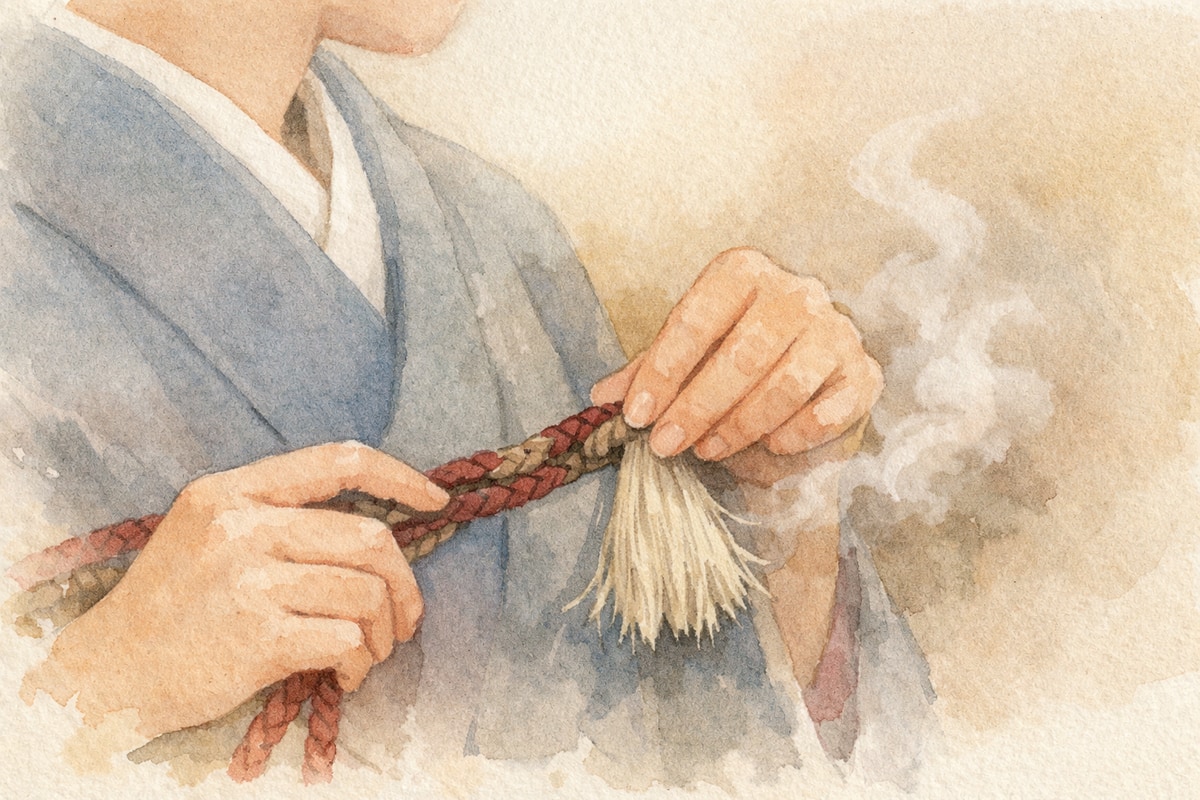
Have you ever pulled out an obijime (a cord tied over the obi) you hadn’t used in a while, only to find the tassels at the ends all fluffed up and messy? Even after a beautifully done kitsuke (dressing in kimono), messy tassels can leave a disappointing impression. But don’t worry — a little know-how can fix frayed tassels, and a few small changes to how you store them can make them much less likely to fray in the first place. In this piece, let’s go through why obijime tassels get messy, how to fix them yourself, and how to store them so you won’t have another “oh no” moment the next time you open the drawer.
Why do the tassels fray or fluff up?
Obijime tassels are often hand-braided from pure silk (shoken) — meaning they’re woven from silk thread — made up of many fine silk strands bundled together. These silk threads actually behave a lot like human hair: repeated friction, humidity, and dryness can cause them to develop quirks or tangle over time. The tassels can get mussed up simply from the kimono rubbing against them while being worn, but putting the obijime away in a drawer with the tassels left messy and unstraightened is one of the biggest causes of fraying. Machine-braided obijime sometimes use synthetic fiber, and because these have less body, they tend to loosen more easily. Tassel fraying isn’t some special problem — it’s simply something that happens naturally to silk thread with use. That’s exactly why it helps to know both how to fix it and how to prevent it.
How to fix it yourself
When the tassels have gotten fluffy and messy, the basic fix is to apply steam to soften the silk threads, then smooth them back into shape. There are several ways to do this, and all of them can be done with things you likely already have at home.
- Boil water in a kettle and hold the tassel near the spout to let the steam dampen it
- Apply only the steam from a steam iron to the tassel (be careful not to let the iron itself touch the tassel directly)
- Open the lid of an electric pot and let plenty of steam rise onto the tassel
- Combing the tassel while applying warm air from a hair dryer is also said to work well on silk thread
Once the tassel is nicely dampened with steam or warm air, lightly squeeze it in your palm or give it a gentle twirl, then comb it out with a comb (such as a boxwood comb) — you’ll be surprised how straight it becomes. This same method works whether the tassel is a cut-end type or a twisted type. After straightening it, don’t put it straight back in the drawer — be sure to let it air out thoroughly in a well-ventilated spot before storing it. If you put it away while still damp, it will quickly develop the same quirks again.
Storage methods to prevent fraying
It would be a shame to fix the tassel once, only to have it fray again. So it’s worth putting a little extra thought into your everyday storage.
One easy method is to wrap the tassel in kaishi paper or hanshi paper and secure it lightly with cellophane tape. If you cut the washi paper to match the width of the tassel and wind it from the cord section down toward the tip, the shape holds nicely. Some people even use clear plastic file folders from a 100-yen shop, cut to fit the tassel’s shape. Using a ready-made gauze “tassel cover,” or a clear cover that wraps either just the tassel or the whole obijime, can prevent fraying with even less effort. Simply wrapping the tassel in tissue or thin paper also helps.
And as a basic rule of storage, always put the tassel away neatly straightened. If you toss it into the drawer still messy, all that extra effort goes to waste. After wearing, airing it in the shade for about half a day and then storing it with a tassel cover — making this a habit will give you peace of mind. If you’d like to revisit how you choose your obijime and obiage (a fabric accent above the obi) in the first place, this article may also be helpful: How to Choose Obijime and Obiage: The Basics of Formality and Color Matching
When to consider replacing it
An obijime made of shoken can’t be washed at home, so if it gets dirty, it needs to be sent out for cleaning. White or off-white ones can reportedly be sent for “Kyoto cleaning,” the same as obi and half-collars. Synthetic obijime, on the other hand, can be washed at home, but since they tend to have less body and loosen more easily, it’s worth keeping an eye on how the tassels hold up too. If steaming no longer helps the tassel come back together, that can be taken as a sign it may be time to consider replacing it. Since this is an item meant to last a long time, it’s also worth reviewing your overall approach to kimono storage — including how you handle tatoushi (a paper wrapper for storing kimono) and everyday care. How to Store Kimono: A Practical Guide to Tatoushi, Mothballs, and Humidity Control
In closing
Obijime tassels tend to fray simply because of the nature of silk thread — it’s hard to avoid entirely. But with just a bit of steam and some smoothing by hand or with a comb, they can be restored to a surprisingly neat state. And after fixing them, wrapping them in a tassel cover or kaishi paper and storing them neatly straightened — make that your habit, and you won’t have another “oh no” moment the next time you open the drawer. Don’t worry, there are really just two things to remember: “fix with steam” and “store it straightened.” With just a little effort, your obijime will stay looking beautiful for a long time to come.