
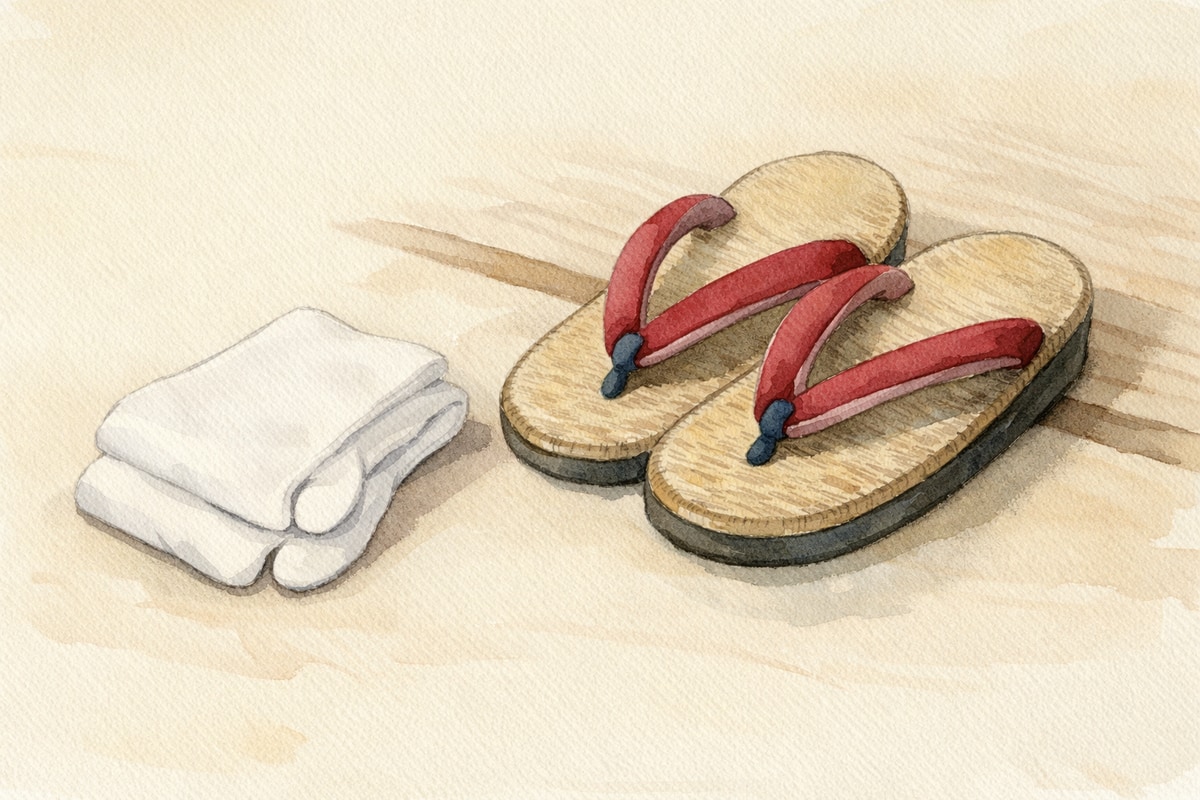
The first pair of tabi socks almost always goes wrong in one of two places: the big toe feels squeezed into its own little pocket like it’s wearing a shoe within a shoe, or the split is so loose it slides around and stops doing its job. Neither problem means tabi socks are a bad fit for you personally — it usually just means the listing was read too quickly. Before you add a pair to your cart, there are really only two things worth slowing down for: how much room the toe pocket gives, and how heavy the knit is. Get those two right and everything else, including sizing, falls into place.
Toe room: the detail every first pair gets wrong
Split-toe construction separates the big toe from the other four, which is what lets the fabric sit properly against a thong strap on geta or zori, and it’s also why tabi socks feel different from ordinary socks the moment you put them on. The toe pocket should hug the big toe without pinching, and the seam of the split shouldn’t dig in when you spread your toes on flat ground. Too tight, and you’ll feel it within the hour, especially if you’re walking rather than just standing around the house. Too loose, and the split migrates — you’ll find the fabric bunching between your toes or the pocket riding halfway up the toe instead of sitting at the base.
Listings rarely spell this out in plain language, so look instead for the words that hint at it. “Stretch cotton blend” or “spandex/elastane content” usually signals a snug, form-following toe pocket that adjusts a little to your foot. A listing that only says “cotton” with no stretch fiber mentioned is more likely to run true to a fixed shape, which is fine if you already know your size range but riskier for a first pair. Reviews that mention the toe pocket feeling “tight at first” are often describing a normal break-in period rather than a true sizing mistake — more on that below.
Fabric weight: matching the sock to what’s on your feet
The second decision, fabric weight, is really a question of what you’re going to wear the socks with and in what weather. A thin, closely knit cotton-blend tabi sock is the one to reach for under sneakers or with sandals in warm weather — it’s low-bulk enough to disappear inside a sneaker toe box and won’t trap heat the way a thicker knit will. A heavier, brushed or looped knit is built for lounging around the house, sleeping in on a cold night, or layering under thicker-soled sandals once the weather turns. Wearing a heavy winter-weight tabi sock inside a snug sneaker is the most common mismatch first-timers make; the sock is doing its job, the shoe just wasn’t sized for it.
- Thin/lightweight knit: everyday sneakers, warm-weather sandals, layering under other socks is not needed
- Mid-weight knit: most zori and geta wear across three seasons, general indoor use
- Heavy/brushed knit: cold-weather lounging, sleeping socks, colder-season sandal wear
Listings usually state this indirectly through material and season language — “breathable,” “quick-dry,” or “thin” points to lightweight; “fleece-lined,” “brushed,” or “winter” points to heavy. If a listing shows the socks folded in a flat pack photo, a thin weave will look almost translucent at the edges, while a heavier knit will look like it holds its own shape even unstretched.
What the first few days actually feel like
Expect a short adjustment period. The split toe changes how your foot sits inside a shoe, and most wearers notice the sensation more in the first two or three wears than afterward, simply because the foot isn’t used to the toes being divided that way. A little snugness at the toe seam on day one that eases by day three is normal; a seam that still digs in after a week usually means the size or the toe-room fit was wrong, not that tabi socks “aren’t for you.” If you’re switching between sneakers and thonged footwear like geta or zori, you may also notice the socks feel different in each — thonged sandals let the split sit exactly where the thong crosses the foot, which is the whole reason the split exists, while inside a closed sneaker the split simply has to coexist with the shoe’s own toe box shape.
An easy first pair for everyday wear: a multi-pack of stretch cotton-blend tabi socks to wear with sneakers, sandals or around the house. Try how the split toe feels in daily rotation before you invest in anything dressier. Please check the product page for current details.
Reading the listing: stretch, thickness, pack size, and sizing across regions
Once toe room and weight are sorted, the rest of the listing is bookkeeping. Check whether the socks are sold as a single pair or in a multi-pack — multi-packs are common and often mix weights or colors, so confirm you’re not accidentally ordering three of the same heavy winter knit. Look for a stated stretch percentage or “one size fits most” language, which tells you the manufacturer is relying on elastane rather than a fixed knit shape to cover a size range. Pay closest attention to how the size range is expressed — some listings give a foot-length measurement in centimeters or inches, others reference regional shoe sizes, and the two don’t convert in a single consistent way across brands, so a foot-length figure in the description is more reliable than a shoe-size label alone. If in doubt, measuring your own foot length and comparing it to the listing’s stated range beats guessing from a shoe size you normally wear.
It’s worth knowing that the tabi socks discussed here — the soft, pull-on kind meant for sneakers, sandals, or lounging — are a different item from the stiff, hook-and-eye (kohaze) tabi worn with formal kimono. Those are cut and sized on a different logic entirely, and if that’s what you’re actually shopping for, the sizing approach is covered separately in this guide to choosing kohaze tabi sizing.
Bringing it back to the two questions that matter
Everything above collapses back into the same short checklist you can run through before checkout: does the listing’s description suggest a toe pocket with some stretch and give, and does the fabric weight match what you’ll actually be doing in them — sneakers and warm-weather sandals want thin and breathable, house wear and cold weather want thick and brushed. Sizing across regions is inconsistent enough that a stated foot-length range is worth more than a shoe-size conversion. Get toe room and fabric weight right, give the first few wears their break-in period, and the split-toe shape stops feeling like a novelty and just becomes how your sneakers, sandals, geta or zori fit.
If the split toe earns a place in your rotation and you would rather have a pair made in Japan, this set of plain white and black tabi socks is the closest to what you would pick up at a shop in Japan. Please check the product page for current details.