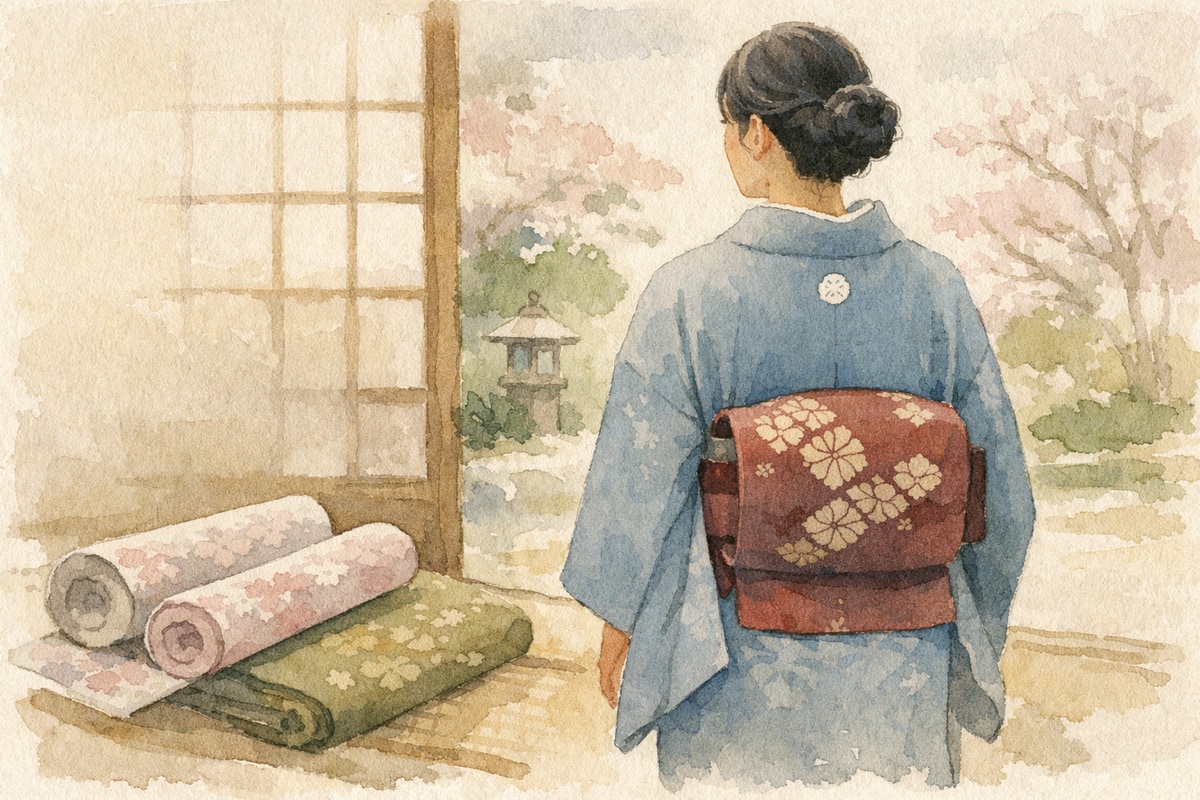
Standing before a bolt of cloth, you might hesitate between a soft pink and a subdued gray. This is a common moment when choosing the color of an iromuji (a solid-color kimono with no pattern). Because the kimono has no pattern, the color alone shapes the whole impression. So which color can you wear confidently to both an entrance ceremony and a tea gathering?
The short answer: when in doubt, a mid-tone color is the safe choice
To cut to the conclusion first, if you’re having just one iromuji tailored, a mid-tone color—neither too deep nor too pale—will serve you well. If you can choose the woven ground pattern (jimon), picking one suited to both celebratory and mourning occasions will widen how often you can wear it afterward. A color that’s too bold limits where you can wear it, while one that’s too plain can look flat at a festive occasion. If you want a single kimono to cover a wide range of occasions, the basic idea is to avoid leaning too far in either direction with both color and pattern.
The formality of an iromuji is actually determined by the number of crests
Before getting into color choices, let’s go through how an iromuji works as a kimono. The formality of an iromuji isn’t decided by the color itself, but by the number of family crests (kamon) it bears. In descending order of formality, that’s five crests, three crests, one crest, and no crest—the more crests, the more suited the kimono is to formal occasions.
With one crest, an iromuji becomes semi-formal wear on the same level as a houmongi (a semi-formal kimono) or a tsukesage, making it wearable for the widest range of occasions—weddings, parties, tea gatherings, and more. That’s exactly why, when having just one iromuji made, most people choose one crest. With no crest at all, it’s treated as casual everyday wear, on the same level as a komon (a casual kimono with a small repeating pattern) or tsumugi (a textured, hand-woven silk). For more on the different types of crests and how they’re applied, see our detailed guide on kimono crests—five, three, or one, and what changes.
One thing worth remembering: the jimon (the woven-in ground pattern) does not indicate formality. A kimono without a jimon may look more casual, but it’s ultimately the number of crests that determines formality, not the ground pattern.
Choosing by impression: the difference between pale and subdued colors
Because an iromuji has no pattern, it pairs easily with almost any obi (the wide sash tied around a kimono) or accessory, making it wearable across many occasions. On top of that, the color you choose greatly shapes the impression it gives. Pale pinks and blues create an elegant, refined air, while grays and blacks lend a chic, more mature feel. Think about whether you want to look more festive or more subdued, and let that guide which direction you choose.
Colors that work for entrance ceremonies, graduations, and tea gatherings
When the occasion is already set, it helps to think in terms of the season’s mood. Pale colors suit the bright feel of a spring entrance ceremony, while for a winter graduation, a subdued gray or black paired with a gold-and-silver obi is often chosen. For more on choosing iromuji colors for school events, see our detailed guide on kimono for mothers at entrance and graduation ceremonies.
For tea gatherings, an iromuji with one crest remains a popular choice. Tsumugi ranks closer to everyday wear in terms of formality and generally isn’t suitable for tea gatherings. An iromuji with one crest, by contrast, works as semi-formal wear, making it a convenient option when you’re unsure what to wear to a tea ceremony.
If you’re adding a crest, lean toward subdued colors and obi as well
If you’re adding a crest to raise the formality, your approach to color shifts slightly too. For a single crest, it’s a good idea to choose a refined fukuro obi or a tsuzureori Nagoya obi depending on the occasion. Choosing a muted, darker color has the advantage of letting you pair it with a black obi for semi-formal mourning wear, or a pale gray obi for a memorial service. If you want one kimono to serve both celebratory and mourning occasions, it’s safer to choose a color that isn’t too bright. For more detail on the formality of mourning attire, see our guide on kimono for memorial services—how to choose between formal, semi-formal, and simplified mourning dress.
With three or five crests, the kimono becomes semi-formal wear ranking above an unmarked houmongi, or even ceremonial dress, so you’ll want to match not just the obi but also the obiage (a fabric accent above the obi) and obijime (a cord tied over the obi) in formal styles. If you want a ground pattern suited to both celebratory and mourning occasions, flowing water, clouds, waves, and yusoku monyou (traditional courtly motifs) work well, with purple, indigo, and gray tones considered easy to wear. If you’ve decided the kimono is strictly for celebratory occasions, a ground pattern with an auspicious motif (kissho monyou) is another option. Keep in mind that the more crests a kimono carries, the more you need to bring the color, ground pattern, obi, and accessories all into alignment with formal dress.
If you can’t decide on a color, trying it on can help
A color swatch on a bolt of cloth can look quite different from how it appears against your face once worn. If you can’t narrow it down to one color, trying on a few options through a rental service is one approach worth considering. Standing before a mirror often reveals differences in mood that photos or swatches don’t capture. It’s also easier to judge how a color pairs with an obi you already own by trying them together in person.
Conclusion
Choosing the color of an iromuji becomes easier when you think along three axes: number of crests, obi pairing, and occasion. If you’re torn, a mid-tone color with one crest and a ground pattern suited to both celebratory and mourning occasions is a safe bet. Since customs around crest number and color can vary by family or region, it’s worth checking with family members or a trusted kimono shop for peace of mind. That said, after all these considerations, an iromuji is a kimono that brings out its wearer’s own elegance no matter which color is chosen. On the day itself, simply enjoy wearing the color you’ve chosen to the fullest.