
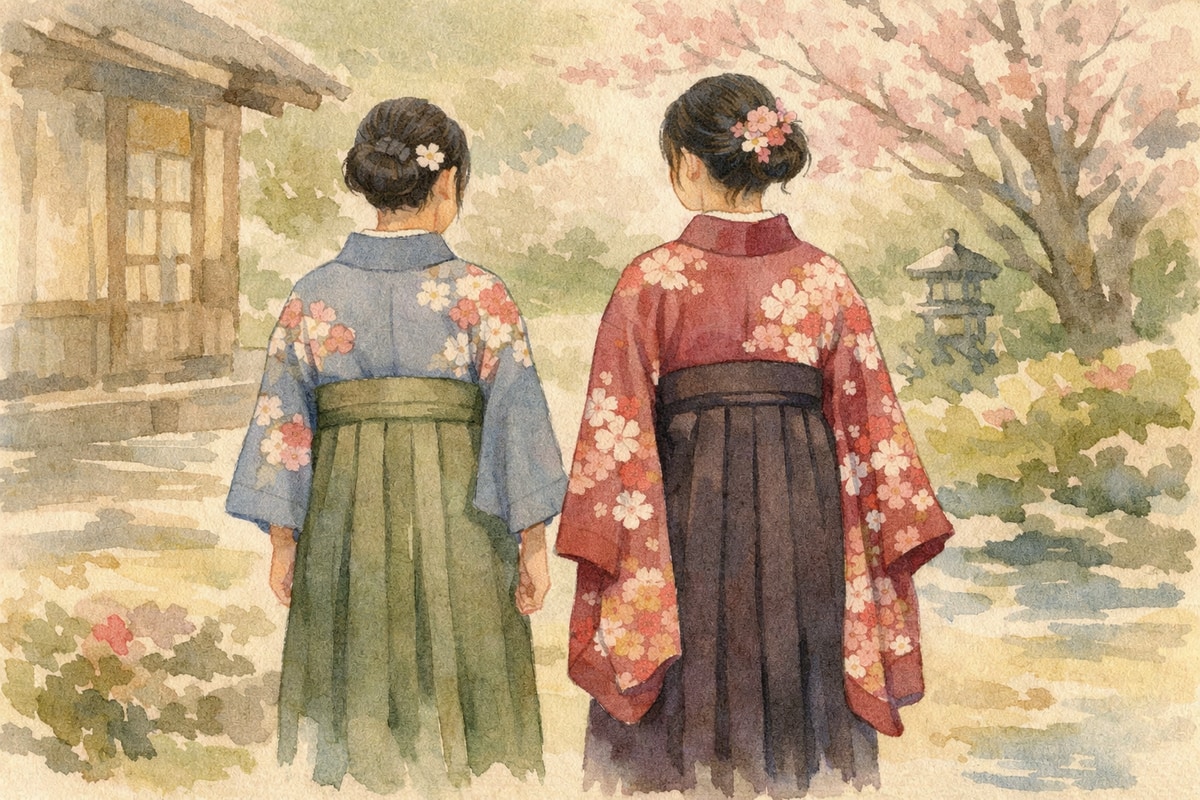
Once you start thinking about your hakama outfit for graduation, one question always comes up: “Can I just wear the furisode (a long-sleeved formal kimono) I wore for my seijin-shiki (the Coming-of-Age ceremony) again at graduation?” or “I keep seeing something called nijaku-sode, but how is it different from a furisode?” Neither idea is wrong — they’re actually two different kimono with different sleeve lengths. Let’s go through them one by one.
To get straight to the point, there are broadly two types of kimono worn with hakama at graduation. One is the nijaku-sode, a kimono with relatively short sleeves. The other is the “furisode hakama” style, in which the furisode worn at seijin-shiki is paired with hakama. Both are perfectly appropriate for graduation, but they differ quite a bit in sleeve length and in the overall impression they give.
How much shorter are nijaku-sode sleeves than furisode sleeves?
The name nijaku-sode comes from the sleeve length being roughly two shaku, or about 76 centimeters. Some sources give a range of about 76 to 85 centimeters, but either way, the sleeves are shorter than those of a furisode. In fact, the nijaku-sode is technically a type of furisode called a “ko-furisode” (small furisode), the shortest-sleeved category within the furisode family.
The furisode typically worn at seijin-shiki, on the other hand, is called a “chu-furisode” (medium furisode), with sleeves measuring roughly 100 to 114 centimeters. Furisode come in three ranks by formality, from highest to lowest: o-furisode (also called hiki-furisode), chu-furisode, and ko-furisode — and the furisode worn at seijin-shiki falls into the chu-furisode category. The exact figures vary a little by source, but if you use the sleeve length of an everyday kimono (about 49 centimeters) as a baseline, it helps to picture the nijaku-sode as falling in between, and the chu-furisode as having even longer sleeves still.
How sleeve length changes the look: ease of movement and impression
The difference in sleeve length directly affects how the outfit looks in motion. Because the nijaku-sode’s sleeves are shorter, they don’t swing around too much when you move your arms, giving a light, easy way of carrying yourself. Whether you’re receiving your diploma or going up and down stairs, there’s reassurance in having fewer moments where you need to worry about your sleeves. The youthful, brisk impression it creates is one of the nijaku-sode’s charms.
The chu-furisode, by contrast, has longer sleeves that create a more graceful, spacious feeling when standing. Because the sleeves hang down long along the sides of the body, some say the overall balance is easier to achieve for taller people. If you’ll be sitting in a chair for long stretches during the ceremony, you’ll naturally find yourself gathering the sleeves onto your lap, so there’s no need to worry too much about that.
The “furisode hakama” option: wearing your seijin-shiki furisode again at graduation
Many people want to make use of the furisode they had made for their seijin-shiki again at graduation. This combination is called “furisode hakama,” pairing a chu-furisode with hakama. Being able to give a furisode you had specially made — or rented — a second outing is a welcome option.
That said, the chu-furisode is a formal kimono of the highest rank, suitable not only for seijin-shiki and graduation but also for attending weddings. Because the sleeves are longer, there are more things to be mindful of in terms of length and movement. The nijaku-sode, meanwhile, is considered semi-formal and is the most commonly chosen option for graduation hakama styling. Which kimono you choose depends on whether you want to make use of a furisode you already have, or whether ease of movement is your priority. If you’re torn between renting a furisode, buying one, or inheriting your mother’s furisode, you may find it helpful to also read Rent, Buy, or Inherit Your Mother’s Furisode? Three Questions to Help You Decide for more to consider.
How to decide when renting nijaku-sode hakama
Once you’ve settled on your kimono, the next step is to check the rental timeline. Graduation ceremonies at most schools are held around March 20, though the exact date varies by school, so please check your own school’s date first.
Booking demand has seasonal peaks. This varies somewhat by shop, but the general pattern is as follows.
- June to July: This is often when on-campus exhibitions are held, and tends to be a peak booking period
- Late August to September: Many people decide around the end of summer vacation, and new hakama designs also tend to appear around this time
- October: A second peak comes after university summer vacation ends
- April onward: After graduation season ends, this is when costume inventory is at its most plentiful
The period when fewer items are available for preview runs from around April through late May, when maintenance on costumes used for graduation ceremonies overlaps. It helps to remember that around June to September is the best time for previewing. If you’d like more detail on the process from booking through to the rental day itself, this is covered in Graduation Hakama Booking Timing and the Rental Process, which is worth checking as well.
Three criteria to help you decide
With all of this in mind, here are three points to help you make your final decision.
- Do you already have a furisode? If you want to make use of the furisode from your seijin-shiki again, furisode hakama is the way to go; if you’re renting something new specifically for graduation, the nijaku-sode is the easier choice
- The mood you want in photos: choose the chu-furisode if you want a composed, formal finish; choose the nijaku-sode if you want a light, youthful impression
- How much you’ll be moving on the day: if you’ll be standing up and sitting down often, such as for receiving your diploma or giving a representative’s address, the nimble feel of the nijaku-sode can be reassuring
Depending on your position and your school’s customs, there may be specific rules about hakama colors and patterns or the formality of the kimono. It’s a good idea to check with your school or the rental shop just to be sure.
In summary
At heart, the difference between the nijaku-sode and the furisode comes down to sleeve length. The roughly 76-centimeter nijaku-sode is a ko-furisode that lets you move lightly, while the chu-furisode, with sleeves over 100 centimeters, creates a graceful, formal silhouette as a first-rank formal kimono. Either one is entirely fitting for graduation. Having walked through all of this, though, what matters most is greeting the day with a joyful heart. That photo of you standing in hakama alongside your friends is sure to become a treasured memory.