Once you know you’ll be wearing a houmongi (a semi-formal kimono), the first worry is usually color and pattern. “Is the color I chose when I was younger still right for my age now?” or “Will I look too plain and get lost in the crowd at a celebration?” These two worries actually come from completely different causes. Once you separate whether something looks off because it’s “too young” or “too plain,” choosing becomes much easier. Let’s go through it step by step.
Let’s start with the conclusion
To get straight to the point, the three things to check when choosing houmongi colors and patterns are the brightness of the base color, the size of the pattern, and how much of the fabric the pattern covers. As you get older, the general guideline shifts toward a slightly muted, calmer base color and a pattern that isn’t too large. But this doesn’t simply mean “the older you are, the plainer you should dress.” In fact, what women in their 40s and 50s need to watch out for is not dressing too young, but overdoing the plainness. Don’t worry — we’ll look at exactly where these lines fall.
What exactly is a houmongi?
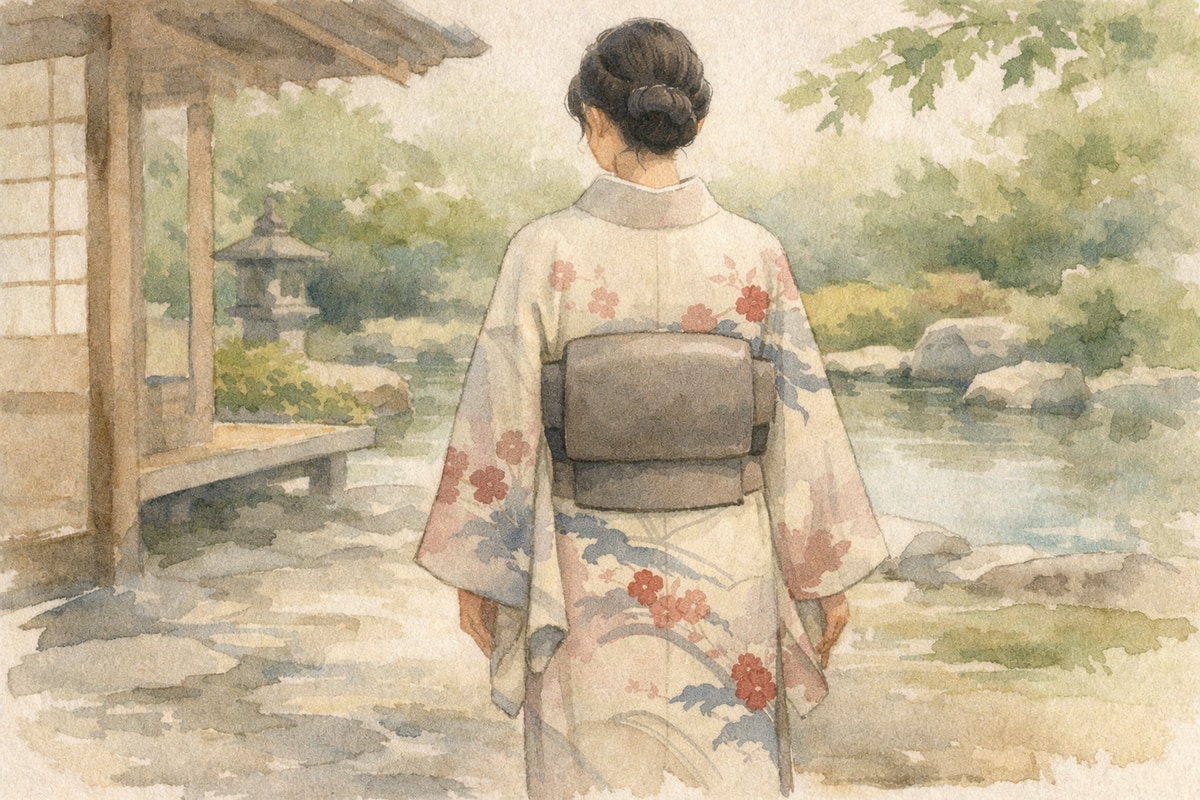
Before getting into colors and patterns, let’s confirm what makes a houmongi distinctive. Its defining feature is that the pattern is drawn across the seams of the kimono. From the shoulder to the chest, down the sode (the sleeve), and along the hem, the design flows continuously like a single painting. This is called an eba pattern.
Eba patterns are made through a painstaking process: white cloth is first temporarily tailored into the shape of a kimono, the design is sketched on, then the cloth is taken apart again to be dyed using techniques such as yuzen. In most modern houmongi, the focal point is the hem of the overlapping front panel (uwamae), with the pattern flowing from the left side of the collar (eri) up to the left chest and sode, and a motif also appearing on the outside of the right sode. A similar kimono called tsukesage exists, but it simplifies the eba pattern — it’s dyed directly on the tanmono (a bolt of kimono cloth) without temporary tailoring, so the pattern simply faces upward. It helps to think of it this way: the difference in how much tailoring effort goes in directly reflects the difference in formality and in how the pattern connects.
Three factors that separate “too young” from “too plain”
When a houmongi looks out of place, the cause is almost always an imbalance in one of three things: the base color, the size of the pattern, or how much of the fabric it covers. For women in their 20s and 30s, the more common pitfall is “overdoing it” — a base color close to a bold primary shade, or accessories like an oversized hair ornament that draw too much attention. High-saturation colors and large patterns tend to suit younger women well, but even the same color and pattern can end up looking overdone depending on how vivid the color is or how large the pattern is.
For women in their 40s and 50s, the opposite tends to happen. In trying hard not to look like they’re dressing too young, some avoid youthful colors like pastels altogether, while others swing too far toward extremely subdued colors — and either way, the result can end up looking like it lacks elegance. Rather than simply dressing more plainly as you get older, the more accurate approach seems to be expressing elegance through calm, muted mid-tones or colors with depth.
Color guidelines by age group
Organizing color tendencies by age gives us the following general guidelines:
- 20s to 30s: This is the age range where high-saturation colors and bold patterns tend to suit well. In their 30s, popular choices include bright pink, wisteria purple, light blue, lavender, and pale cream — colors that let you enjoy a sense of vibrancy.
- 40s: Colors with a touch of soft muted brightness are said to blend well with the skin and create an elegant impression. The idea is to choose a color with a bit of calmness added, rather than a sharp, primary tone.
- 50s and above: It’s important to avoid flashiness while also not swinging too far toward extremely subdued colors. Expressing elegance through colors with depth is the landing point that avoids looking either too young or too plain.
If you’re unsure, the safest approach is to avoid extreme colors and lean toward mid-tones instead. Once you know the general guideline for your age group, let’s also check how the pattern itself reads visually.
Also check pattern size and how the eba design reads
There are several types of eba patterns, including sou-eba (pattern flowing across the entire garment), bubun-eba (pattern on part of the garment), and some created through hand-painted yuzen. The larger and more continuous the pattern across the garment, the more vivid and festive it looks — so women in their 20s and 30s can often carry off a houmongi with a bold, large pattern, while women in their 40s and 50s tend to look more refined and pulled-together in one with a slightly smaller or less dense pattern. Paying attention not just to the base color but also to how much area the pattern covers will sharpen your sense of what to choose.
How the right approach changes by occasion
The priorities for color and pattern also shift depending on the occasion. A wedding calls for a festive, celebratory look, while at a school event like Shichi-Go-San (a celebration for children aged 7, 5, and 3) or a school entrance ceremony, it’s natural to be mindful of how your outfit compares with other parents present. Since this can vary depending on your role and region, if you’re ever unsure, it’s reassuring to check with someone close to the venue or the host. We go into more detail on how to choose based on your role as a wedding guest in Attending a Wedding in Kimono: How to Choose Based on Your Role (Family, Friend, Boss), and on what mothers should wear for Shichi-Go-San in What Should the Mother Wear for Shichi-Go-San? Choosing Between Houmongi, Iromuji, and Komon.
The order to check patterns when renting
When choosing a houmongi through a rental service, judging by photos alone can sometimes give a different impression than the real thing. Checking things in the following order helps avoid mismatches:
- First, look at the base color. Since the base color takes up the largest area in any photo and is the first thing your eye catches, check whether it suits your skin tone.
- Next, look at the size and density of the pattern. Check how far the pattern spreads from the hem of the uwamae up toward the chest area.
- Finally, look at the pattern’s placement. Since eba patterns are designed to connect across the seams, check whether the pattern looks continuous and unbroken once the kimono is worn.
If you’re torn, let whether the base color flatters your face be your top priority. More than pattern preference, the base color is what directly affects both how you photograph and how you’re perceived in person. If you’re deciding between renting and buying, Should You Rent or Buy a Houmongi? How to Decide Based on How Often You’ll Wear It can also help make the choice easier.
In closing
Choosing houmongi colors and patterns becomes much less confusing when you use three yardsticks: the base color, the size of the pattern, and how much of the fabric it covers. Women in their 20s and 30s tend to suit bold colors and large patterns well, while women in their 40s and 50s can find a balance that avoids looking either too young or too plain by favoring mid-tones that convey elegance. That said, after going through all of this step by step, the most important thing is simply feeling radiant and at ease on the day itself. May you find that one outfit that, the moment you slip it on in front of the mirror, makes your shoulders relax with quiet relief.