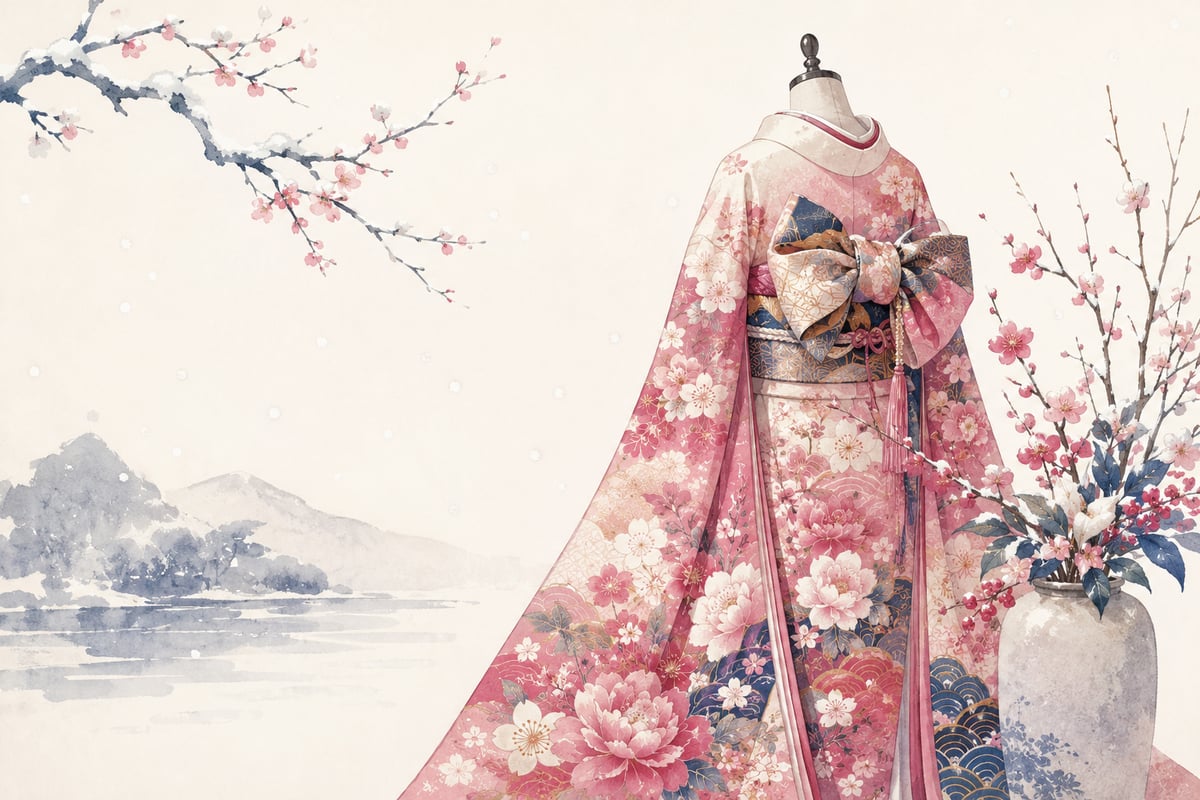
Let’s start with the conclusion: there’s no single “right answer” for every family when it comes to preparing a furisode (a long-sleeved formal kimono). Renting, buying, or wearing “mama-furi” (inheriting your mother’s furisode) — each of these three paths has its own merits, and the choice comes down to three questions: do you want to keep it afterward, how much time can you spend preparing, and does your family already have a furisode?
This article walks through the differences between the three approaches and what to check for each, in order. By the time you finish reading, the path that suits you should be clear.
🌸 Start here (for those in a hurry)
If you’ll only wear it once, for the seijin-shiki (the Coming-of-Age ceremony), renting is a good starting point; if you plan to wear it repeatedly and want to keep it, consider buying; and if your mother has a furisode, mama-furi is worth considering first. That’s the basic idea. Since checking the size and condition for mama-furi can take time, it’s best to get started early.
The Three Paths, in a Nutshell
- Renting — The lightest option. Once you return it, you’re done — no storage or upkeep needed
- Buying — The path for long-term enjoyment. It becomes yours to wear again and again
- Mama-furi — The path of inherited sentiment. A family keepsake comes back to life in your daughter’s special-occasion appearance
Comparison Table — How the Three Methods Differ
| Aspect | Renting | Buying | Mama-furi |
|---|---|---|---|
| Do you keep it? | No (returned) | Yes | Yes (inherited) |
| Effort to prepare | Minimal, though popular patterns should be booked early | The enjoyment (and work) of assembling all the accessories | Starts with checking size and condition; alterations can take time if needed |
| Freedom in size & pattern | May be limited depending on body type | High degree of freedom | Based on your mother’s measurements |
| After wearing | Just return it | Cleaning and storage | Cleaning and storage |
| Best for | Wearing just once, keeping things simple | Wearing repeatedly, wanting a keepsake | Having a family furisode, valuing sentiment |
*This is a general summary of tendencies. Conditions vary by shop and service.
What to Check for Each Path
If You Choose to Rent
This is the lightest option of the three. There are two things worth checking.
- Timing of your booking — Popular patterns get reserved first. If you have your heart set on a particular design, book early
- What’s included in the set — What comes with the rental varies by shop. Check against a packing checklist to confirm
If You Choose to Buy
It becomes a piece that’s truly your own, useful not only for the seijin-shiki but for later occasions like attending a wedding. If you have a younger sister, being able to pass it on and wear it together is another advantage unique to buying. On the other hand, buying also means taking on the ongoing task of cleaning and storage after each wearing. The difference in thinking compared with renting is discussed further in this article.
If You Choose Mama-furi
Wearing your mother’s furisode — for a family, there’s hardly a warmer choice than this. That said, there are three things to check beforehand to make sure it can be worn beautifully.
- Size — Whether it fits your daughter’s build. Alterations may be needed
- Condition — Whether stains or mold have developed during long storage
- Accessories — Whether the obi and other accessories are complete and in good condition
If alterations or cleaning turn out to be necessary, it can take several months. If you’re considering mama-furi, start by taking the furisode out of storage and checking its condition — that’s the surest first step.
Three Questions for When You’re Undecided
| Question | Yes | No |
|---|---|---|
| Q1. Does your family already have a furisode (your mother’s or older sister’s)? | Start with the three mama-furi checks | Go to Q2 |
| Q2. Do you plan to wear it after the seijin-shiki, or do you want to keep it? | Buying is a candidate | Go to Q3 |
| Q3. Do you want to keep the preparations simple? | Renting is a candidate | Take your time comparing — trying items on at a shop can help too |
*This is meant as a guide to help organize your thinking. Please choose according to your family’s circumstances.
Once You’ve Decided — Next Steps
- Consult a shop or service — Book a fitting or condition check. If tailoring or alterations are involved, it’s reassuring to start earlier than you might expect
- Check what you’ll need — Use a checklist to sort out what’s included in the set versus what you need to prepare yourself
- Plan your schedule leading up to the day — Deciding whether to do a maedori (a pre-ceremony photo shoot) at this stage will save you from a last-minute scramble
Frequently Asked Questions
Q. Won’t mama-furi look old-fashioned?
A. How you pair the obi and accessories can completely change the overall impression. Shops can advise on styling your mother’s furisode in a way that suits your daughter today, so bring the actual piece in for a consultation first.
Q. I’ve seen the term “made-to-order rental.” What is that?
A. This is a rental of a brand-new furisode tailored to fit your size. It combines the beauty of something new with the ease of renting, but since tailoring takes time, it assumes you’ll apply well in advance.
Q. What if I really can’t decide?
A. Start by deciding just one thing: whether you want to keep it. If that feeling is clear, consider buying or mama-furi; if not, start by looking into renting — this single question is enough of an entry point.
In Summary
- Preparing a furisode comes down to three paths — renting, buying, or mama-furi. Choose based on fit with your family, not which is “better”
- The deciding factors are whether you want to keep it, the time available, and whether your family has a furisode
- For mama-furi, check size, condition, and accessories early — alterations can take time
- Whichever path you take, consult a shop if you’re unsure — trying it on often provides the answer
…Having walked through all these steps, what matters most is that your daughter greets the day with a smile. Whichever of the three paths you choose, the star of the day will shine all the same. We wish you wonderful preparations.
If you’d like to review the basics of kimono types and formality levels, see also our quick-reference guide to kimono types and formality.
For a fuller overview of choosing kimono for events like furisode and hakama, see our guide to kimono for special occasions.