
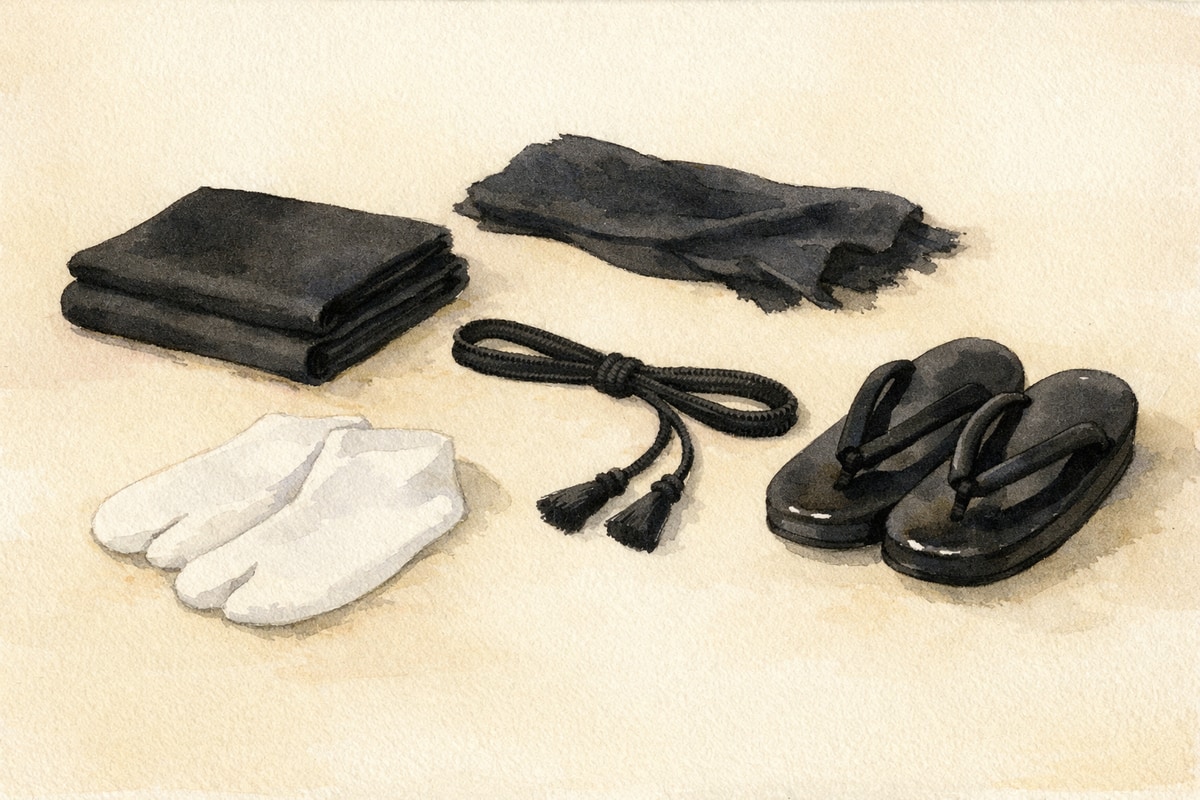
News of a death usually arrives without warning. Your mourning kimono may be tucked away in the wardrobe, but can you say for certain, in that sudden moment, whether the obi (the wide sash tied around a kimono) and all the small accessories are complete as a set? We sometimes receive phone calls asking exactly this. Is any black item acceptable, or is it fine to mix in white pieces? Let’s go through it step by step.
Mourning kimono are, at their base, “plain black with five crests”
To get straight to the point, the formal mourning kimono in wasou (traditional Japanese dress) is a solid black kimono bearing five dyed-in family crests. With the family crest dyed white on the back, both chest panels, and the back of both sleeves, this represents the most formal form of mourning dress. The obi, obiage (a fabric accent above the obi), and obijime (a cord tied over the obi) are all matched in solid black as well — there is no room here for patterns or color. For more on the number and meaning of crests, please also see Kimono Crests: What Changes Between Five, Three, and One? A Gentle Guide to Family Crests, Women’s Crests, Dyed and Embroidered Crests, which goes into more depth and may help deepen your understanding.
The obi, obijime, obiage, zori, and bag are all matched in black
The idea behind formal mourning dress is to unify not just the kimono itself, but nearly everything worn with it, in black. Specifically:
- Obi: A plain black obi (Nagoya-style) tied in a single-fold taiko knot is standard
- Obiage: Solid black
- Obijime: A flat-braided black cord
- Zori (flat kimono sandals): Solid black fabric with no sheen
- Bag: Solid black fabric with no sheen
Accessories such as obi clasps or hair ornaments are not worn with formal mourning dress. The simplest rule of thumb is that every visible accessory should be black. Zori and bags in shiny or patent-like materials are easy to mistake for celebratory items, so it’s wise to check carefully when purchasing.
Tabi, han-eri, and nagajuban stay white — why not black?
This is where many people are surprised: tabi (split-toe socks), the han-eri (half-collar), and the nagajuban (an under-kimono) are paired with white, not black. Amid an otherwise all-black ensemble, having just these three items remain white may seem puzzling to those assembling mourning wear for the first time. However, this is a point of agreement across multiple sources, and rather than varying by region or household, it is a convention widely established for wasou mourning dress. Choose a plain white han-eri and plain, unpatterned white tabi. Since ill-fitting tabi can even affect how you stand and carry yourself, it may help to check sizing in advance using Tabi Sizing and Selection: A Gentle Guide to Materials, Colors, and Tabi Covers, so you won’t run into trouble on the day.
Note that this describes the formal mourning attire worn at funerals and wakes. At memorial services, depending on one’s role or how many times the service has been held, a somewhat less formal level of dress than full mourning attire may be chosen instead. Since this can vary by one’s position and region, it’s worth also checking Kimono for Memorial Services: How to Choose Between Formal, Semi-Formal, and Simplified Mourning Dress, With Gentle Notes on Solid-Color Kimono and Accessory Etiquette to reduce any uncertainty.
Three points to check if you have an inherited black montsuki at home
Many households have a black montsuki (a crested formal kimono) handed down from a mother or grandmother, resting at the back of a wardrobe. Since it’s a piece that has been carefully passed down, it can be a reassuring resource as long as its condition holds up. Before wearing it, please check the following three points.
- Family crest: Does it match the crest that is proper for you to wear? Whether it should be the crest of the family you married into or your birth family can be a source of confusion — checking with family or a specialist kimono shop (gofukuten) is the surest way to be certain
- Condition of the fabric: Check for yellowing, stains, or the distinctive smell of mildew. A kimono that has been stored away for a long time is best inspected once by a specialist shop for peace of mind
- Size: Does the mitake (the kimono’s overall length) and yuki (the sleeve length from center-back to wrist) suit your current build? If it doesn’t fit, it’s worth asking whether it can be altered
If all three points check out, the kimono can be worn as is. Simply buying the obi and accessories to complete the set is also a thoroughly practical option.
If assembling a full set from scratch, what to check when buying as a set
If you need to put together a full set in a hurry, choosing one sold as a mourning-wear set will save you effort. That said, the contents of these sets vary by retailer, so it’s reassuring to confirm the following before purchasing.
- Whether the kimono, obi, obiage, obijime, zori, bag, nagajuban, and tabi are all included
- Whether the obi is a Nagoya-style obi, and if you’re not confident tying it, whether a pre-tied version is also available
- Whether the crest is already applied, or whether your family crest will need to be added afterward
If you check with the plan of only buying what’s missing from the set, your preparations will go smoothly without waste. Making a simple list of what you already have and what you still need, then comparing them, is the surest way to avoid confusion.
In closing
Mourning kimono attire centers on a solid black kimono bearing five crests, paired with a black obi, obijime, obiage, zori, and bag, while only the tabi, han-eri, and nagajuban remain white. If you have a black montsuki at home, checking these three points — the family crest, the fabric’s condition, and the size — will tell you whether it’s ready to serve you again. Please don’t worry: it’s worth inspecting what you already have ahead of time, so that even sudden news won’t catch you unprepared. It is, of course, a solemn occasion, but preparing yourself properly is simply part of seeing the departed off with care. We hope you can meet the day with a calm and settled heart.