
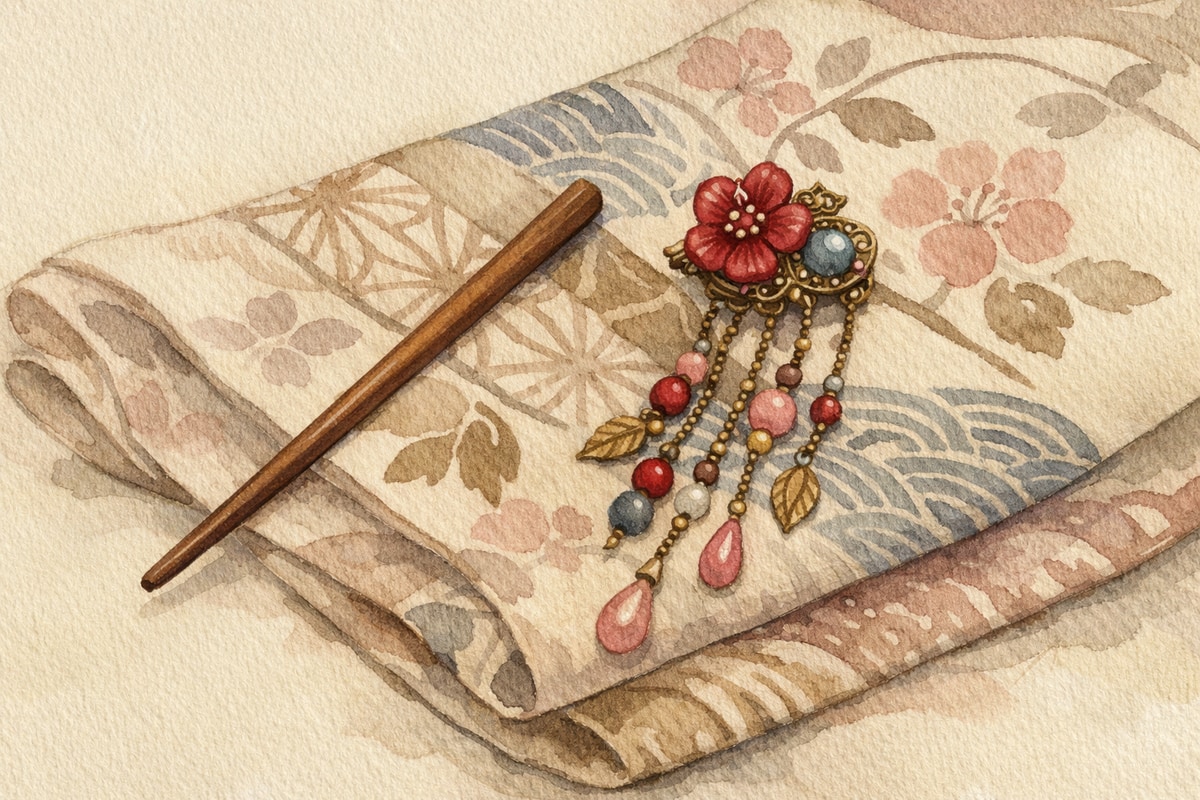
A plain wooden stick with a pointed end can hold a bun perfectly well, and plenty of listings call it a kanzashi because the word sells. But kanzashi is a broader category than that, and if you are shopping by photo alone, on a site where you cannot pick the piece up and feel its weight, it helps to know what you are actually looking at before you decide whether it belongs with your kimono or just in your everyday hair routine.
What the word kanzashi actually covers
Kanzashi is not one object, it is a family of hair ornaments that developed alongside Japanese hairstyles over centuries. It includes simple single-prong sticks (plain bo-kanzashi), sticks with a decorative head, dangling ornaments with hanging strands (hana kanzashi, often seen on maiko), U-shaped ornaments (kogai), and flat combs (kushi) that are sometimes grouped with kanzashi even though they are technically a separate accessory. A wooden hair stick, in Western terms, usually corresponds to only the simplest end of this family — a bare shaft with little or no ornament — while the word kanzashi in Japanese usage can mean something far more elaborate. This gap in meaning is exactly where mismatched listings happen.
Why the confusion is common in English listings
Sellers writing for an international audience often use kanzashi as a general keyword because it is searched more than the more accurate term for what they are selling. This is not necessarily dishonest, it is just imprecise. A listing titled simply “kanzashi hair stick” might be a genuine antique lacquered ornament, or it might be a modern, mass-produced dowel with a bead glued on top. Both can be called by the same word, so the title alone tells you very little.
What to check before you decide it is a “real” kanzashi
Because the word covers so much ground, judging authenticity means looking past the label and reading the description for specifics. A few things worth checking, in the order they usually matter to a buyer:
- Material named plainly. Traditional kanzashi are made from materials like tsuge (boxwood), other hardwoods, lacquer, silver, tortoiseshell (now largely replaced by synthetic substitutes for conservation reasons), or fabric flowers built on wire for hana kanzashi. A listing that only says “wood” without naming the type, or “metal” without saying plated or solid, is giving you less information than a careful seller would.
- Construction detail, not just appearance. A hand-carved or hand-lacquered piece will usually show slight asymmetry, a smooth hand-finished surface, and a prong that tapers naturally. A cast or machine-turned piece tends to look extremely uniform, which is not a flaw in itself, but it is a different kind of object with a different history.
- Age language used honestly. Words like “vintage,” “antique,” “reproduction,” or “new, handmade in traditional style” mean different things, and a trustworthy listing keeps them separate. Be cautious of listings that use “antique style” and “antique” interchangeably in the same paragraph.
- Function described accurately. Some ornamental kanzashi, especially the dangling hana kanzashi type, are decorative additions worn alongside a hairpin that does the actual holding, not stand-alone functional sticks. If a delicate flower-covered piece is advertised as something that will hold a thick bun in place all day, that claim deserves skepticism regardless of how authentic the materials are.
None of these points require you to be an expert in Japanese craft history. They just require the listing to be specific, and a specific listing is usually written by someone who actually knows the object.
Matching the ornament to the occasion
Once you know roughly what category you are holding, the next question is where it belongs. This is where custom varies quite a bit by region, generation, and personal taste, so treat the following as general tendencies rather than fixed rules.
- A plain wooden stick reads as casual almost everywhere. It suits everyday hairstyles, whether or not you are wearing kimono, and it pairs comfortably with a simple cotton yukata or an informal wool or cotton kimono. It is not the piece most people would reach for with formal silk kimono.
- A modest kanzashi with a small decorative head — a carved flower, a bead, a simple metal fitting — sits in the middle. It can dress up a casual kimono outfit or dress down a semi-formal one, and this flexibility is part of why it is a practical everyday choice for someone who wears kimono only occasionally.
- An elaborate hana kanzashi with hanging chains or clustered fabric flowers is traditionally associated with more festive or formal contexts, and in some regional practices with young, unmarried women’s hairstyles specifically, though this association has loosened over time and is not observed identically everywhere. It is a striking piece, but it is not the ornament most adult kimono wearers use for a quiet daily outfit.
Formality in kanzashi, like formality in obi and kimono themselves, is a matter of degree rather than a hard line, and different schools of kitsuke (kimono dressing) and different families will place the same ornament slightly differently on that scale.
A plain wooden hair stick set for everyday updos: four simple sticks you can twist into a bun, with or without kimono. It is a modern hair accessory rather than a kanzashi, so think of it as an easy first step before you look at proper kanzashi. Please check the product page for current details.
A practical way to read a listing
When you are choosing between several listings and cannot handle the piece, it helps to rank what you are reading rather than reacting to the first word you see. Ask first whether the material and construction are named specifically. Ask second whether the age claim is stated carefully. Ask third whether the described function matches how the piece looks. A listing that answers all three without hedging is worth more trust than one that simply repeats the word kanzashi in the title several times. Photos help too — a close, well-lit image of the prong tip and the join between shaft and ornament will tell you more about hand-finishing than any product description.
So, kanzashi or hair stick? Both are legitimate things to own, and neither is automatically better than the other — they simply serve different days. A plain wooden stick is an honest, useful tool for ordinary hair, kimono or not, and calling it a kanzashi is not wrong so much as incomplete. The real question is not which word a seller uses, but whether the listing gives you enough concrete detail to know which end of that long, varied family you are actually buying, and whether that piece suits the kimono occasion you have in mind.