
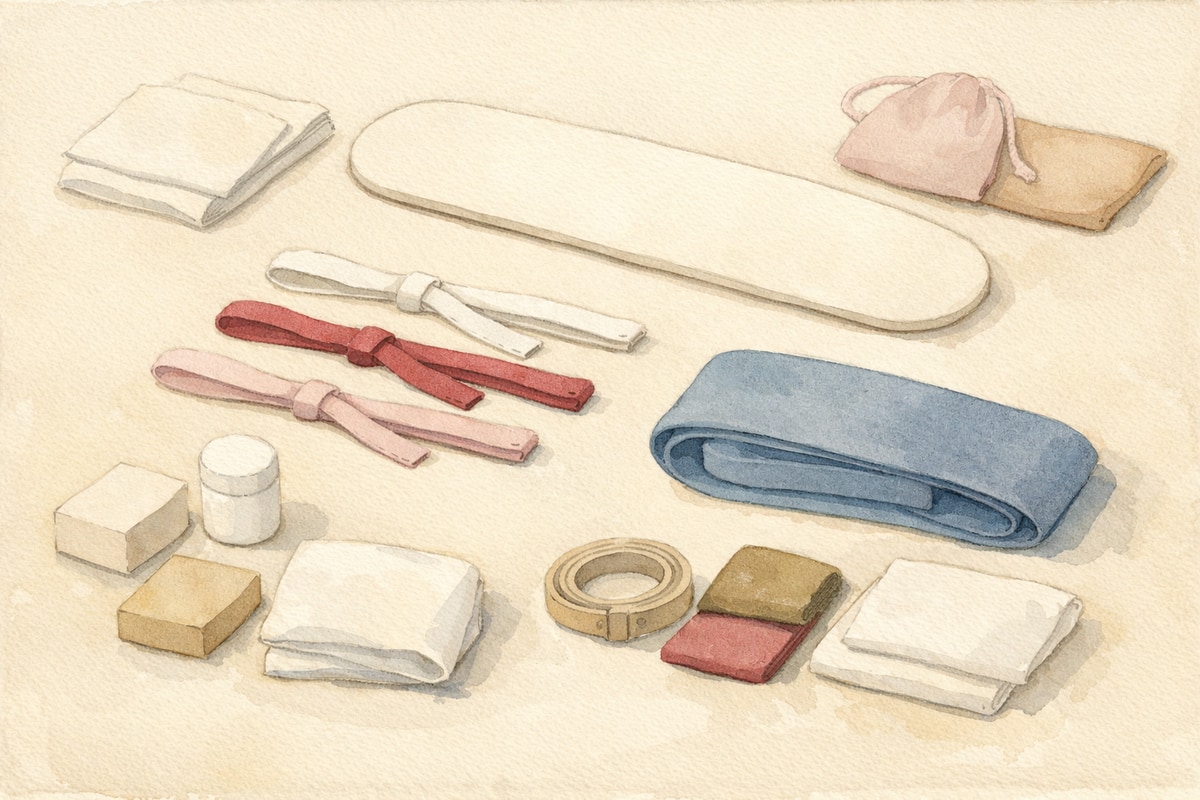
“I’ve picked out my kimono!… so what else do I need?” This is actually the most common stumbling block for first-timers. A kimono alone — even with its obi (the wide sash tied around a kimono) — isn’t enough to get dressed. There are layers to wear underneath, cords to tie, supports to hold everything in place. These unseen tools are what hold up that beautiful silhouette.
Don’t worry — you only need to remember “4 categories.” Save this article’s checklist, and you’ll never find yourself short of something right before an event. Let’s go through them one by one together.
🌸 Start here (for those in a hurry)
Everything you need falls into 4 categories: [kimono and coordinating pieces / undergarments / dressing accessories / finishing touches]. Rental sets often include most of these, but what’s included varies by service, so the quickest shortcut is simply asking, “Are undergarments, tabi socks, and padding towels included?”
Think of what you need in “4 categories”
No need to memorize a long list of individual items right away — let’s start with the big picture.
hadagi (an innermost undergarment) top and under-slip / tabi socks / padding towels, etc.
The unsung heroes that protect the kimono from sweat and skin oils
kimono / obi / nagajuban (an under-kimono, with a half-collar attached) / obiage (a fabric accent above the obi) / obijime (a cord tied over the obi)
The members that create the “visible” part of your look
koshihimo (waist cords) / datejime (an underbelts) / erishin (a collar stiffener) / obi-ita (an obi board) / obi-makura (an obi pillow), etc.
Invisible from the outside, but the true heroes that prevent kizukure (the kimono coming loose)
zori (flat kimono sandals) / bag / hair accessories / haori jacket or shawl (seasonal)
In charge of the final styling and practical touches
Your packing checklist (a keeper)
This is the main dish of this article. When shopping or packing, try checking things off from the top.
| ✓ | Item | Its role in a nutshell |
|---|---|---|
| ① Undergarments | ||
| □ | Hadagi top and under-slip (susoyoke) | Underwear worn beneath the kimono. One-piece styles that combine both are also available and are easy for beginners to wear |
| □ | Tabi socks | The “socks” of wasou (traditional Japanese dress). Easy to forget, so prepare them early |
| □ | Padding towels | Used to even out the body’s lines. The number needed varies by body type and dressing method, so check with whoever is dressing you |
| □ | Wasou bra | Having one makes it easier to achieve a neat silhouette. Whether it’s essential is a matter of opinion, so it’s worth discussing |
| ② Kimono and coordinating pieces | ||
| □ | Kimono | The star of the show. How to choose the right type for an occasion is covered in a separate article |
| □ | Obi | The key to coordinating with the kimono |
| □ | Nagajuban (with a half-collar attached) | Worn under the kimono; the half-collar peeks out at the collar |
| □ | Obiage and obijime | A supporting duo that decorates and secures the obi |
| ③ Dressing accessories | ||
| □ | Koshihimo (waist cords) | Cords that anchor the foundation of your look. It’s said that 5–6 are usually enough |
| □ | Datejime (underbelts) | The basic setup uses two — one for the nagajuban and one for the kimono |
| □ | Erishin (collar stiffener) | A stiffener that helps the eri (the collar) stand neatly |
| □ | Obi-ita (obi board) | A board that prevents wrinkles at the front of the obi |
| □ | Obi-makura (obi pillow) | A pillow that shapes the obi knot |
| □ | Korin belt (a dressing belt) | A handy auxiliary item. Whether it’s used depends on the dressing method |
| ④ Finishing touches | ||
| □ | Zori | It’s reassuring to try them on once beforehand |
| □ | Bag | Doesn’t have to be a wasou-specific bag, as long as it suits the outfit |
| □ | Hair accessories | Choose according to the occasion and your taste |
| □ | Haori jacket or shawl | For seasonal warmth and style |
*These are general guidelines for representative items. Quantities may vary depending on the type of kimono worn, the dressing method, and the shop’s guidance
Tabi socks top the list of things people forget, as the note above says. If you need a pair, this is the classic choice: white tabi with four kohaze clasps, made in Japan by Fukusuke. Only a few sizes are listed, so please check that yours is available on the product page.
What you need to prepare yourself changes depending on renting, buying, or using your own kimono
If you’re still deciding which route to take, feel free to first check out “Should You Rent or Buy a Kimono? 5 Questions to Help You Decide What’s Right for You” to find the approach that suits you, then come back to this checklist.
If renting
Kimono rentals often come with a full set of everything you need, making this the easiest route for beginners. That said, what’s included in the set varies by service. When booking, here’s our go-to question: “Are undergarments, tabi socks, and padding towels included?” Asking this one thing will greatly ease your worries on the day.
If buying
The surest approach is to bring the checklist above to the shop and ask, “Is this enough?” If you’ve already decided on your kimono, the staff can help you choose matching accessories at the same time.
If using a kimono you already own or were given
Kimono kept in a home wardrobe or received as a hand-me-down often come with the kimono itself but are missing the dressing accessories. Check the contents against the checklist and buy only what’s missing.
Also note that furisode (a long-sleeved formal kimono) requires additional special accessories (such as a sanjuhimo cord used for the obi knot). For seijin-shiki (the Coming-of-Age ceremony) preparations, it’s safest to follow the guidance of the shop or the person dressing you.
Points that often cause confusion — 3 things worth checking
1. How many koshihimo do I need?
The general guideline is that 5–6 are usually enough. However, the number used varies by dressing method, so if someone else will be dressing you, the surest approach is to simply ask, “How many koshihimo should I prepare?”
2. Do I need both a hadagi and a nagajuban?
Yes, you need both. Though similarly named, these two serve completely different roles. The hadagi is “underwear” that protects the kimono from sweat and skin oils. The nagajuban is “the layer worn under the kimono,” and it’s the piece whose half-collar shows at the neckline. Remember the three-layer structure from the inside out: hadagi → nagajuban → kimono.
3. Is a wasou bra absolutely necessary?
It’s an item that makes it easier to achieve a neat silhouette, but whether it’s essential is a matter of opinion. In some cases your own underwear can substitute, so it’s fine to decide after consulting with whoever is dressing you. For more on how to choose one, see How to Choose a Wasou Bra and Undergarments, and the Basics of Padding.
A suggested preparation timeline
Here’s a suggestion from our editorial team. Working backward from your event with this much lead time can bring real peace of mind.
| Timing | What to do |
|---|---|
| By 1 month before | Decide your route (rental / purchase / own kimono). If renting, confirm what’s included in the set |
| 1–2 weeks before | Check your items against the checklist. Buy anything that’s missing |
| The day before | Gather everything together for a final check. Lay out your zori and bag too |
| On the day | Focus your final check on three items: “tabi socks, koshihimo, and towels” |
Frequently asked questions
Q. Is a one-piece style hadagi okay?
A. Yes, that’s fine. The one-piece style, which combines the top and under-slip in one, is easy to put on and is a beginner-friendly type.
Q. Should I buy a Korin belt?
A. It’s a classic “nice to have” item, but it’s not essential. Whether you use one depends on the dressing method, so it’s fine to check with whoever is dressing you before deciding.
Q. Is this list all I need to be fully prepared?
A. This list covers the representative items, but additional items may be needed depending on the type of kimono worn (especially furisode) or the dressing method. In the end, follow the guidance of the shop or the person dressing you.
Summary
- Think of what you need in 4 categories (undergarments, kimono and coordinating pieces, dressing accessories, and finishing touches)
- Rentals often come as a full set, but checking what’s included is the most important step
- If unsure about quantities, ask the person doing your dressing
- Do your check 1–2 weeks before. The usual forgotten items are “tabi socks, koshihimo, and towels”
- Save this page and you can use it again for your next event
Once your items are ready, all that’s left is to enjoy the day. If you’re still deciding which kimono to wear, check out A Quick-Reference Guide to Kimono Types and Formality. Have a wonderful day 🌸
For kimono care and storage, see our Kimono Care and Storage Guide as well.