
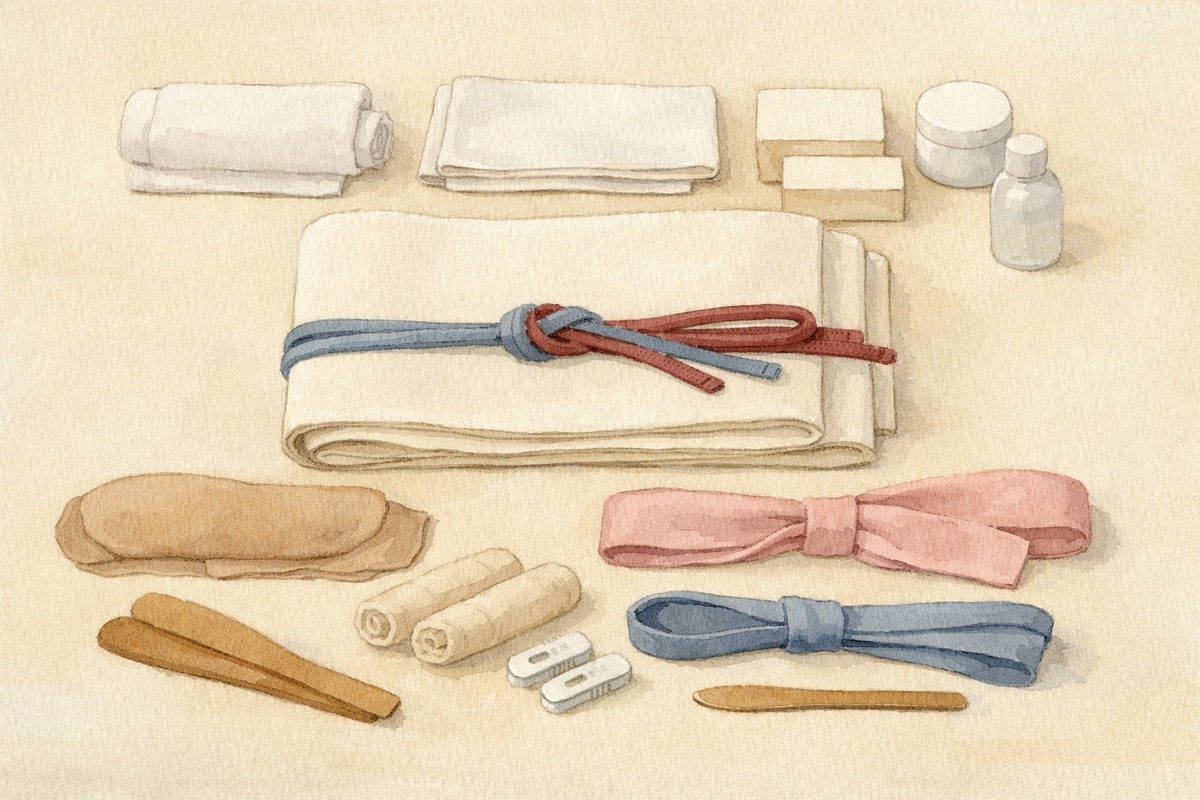
“What do I do if my kimono starts coming loose while I’m out?” — Actually, once you know a few simple tricks, you can fix most of these mishaps right on the spot. No need to panic. Let’s go through the fixes together, scene by scene, with Iroha.
🌸 Start here (for those in a hurry)
Most cases of the kimono coming loose (kizukure) happen in just three spots: the collar, the obi, and the hem. Each can be fixed with a simple motion — smoothing it down by hand, pulling it up, or tucking it into the koshihimo (waist cord).
If the collar starts to loosen
If the collar (eri) looks like it’s loosening, gently smooth it with your hand and tuck the loose part under the obi (the wide sash tied around a kimono). You can also adjust it by lightly pulling down on the tip of the ohashori (the fold tucked at the waist). If there’s a mirror nearby, take a moment to check that both sides are symmetrical too.
If the obi starts to slip down
If you feel the obi slipping down, hold the lower edge of the front of the obi with both hands and pull it up evenly from bottom to top. Then smooth it out with your palms, working from the center out to both sides, and it should settle back into place neatly.
If the obiage (a fabric accent above the obi) peeks out or comes undone
If the obiage is only slightly showing, you can fix it by lifting the obi a little with one hand and tucking the fabric back into the gap. If it has come completely undone, the surest fix is to untie it and retie it from scratch.
If the hem starts to drop
If the hem starts to sag, slip your hand under the ohashori, tuck the drooping side of the hem into the koshihimo, and rearrange the ohashori. Once the hem gets stepped on, it becomes harder to fix, so it’s best to correct it as soon as you notice it.
If fabric bunches up around the hips
After sitting or walking for a while, the fabric around the hips can sometimes bunch up. When this happens, smooth the loose fabric upward with your hand and tuck it into the koshihimo under the ohashori.
Always check your back view after using the restroom
After using the restroom, it’s a good habit to check your back view to make sure the ohashori hasn’t flipped up. Using the backs of both hands, smooth it down from top to bottom, and it will settle back into a neat shape.
Frequently Asked Questions
Q. I’m not confident fixing it by myself. Should I ask someone to help?
A. The methods introduced here are generally things you can manage on your own. That said, if things have come apart significantly, it’s reassuring to fix them calmly in a restroom stall, or to ask someone nearby for a hand.
Q. What if I really can’t fix it?
A. Trying too hard to fix it yourself can sometimes make things worse. If the venue offers a kitsuke (dressing in kimono) touch-up service, relying on that is also a good option.
Q. Is there a way of walking that helps prevent kizukure?
A. Walking with a slightly pigeon-toed gait and smaller steps is said to help prevent the kimono from coming loose. Try taking slightly smaller strides than you normally would.
Summary
- Most kizukure comes down to just three spots: the collar, the obi, and the hem
- The basic fixing motions are smoothing, pulling up, and tucking into the koshihimo
- Make it a habit to check your back view after using the restroom
- If you can’t fix it yourself, don’t force it — rely on a kitsuke touch-up service if one is available
For the full picture of what to bring, take a look at this checklist as well 🌸