
“My sister’s getting married — is it okay to just rent a tomesode?” If you’ve ever held an invitation and felt that flicker of worry, you’re not alone. Honestly, this is one of the most common dilemmas people run into. Buying one seems expensive, but renting makes you wonder if it might come across as impolite. Here’s the short answer: once you understand your role at the wedding and roughly how often you’ll wear a tomesode in the future, deciding between renting and buying gets a lot easier. In this piece, we’ll walk through those two points one at a time.
Your role at the wedding changes how formal your kimono should be
First, it helps to know that there are general guidelines for tomesode formality based on your relationship to the bride and groom. Typically, the mother or grandmother of the bride or groom wears a black tomesode with five family crests, while sisters and aunts wear either a black tomesode or a slightly more understated iro-tomesode (a colored tomesode). Pattern placement and color choices can also shift depending on age, so it’s worth figuring out roughly where you fall before you start browsing at a rental shop.
The number of crests is what separates black tomesode from iro-tomesode in formality
It’s also worth clarifying the difference between black tomesode and iro-tomesode. A black tomesode can only be worn by married women and always carries five crests. An iro-tomesode, on the other hand, can be worn by married or unmarried women, and comes with a choice of one, three, or five crests. An iro-tomesode with five crests ranks as formal as a black tomesode, making it top-tier formal wear, while versions with three or one crest are suited to a wider range of occasions, like a friend’s wedding reception or a school entrance ceremony. In other words, the same iro-tomesode can shift dramatically in formality depending purely on the number of crests. If you’d like to dig deeper into this, take a look at How Do Five, Three, or One Kimono Crests Change Formality?. And if you want the full picture comparing black tomesode, iro-tomesode, and houmongi (a semi-formal kimono), The Difference Between Black Tomesode, Iro-Tomesode, and Houmongi is a helpful read too.
The pros and cons of renting — and what happens with the family crest?
Now, on to the main question. If you go with a rental, the family crest is probably what worries you most. In fact, many rental providers use a general-purpose crest — often a hawk feather or a five-three paulownia design — instead of an actual family crest, so you don’t need to worry about matching your own. Some providers even use a sticker-style crest that can be applied as needed. Wearing a kimono without your actual family crest is not considered impolite, so you can put your mind at ease on that front.
The biggest appeal of renting is that you can simply return the tomesode after wearing it — no cleaning or storage required afterward. If you only wear a tomesode a handful of times, skipping the hassle of dry cleaning and being able to choose from the latest designs is reassuring. On the other hand, if it bothers you that your crest might look different from other relatives’, that’s not really a drawback of renting so much as a sign that buying, discussed next, might suit you better.
The pros and cons of buying — and the ongoing work of storage
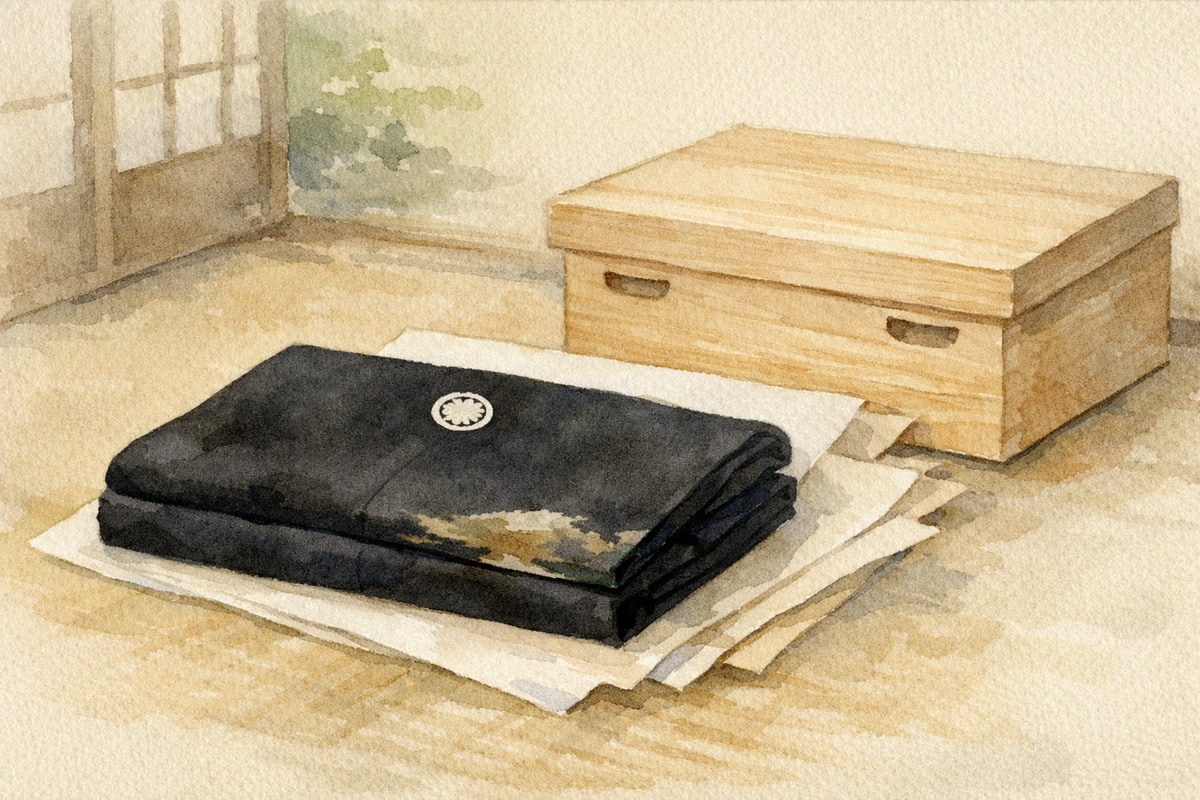
The biggest advantage of buying is that you can have your actual family crest added. If you’d rather avoid having a different crest from other relatives, buying and adding your real family crest is considered the safer choice. That said, after buying, you’ll need to keep up with cleaning to prevent stains and discoloration, find proper storage such as a paulownia wood chest, and maintain the kimono over time — swapping out desiccants and moth repellents and airing it out periodically. This is worth knowing before you commit to a purchase.
As for storage, paulownia wood is known for regulating humidity and helping protect kimono from mold, and a paulownia wood chest lets you store a kimono flat inside tatoushi (a paper wrapper for storing kimono). That said, it would be a mistake to assume a paulownia chest guarantees mold will never happen — chests with slide rails, for instance, can actually see bigger swings in temperature and humidity. Because the inside of a chest tends to stay closed up, humidity can build, and condensation is especially likely in poorly lit rooms, so using a dehumidifying agent as routine upkeep is essential. It would be a shame to find a stain on a tomesode you went to the trouble of buying, so this is one area worth staying diligent about.
No need to stress over whose family crest to use
Once you’ve decided to buy, another question comes up: whose family crest should you use? Actually, there’s no fixed rule here — it comes down to regional custom and family tradition. In some areas, particularly around the Kansai region, there’s a custom called onnamon (a “women’s crest”), passed down only through women — from mother to daughter to granddaughter. This matrilineal practice is mainly seen in western Japan, and there’s really no single, universal rule for how crests are passed down. Since crests can be re-dyed onto a kimono later if needed, there’s no rush — you can take your time and check with your own family or your partner’s family before deciding.
Don’t forget to coordinate formality levels among relatives
One more thing worth bridging into: balance among relatives. In some regions, it’s customary for all the female relatives to wear black tomesode, and it’s recommended that both families check in with each other about formality levels ahead of time. Kimono customs for relatives at weddings vary quite a bit by region — in some cases, an iro-tomesode with five crests and a hiyoku lining (a double-layered finish) can count as equally formal as a black tomesode, and be worn by a grandmother, sister, or aunt. Some mothers of the bride or groom do choose an iro-tomesode, but it still seems more common for families to go with a black tomesode. Rather than deciding entirely on your own, it’s worth casually checking in with the bride, groom, or their parents so no one feels out of place on the day because of a formality mismatch.
A checklist for when you’re still unsure
Here’s everything above, organized into points worth checking as you decide.
- Is your role closer to that of a mother/grandmother, or a sister/aunt?
- How many more occasions are you likely to wear a tomesode for going forward (just a few times points toward renting)?
- Does your crest need to match other relatives’?
- Can you realistically manage storage space and cleaning upkeep?
- Have both families already discussed formality levels?
Our suggestion: start by talking with your family about roughly how many times you expect to wear a tomesode going forward. If it’s just once every few years, renting is clearly the lighter option. But if there are likely to be more relatives’ weddings coming up, it’s worth thinking about whether you have the space to store a kimono properly before you even get to the price tag. If you’d like more specifics on rental and purchase timing and typical price ranges, Renting or Buying a Black or Colored Tomesode? A Guide Based on Price and Booking Timing is worth bookmarking too.
In summary
By now, the question we opened with — whether it’s fine to rent a tomesode — probably feels much clearer. Once you understand the formality guidelines tied to your role, know that options like general-purpose crests or onnamon exist for the family crest question, and think through how often you’ll wear it against the effort of upkeep, the decision becomes much more straightforward. There’s no single right answer when it comes to crests, or to renting versus buying — it really depends on each family’s circumstances. That’s exactly why a quick check-in between both families ahead of time brings the most peace of mind on the day itself.